Where Do Convection Currents Occur — Reading Comprehension
Rate this
Premium Resource
Present
Present in classroom. No work saved
Assign
Classroom with student accounts, Track progress
Quick Play
No student accounts, assign with a link
Grades
6
PRINT+DIGITAL RESOURCE
This learning resource is available in interactive and printable formats. The interactive worksheet can be played online and assigned to students. The Printable PDF version can be downloaded and printed for completion by hand.
This engaging, audio-integrated reading passage, 'Where Do Convection Currents Occur,' is designed for Grade 6 students and aligns with NGSS MS-ESS2-6. It explores the fascinating phenomenon of convection currents, explaining how unequal heating drives these movements in the atmosphere, oceans, and within Earth's mantle. Students will learn about the transfer of heat, the role of density, and how these currents influence weather patterns and climate. Key terms like 'convection,' 'density,' 'atmosphere,' 'oceans,' and 'mantle' are clearly defined, making complex scientific concepts accessible. The passage aims to build foundational understanding of Earth's dynamic systems.
CONTENT PREVIEW
Expand content preview
Convection currents drive weather, ocean circulation, and plate tectonics deep inside Earth.
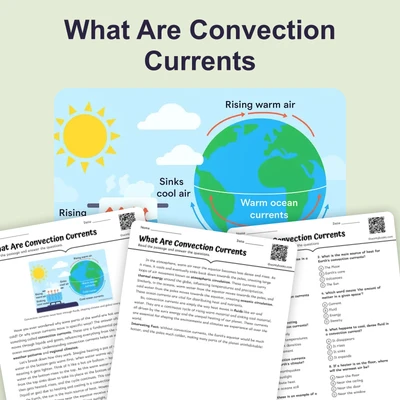
Have you ever seen water boil in a pot? The way the water moves is a perfect example of a convection current! Convection is a way that heat moves, specifically in liquids and gases. It happens when warm fluid (liquid or gas) rises, and cooler fluid sinks, creating a continuous loop of movement.
But where do these important currents occur on Earth? They are happening all around us, influencing our weather, oceans, and even the ground beneath our feet!
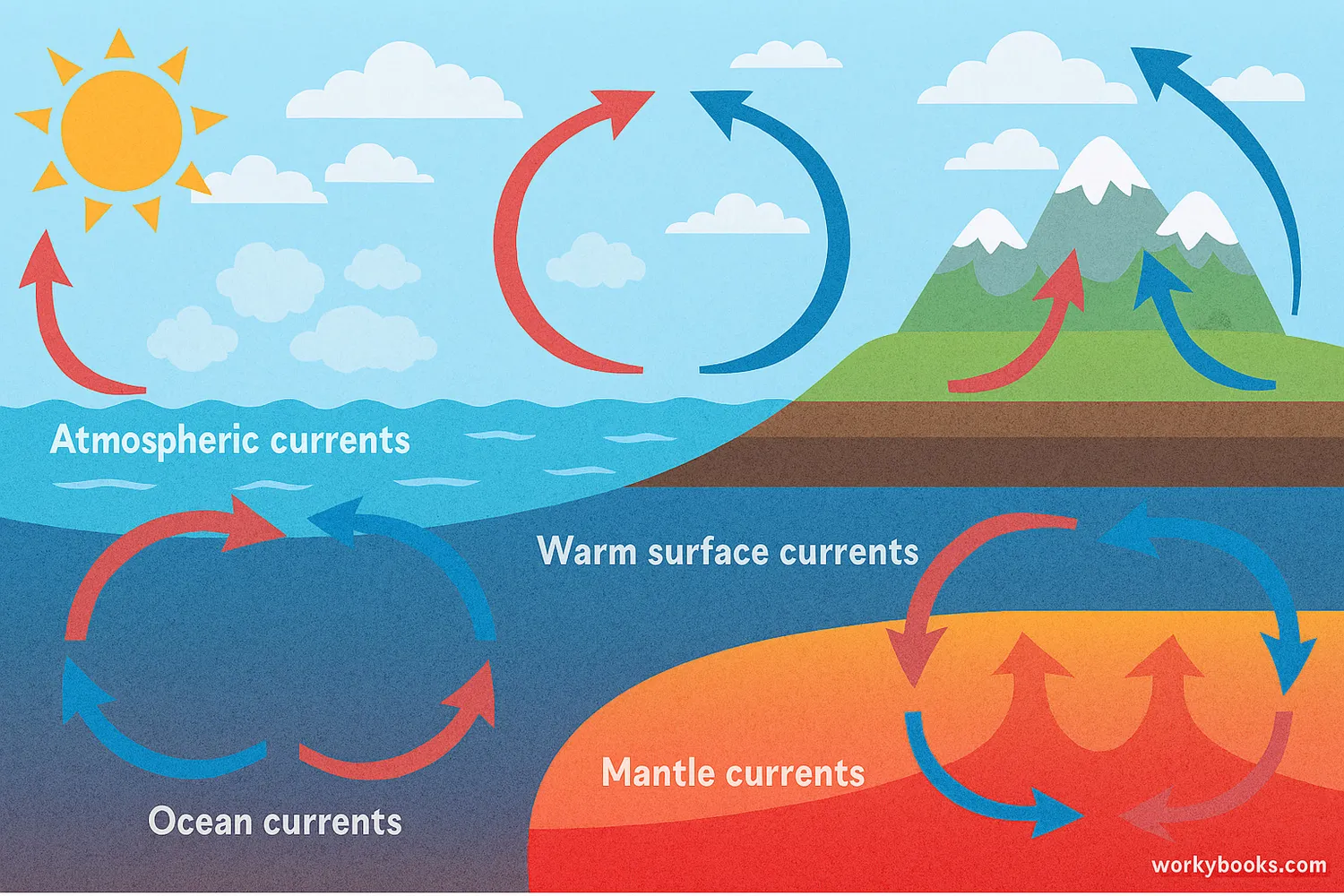
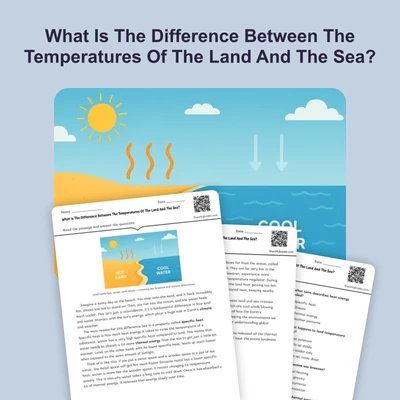
One major place you'll find convection currents is in the atmosphere, which is the layer of gases surrounding Earth. The Sun heats the Earth's surface unevenly. Areas near the equator receive more direct sunlight and get warmer than the poles. This unequal heating causes air to warm up, become less dense (lighter), and rise. As this warm air rises, cooler, denser air from other areas rushes in to take its place. This rising and sinking of air creates atmospheric convection currents, which are responsible for many of our weather patterns, like winds and storms. Understanding atmospheric circulation helps us predict weather and study global climate.
Convection currents also play a huge role in the oceans. Just like the atmosphere, the Sun heats the ocean water unevenly. Warm water at the surface, especially near the equator, becomes less dense and rises or flows towards cooler regions. As this warm water moves, colder, denser water from deeper parts of the ocean or from polar regions sinks and flows to replace it. These vast ocean currents, driven by temperature and salinity (saltiness), help distribute heat around the globe, influencing regional climates and marine life. The Gulf Stream is a famous example of an ocean current that brings warm water to Europe.
Finally, convection currents occur deep inside the Earth in the mantle. The mantle is the thick layer of rock between Earth's crust and its core. Although the mantle is solid, it behaves like a very thick, slow-moving liquid over long periods. Heat from Earth's core causes the material in the lower mantle to warm up, become less dense, and slowly rise. As it reaches the upper mantle, it cools, becomes denser, and sinks back down. This incredibly slow movement of material in the mantle is what drives plate tectonics, the process that causes continents to move, creates mountains, and leads to earthquakes and volcanoes. So, convection currents are vital for shaping our planet!
Interesting Fact: Without convection currents in Earth's mantle, our planet might not have plate tectonics, and its surface would look very different, possibly without continents or oceans as we know them!
What is convection?
Heat moving through solidsHeat moving in liquids/gasesHeat stopping completelyHeat becoming cold
Where is the mantle located?
Above the atmosphereBelow Earth's coreBetween crust and coreOn ocean surface
Why does warm air rise?
It is heavierIt is less denseIt is colderIt expands rapidly
Unequal heating causes convection in:
Only solid objectsOnly cold regionsLiquids and gasesInner Earth only
What do ocean currents help distribute?
Air pressureSunlight intensityHeat around globeEarthquakes
They create mountainsThey cool all regionsThey redistribute heatThey cause earthquakes
The Gulf Stream is an example of an ocean current that brings warm water.
TrueFalse
What does 'dense' mean in the passage?
Full of airVery lightPacked closely togetherSpread very thin
What might happen without mantle convection?
No weather patternsNo ocean currentsNo plate tectonicsNo sunlight
Perfect For:
👩🏫 Teachers
• Reading comprehension practice
• Auto-graded assessments
• Literacy skill development
👨👩👧👦 Parents
• Reading practice at home
• Comprehension improvement
• Educational reading time
🏠 Homeschoolers
• Reading curriculum support
• Independent reading practice
• Progress monitoring
Reading Features:
📖
Reading Passage
Engaging fiction or nonfiction text
❓
Comprehension Quiz
Auto-graded questions
📊
Instant Feedback
Immediate results and scoring
📄
Printable Version
Download for offline reading
🔊
Read Aloud
Voice-over with word highlighting
Reviews & Ratings
No reviews yet. Be the first to share your experience!
Related Content
Tools and Technology in Earth Science
This middle school science reading passage explores the wide range of tools and technologies used in Earth science, from...
MS-ESS2-2MS-ESS3-2MS-ETS1-1MS-PS4-3
Scientific Inquiry in Earth Science
This passage explores scientific inquiry in Earth science for grades 6-8, aligned with NGSS standards MS-ESS1-4, MS-ESS2...
MS-ESS1-4MS-ESS2-1MS-ESS3-5SEP
What Is Earth Science?
This engaging middle school science passage introduces students to the field of Earth science, aligning with NGSS standa...
MS-ESS1MS-ESS2MS-ESS3SEP
Earth: Our Home in Space
This engaging Grade 4-5 science passage, aligned to NGSS, introduces students to Earth's special place in the solar syst...
Earth's Spheres
This middle school science passage introduces students to Earth's four major spheres: the geosphere, hydrosphere, atmosp...
MS-ESS2-4MS-ESS2-6
What Is Space Weather and How Does It Affect the Earth?
This NGSS-aligned science passage for middle school explains what space weather is and how it affects Earth. Students le...
MS-ESS2-2
Earth's Energy Balance
This engaging, NGSS-aligned science passage for grades 6–8 explores Earth's energy balance, a key process that keeps our...
MS-ESS2-6
Earth's Rotation
This middle school science passage, aligned with NGSS standard MS-ESS1-1, focuses on Earth's rotation—how Earth spins on...
MS-ESS1-1
Earth's Interior
This comprehensive passage for grades 6-8 explores Earth's layered interior, including the crust, mantle, outer core, an...
MS-ESS2-1MS-ESS2-2
Facts About Earth
This engaging science reading passage introduces Grade 4 and 5 students to Earth, our home planet. Aligned with NGSS sta...
Meteorite Impacts on Earth
This engaging science reading passage for Grades 4-5 explores meteorite impacts on Earth, aligning with NGSS standards. ...
Venus: Earth's Twin?
This comprehensive science passage for grades 6-8 examines Venus—often called Earth's twin—by exploring its similarities...
MS-ESS1-2MS-ESS1-3
Earth Changes Over Millions of Years
This engaging, audio-integrated science passage for Grade 4-5 students explores how Earth has changed over millions of y...
Earth's Quick and Slow Changes
In 'Earth's Quick and Slow Changes,' students categorize 12 Earth events by their speed of occurrence, enhancing underst...
Earth's Moon Facts
This engaging science passage, 'The Moon: Earth's Companion,' is designed for Grade 4-5 students and aligns with NGSS ge...
Earth: Our Home Planet
This comprehensive science passage for grades 6-8 explores Earth’s unique characteristics and the interconnected systems...
MS-ESS1-2
Earth's Revolution
This middle school science passage explores the science behind Earth's revolution around the Sun, closely aligned with N...
MS-ESS1-1
Earth's Seasons
This comprehensive reading passage for grades 6-8 explains why Earth has seasons, revealing the scientific mechanisms be...
MS-ESS1-1
Earth's Place in the Universe
This reading passage explains Earth's place in the universe, supporting NGSS 1-ESS1-1. It describes how Earth is one of ...
1-ESS1-1
Aphelion and Perihelion
This engaging reading passage, 'Aphelion and Perihelion,' delves into the fascinating aspects of Earth's elliptical orbi...
MS-ESS1-1: DEVELOP AND USE A MODEL OF THE EARTH-SUN-MOON SYSTEM TO DESCRIBE THE CYCLIC PATTERNS OF LUNAR PHASESECLIPSES OF THE SUN AND MOONAND SEASONS.