Where is the Ozone Layer Located — Reading Comprehension
Rate this
Premium Resource
Present
Present in classroom. No work saved
Assign
Classroom with student accounts, Track progress
Quick Play
No student accounts, assign with a link
Grades
3
4
5
6
7
8
PRINT+DIGITAL RESOURCE
This learning resource is available in interactive and printable formats. The interactive worksheet can be played online and assigned to students. The Printable PDF version can be downloaded and printed for completion by hand.
"This NGSS-aligned reading passage for middle school students explores the critical role of the ozone layer. It details the layer's location in the stratosphere, its composition of ozone (O3), and its function as a natural shield against the sun's harmful ultraviolet (UV) radiation. The passage also explains the natural cycle of ozone formation and destruction and connects the topic to the real-world problem of ozone depletion caused by human-made chemicals like chlorofluorocarbons (CFCs). It discusses the success of international agreements like the Montreal Protocol in addressing this issue and emphasizes the ongoing recovery of the ozone layer. The content is designed to enhance understanding of Earth's atmospheric layers and the impact of human activity on the environment, aligning with key science standards."
CONTENT PREVIEW
Expand content preview
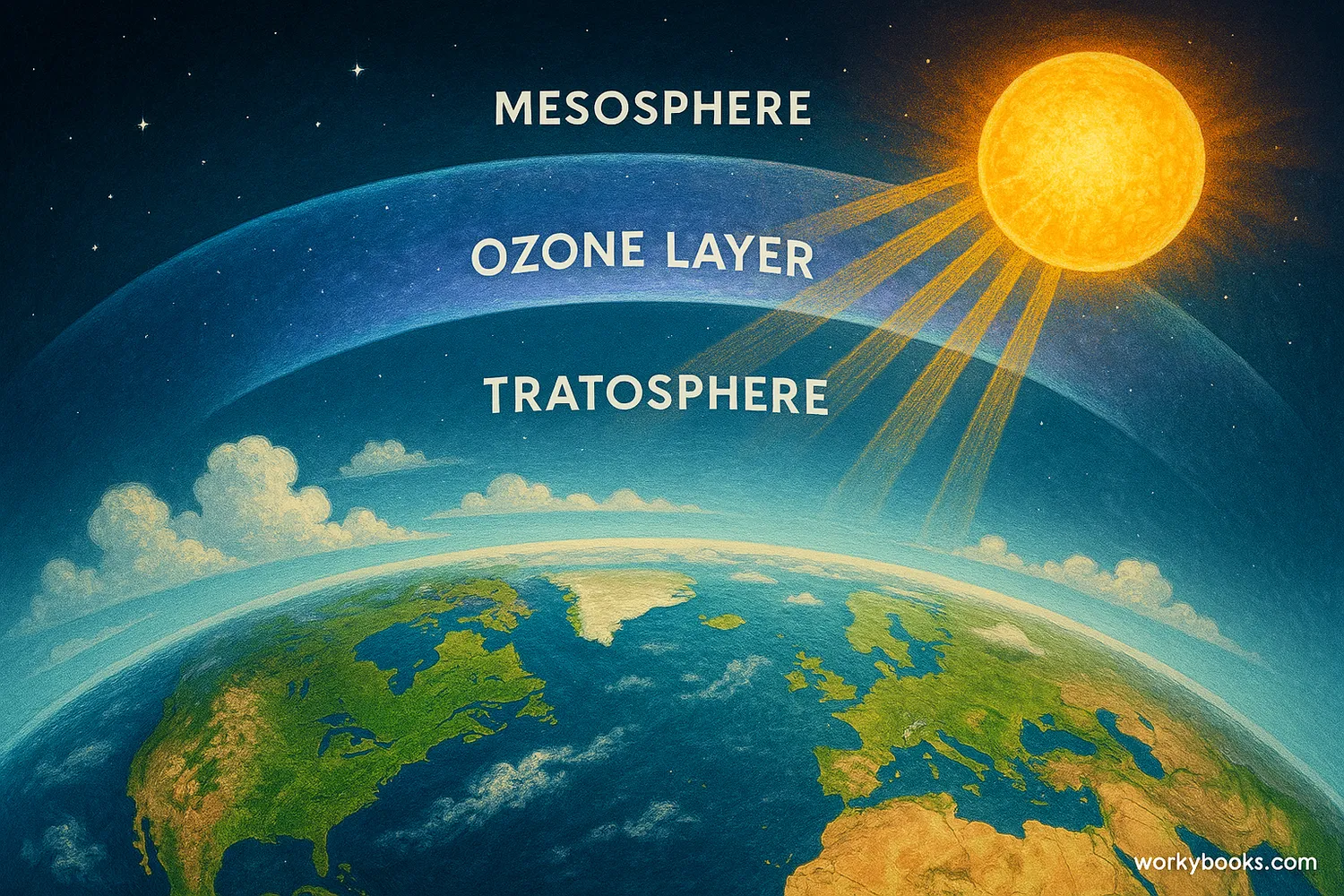
Earth's atmosphere, showing the ozone layer within the stratosphere protecting the planet from the sun's harmful UV radiation.
The Earth's atmosphere is a complex system of layers, each with distinct characteristics. One of the most crucial of these layers is the ozone layer, a region within the stratosphere. This layer is not a solid shield but rather a concentration of ozone gas (O3) that plays a vital role in protecting life on Earth. Its primary function is to absorb a significant portion of the sun's harmful ultraviolet (UV) radiation, which would otherwise reach the planet's surface and cause widespread damage to living organisms.
Located within the stratosphere, the ozone layer exists at an altitude of approximately 15 to 30 kilometers (9 to 18 miles) above the Earth's surface. In this layer, a continuous cycle of ozone formation and destruction occurs. High-energy UV radiation from the sun strikes oxygen molecules (O2), splitting them into individual oxygen atoms (O). These free atoms then combine with other oxygen molecules to form ozone (O3). This natural process maintains a stable concentration of ozone, ensuring the protective layer remains intact.
The ozone layer's ability to absorb UV radiation is essential for all life on Earth. Exposure to high levels of UV radiation can lead to serious health problems in humans, such as skin cancer and cataracts. It can also damage the DNA of plants and animals, disrupt marine ecosystems, and harm agricultural crops. The existence of the ozone layer allowed life to evolve and thrive on land, as it provided a necessary barrier against the sun's intense radiation.
Human activities, particularly the use of certain chemicals like chlorofluorocarbons (CFCs), have historically disrupted the natural balance of the ozone layer. These chemicals, once widely used in aerosols and refrigerants, released chlorine atoms into the stratosphere. A single chlorine atom can destroy thousands of ozone molecules, leading to a thinning of the layer, famously known as the "ozone hole." International efforts, such as the Montreal Protocol, have successfully phased out many of these harmful substances, allowing the ozone layer to begin its slow process of recovery.
Fun Fact: The total amount of ozone in the atmosphere, if compressed into a single layer at the Earth's surface, would only be about the thickness of three dimes!
Where is the ozone layer primarily located?
The troposphereThe stratosphereThe mesosphereThe thermosphere
What is the main function of the ozone layer?
To create weather patternsTo absorb harmful UV radiationTo increase the Earth's temperatureTo produce oxygen for breathing
What is the chemical formula for an ozone molecule?
O
2
OO
3
CO
How does UV radiation from the sun contribute to ozone formation?
It splits apart oxygen molecules.It cools the stratosphere.It combines with nitrogen to form ozone.It creates a solid protective barrier.
Which of the following is a negative effect of increased UV radiation reaching Earth's surface?
Increased plant photosynthesisDamage to agricultural cropsA stronger magnetic fieldMore frequent hurricanes
Based on the passage, what caused the "ozone hole"?
Natural volcanic eruptionsThe release of oxygen into the atmosphereChemicals like CFCs from human activitiesToo much ozone being created
What is the main idea of the reading passage?
The dangers of ground-level ozone.The layers of the Earth's atmosphere.The importance and recovery of the ozone layer.How to create ozone in a lab.
If the Montreal Protocol had not been implemented, what would be a likely consequence?
The stratosphere would become warmer.Ozone would stop forming naturally.The ozone layer's recovery would be delayed.The troposphere would shrink in size.
Perfect For:
👩🏫 Teachers
• Reading comprehension practice
• Auto-graded assessments
• Literacy skill development
👨👩👧👦 Parents
• Reading practice at home
• Comprehension improvement
• Educational reading time
🏠 Homeschoolers
• Reading curriculum support
• Independent reading practice
• Progress monitoring
Reading Features:
📖
Reading Passage
Engaging fiction or nonfiction text
❓
Comprehension Quiz
Auto-graded questions
📊
Instant Feedback
Immediate results and scoring
📄
Printable Version
Download for offline reading
🔊
Read Aloud
Voice-over with word highlighting
Reviews & Ratings
No reviews yet. Be the first to share your experience!
Related Content
Earth: Our Home in Space
This engaging Grade 4-5 science passage, aligned to NGSS, introduces students to Earth's special place in the solar syst...
Tools and Technology in Earth Science
This middle school science reading passage explores the wide range of tools and technologies used in Earth science, from...
MS-ESS2-2MS-ESS3-2MS-ETS1-1MS-PS4-3
Earth's Place in the Universe
This reading passage explains Earth's place in the universe, supporting NGSS 1-ESS1-1. It describes how Earth is one of ...
1-ESS1-1
Scientific Inquiry in Earth Science
This passage explores scientific inquiry in Earth science for grades 6-8, aligned with NGSS standards MS-ESS1-4, MS-ESS2...
MS-ESS1-4MS-ESS2-1MS-ESS3-5SEP
What Is Space Weather and How Does It Affect the Earth?
This NGSS-aligned science passage for middle school explains what space weather is and how it affects Earth. Students le...
MS-ESS2-2
Escape Velocity and Space Travel
This middle school science passage introduces students to the concept of escape velocity—the minimum speed required to b...
MS-ESS1-2MS-PS2-4
Space Stations
This informational science reading passage for grades 6-8 explores the complex systems and technology behind space stati...
MS-ESS1-3MS-ETS1-1
What Is Earth Science?
This engaging middle school science passage introduces students to the field of Earth science, aligning with NGSS standa...
MS-ESS1MS-ESS2MS-ESS3SEP
The Space Garden
This innovative passage combines plant science with space exploration, aligning with NGSS standards for life sciences an...
RL.3.1RL.2.1RL.4.9
Measuring Distances in Space
This middle school science passage explores how astronomers measure the vast distances in space, aligning with NGSS stan...
MS-ESS1-3
Earth: Our Home Planet
This comprehensive science passage for grades 6-8 explores Earth’s unique characteristics and the interconnected systems...
MS-ESS1-2
Meteorite Impacts on Earth
This engaging science reading passage for Grades 4-5 explores meteorite impacts on Earth, aligning with NGSS standards. ...
Exploring Space: Rockets and Spacecraft
Space exploration has been one of humanity's greatest achievements, made possible by rockets and spacecraft. Rockets act...
RI.4.4RI.4.2
Earth's Rotation
This middle school science passage, aligned with NGSS standard MS-ESS1-1, focuses on Earth's rotation—how Earth spins on...
MS-ESS1-1
Facts About Earth
This engaging science reading passage introduces Grade 4 and 5 students to Earth, our home planet. Aligned with NGSS sta...
Earth's Moon Facts
This engaging science passage, 'The Moon: Earth's Companion,' is designed for Grade 4-5 students and aligns with NGSS ge...
International Space Station
Discover the wonders of the International Space Station with this informative coloring page showcasing the orbiting outpost where astronauts live and work in space. As children color the complex modul...
Earth's Seasons
This comprehensive reading passage for grades 6-8 explains why Earth has seasons, revealing the scientific mechanisms be...
MS-ESS1-1
Venus: Earth's Twin?
This comprehensive science passage for grades 6-8 examines Venus—often called Earth's twin—by exploring its similarities...
MS-ESS1-2MS-ESS1-3
The Space Needle
Students read a passage about the history and features of Seattle's Space Needle, then answer comprehension questions to...