Which Planet Has The Greatest Atmospheric Pressure At Its Surface? — Reading Comprehension
Rate this
Premium Resource
Present
Present in classroom. No work saved
Assign
Classroom with student accounts, Track progress
Quick Play
No student accounts, assign with a link
Grades
6
PRINT+DIGITAL RESOURCE
This learning resource is available in interactive and printable formats. The interactive worksheet can be played online and assigned to students. The Printable PDF version can be downloaded and printed for completion by hand.
This educational passage, audio-integrated for diverse learners, explores the fascinating question: Which planet has the greatest atmospheric pressure at its surface? Students will learn about atmospheric pressure, its factors, and compare the atmospheres of different planets like Venus, Earth, and Mars. Aligned with NGSS MS-ESS1-3, this content helps students analyze and interpret data to determine scale properties of objects in the solar system, focusing on planetary atmospheres. Key terms like 'atmosphere,' 'pressure,' and 'density' are defined, making complex scientific concepts accessible. The passage is designed for a 6th-grade reading level, making it suitable for middle school science classes.
CONTENT PREVIEW
Expand content preview
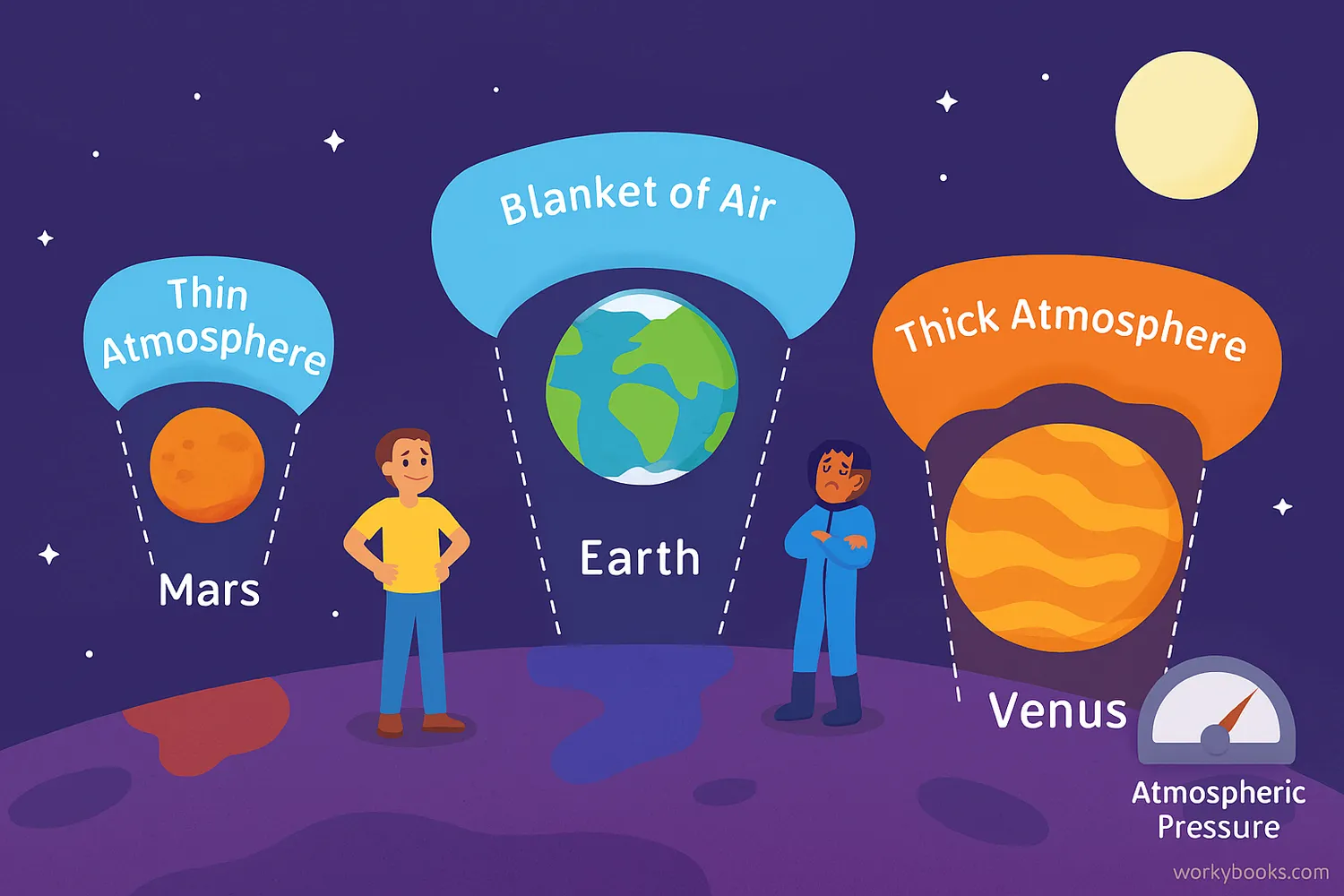
Comparison of surface pressures on Mars, Earth, and Venus.
Have you ever wondered what it would feel like to stand on another planet? Would the air be thick or thin? Would it push down on you a lot or a little? This depends on the planet's atmosphere and its atmospheric pressure. Atmospheric pressure is simply the force that a planet's air pushes down on its surface. Imagine a giant blanket of gas surrounding a planet; the weight of that blanket creates pressure.
Our solar system is home to a variety of planets, each with its own unique atmosphere. For example, Earth has an atmosphere mostly made of nitrogen and oxygen, which provides a comfortable pressure for us to live. Mars, on the other hand, has a very thin atmosphere, so thin that the atmospheric pressure there is less than 1% of Earth's. This means you'd feel very little pushing down on you on Mars.
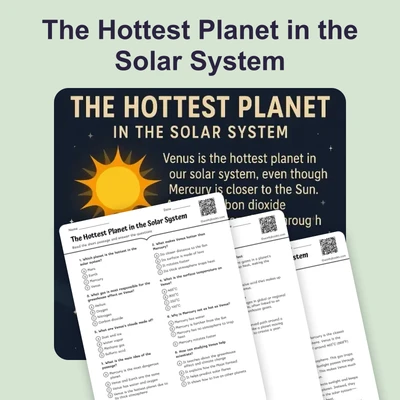
But which planet has the greatest atmospheric pressure at its surface? The answer might surprise you: it's Venus. While planets like Jupiter and Saturn are gas giants with massive atmospheres, their surfaces are not solid. When we talk about "surface pressure," we usually mean a solid surface. Venus has a solid surface, but its atmosphere is incredibly dense and thick. It's mainly made of carbon dioxide, which traps a lot of heat, making Venus extremely hot.
The atmospheric pressure on Venus's surface is about 92 times greater than Earth's! To put that into perspective, imagine being 900 meters (about half a mile) underwater on Earth. That's the kind of crushing pressure you would experience on Venus. This extreme pressure, combined with scorching temperatures, makes Venus an incredibly hostile environment. So, when comparing rocky planets with solid surfaces, Venus definitely wins the prize for the greatest atmospheric pressure.
Understanding these differences helps scientists study how planets form and change over time. It's a key part of analyzing and interpreting data to determine scale properties of objects in the solar system, aligning with NGSS MS-ESS1-3.
Interesting Fact: The atmospheric pressure on Venus is so strong it would crush a human in an instant, even without considering the extreme heat!
Which planet has the greatest atmospheric pressure at its surface?
EarthMarsVenusJupiter
What is atmospheric pressure?
Force of air pushingPlanet's temperatureAmount of waterLight from sun
What is Earth's atmosphere mostly made of?
Carbon dioxideNitrogen and oxygenHydrogen and heliumMethane gas
True or False: Mars has a very thick atmosphere.
TrueFalse
Why is Venus so hot?
Close to SunFast rotationDense CO2 atmosphereMany volcanoes
How does Venus's pressure compare to Earth's?
Much lessAbout the sameSlightly more92 times greater
What does a dense atmosphere mean?
Very spread outThick and heavyEasy to breatheMostly water
Which gas makes up most of Venus's atmosphere?
NitrogenOxygenCarbon dioxideMethane
If a planet had no atmosphere, what would its surface pressure be?
Very highExtremely lowSame as Earth'sZero pressure
The word 'hostile' in the passage means:
FriendlyPleasantUnfavorableBright
Perfect For:
👩🏫 Teachers
• Reading comprehension practice
• Auto-graded assessments
• Literacy skill development
👨👩👧👦 Parents
• Reading practice at home
• Comprehension improvement
• Educational reading time
🏠 Homeschoolers
• Reading curriculum support
• Independent reading practice
• Progress monitoring
Reading Features:
📖
Reading Passage
Engaging fiction or nonfiction text
❓
Comprehension Quiz
Auto-graded questions
📊
Instant Feedback
Immediate results and scoring
📄
Printable Version
Download for offline reading
🔊
Read Aloud
Voice-over with word highlighting
Reviews & Ratings
No reviews yet. Be the first to share your experience!
Related Content
Earth: Our Home in Space
This engaging Grade 4-5 science passage, aligned to NGSS, introduces students to Earth's special place in the solar syst...
Tools and Technology in Earth Science
This middle school science reading passage explores the wide range of tools and technologies used in Earth science, from...
MS-ESS2-2MS-ESS3-2MS-ETS1-1MS-PS4-3
Earth's Place in the Universe
This reading passage explains Earth's place in the universe, supporting NGSS 1-ESS1-1. It describes how Earth is one of ...
1-ESS1-1
Scientific Inquiry in Earth Science
This passage explores scientific inquiry in Earth science for grades 6-8, aligned with NGSS standards MS-ESS1-4, MS-ESS2...
MS-ESS1-4MS-ESS2-1MS-ESS3-5SEP
What Is Space Weather and How Does It Affect the Earth?
This NGSS-aligned science passage for middle school explains what space weather is and how it affects Earth. Students le...
MS-ESS2-2
Escape Velocity and Space Travel
This middle school science passage introduces students to the concept of escape velocity—the minimum speed required to b...
MS-ESS1-2MS-PS2-4
Space Stations
This informational science reading passage for grades 6-8 explores the complex systems and technology behind space stati...
MS-ESS1-3MS-ETS1-1
What Is Earth Science?
This engaging middle school science passage introduces students to the field of Earth science, aligning with NGSS standa...
MS-ESS1MS-ESS2MS-ESS3SEP
The Space Garden
This innovative passage combines plant science with space exploration, aligning with NGSS standards for life sciences an...
RL.3.1RL.2.1RL.4.9
Earth: Our Home Planet
This comprehensive science passage for grades 6-8 explores Earth’s unique characteristics and the interconnected systems...
MS-ESS1-2
Measuring Distances in Space
This middle school science passage explores how astronomers measure the vast distances in space, aligning with NGSS stan...
MS-ESS1-3
Meteorite Impacts on Earth
This engaging science reading passage for Grades 4-5 explores meteorite impacts on Earth, aligning with NGSS standards. ...
Earth's Rotation
This middle school science passage, aligned with NGSS standard MS-ESS1-1, focuses on Earth's rotation—how Earth spins on...
MS-ESS1-1
Facts About Earth
This engaging science reading passage introduces Grade 4 and 5 students to Earth, our home planet. Aligned with NGSS sta...
Exploring Space: Rockets and Spacecraft
Space exploration has been one of humanity's greatest achievements, made possible by rockets and spacecraft. Rockets act...
RI.4.4RI.4.2
Earth's Moon Facts
This engaging science passage, 'The Moon: Earth's Companion,' is designed for Grade 4-5 students and aligns with NGSS ge...
Earth's Seasons
This comprehensive reading passage for grades 6-8 explains why Earth has seasons, revealing the scientific mechanisms be...
MS-ESS1-1
Venus: Earth's Twin?
This comprehensive science passage for grades 6-8 examines Venus—often called Earth's twin—by exploring its similarities...
MS-ESS1-2MS-ESS1-3
What Makes Earth Perfect for Life?
This Grade 4-5 science passage, aligned with NGSS standards, explores the essential features that make Earth the perfect...
International Space Station
Discover the wonders of the International Space Station with this informative coloring page showcasing the orbiting outpost where astronauts live and work in space. As children color the complex modul...