Why Are Temperature Changes In The Troposphere And Stratosphere Different? — Reading Comprehension
Rate this
Premium Resource
Present
Present in classroom. No work saved
Assign
Classroom with student accounts, Track progress
Quick Play
No student accounts, assign with a link
Grades
6
PRINT+DIGITAL RESOURCE
This learning resource is available in interactive and printable formats. The interactive worksheet can be played online and assigned to students. The Printable PDF version can be downloaded and printed for completion by hand.
This educational passage, audio-integrated for diverse learners, delves into the fascinating reasons behind the distinct temperature changes observed in Earth's troposphere and stratosphere. Students will explore key concepts like the ozone layer, greenhouse gases, and how the Sun's energy interacts with different atmospheric layers. Aligned with NGSS standard MS-ESS2-6, it helps students understand how unequal heating contributes to atmospheric patterns. The content is designed for a Grade 6 reading level, making complex scientific ideas accessible and engaging. Key terms are defined, and the passage is structured to build a strong foundation in atmospheric science.
CONTENT PREVIEW
Expand content preview
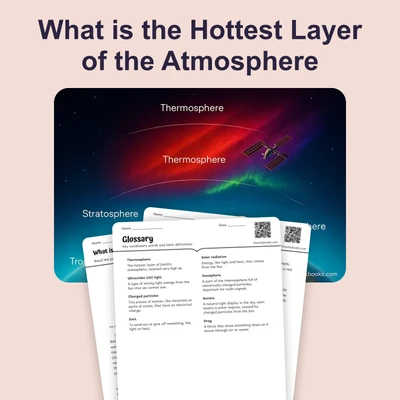
Temperature changes in troposphere and stratosphere explained through heat sources and altitude.
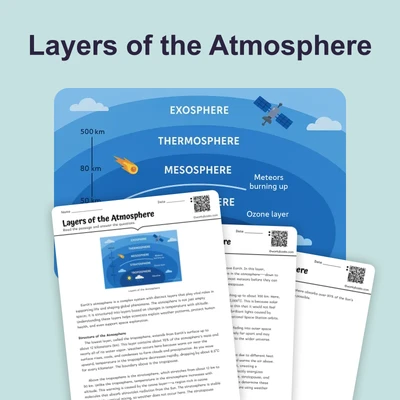
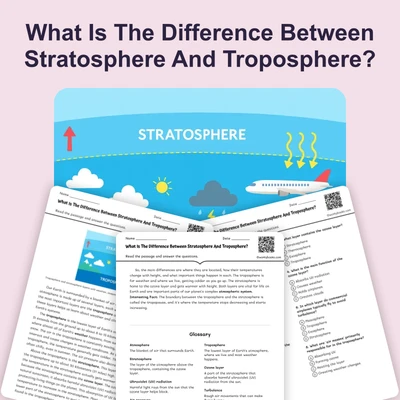
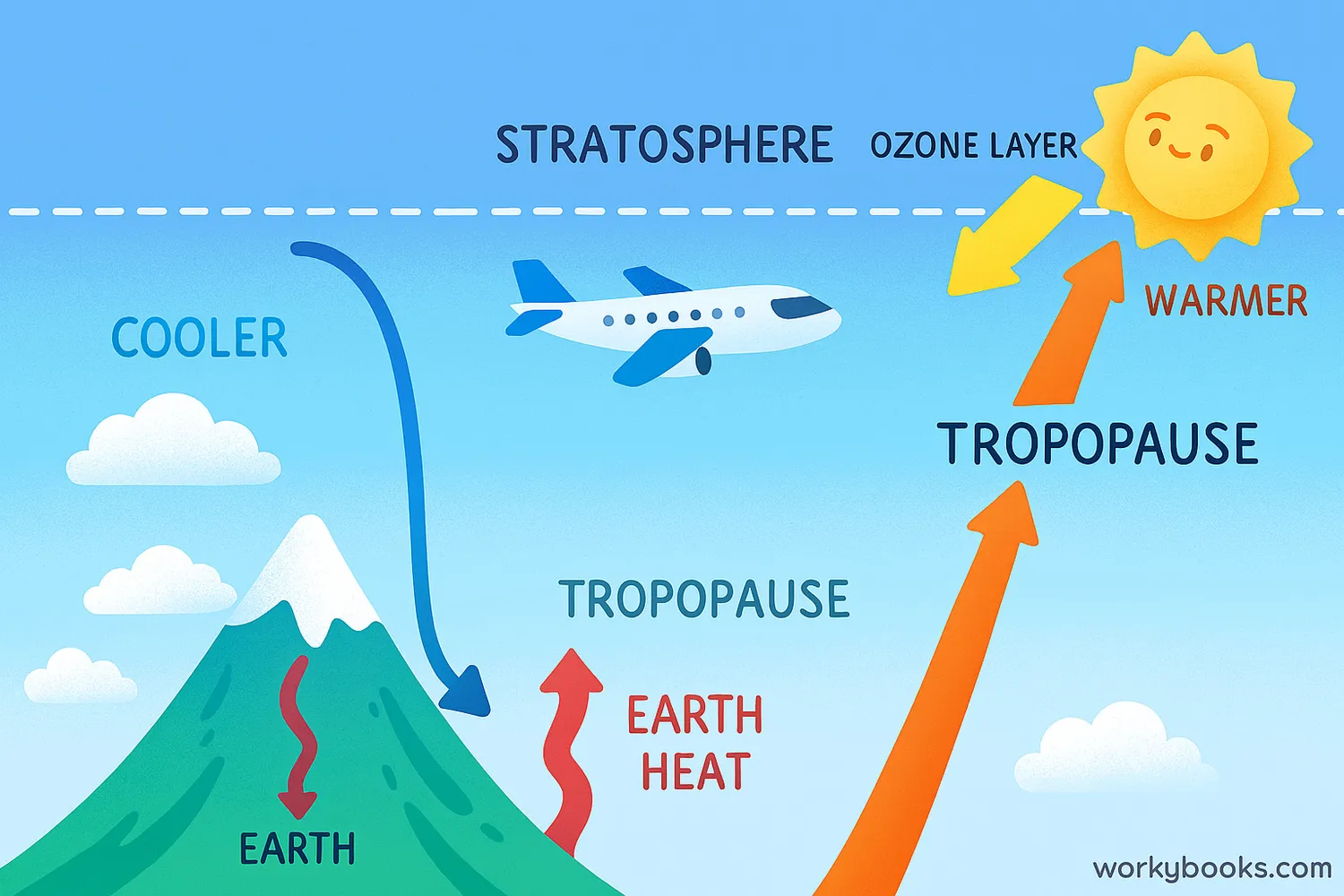
Have you ever wondered why it gets colder when you climb a tall mountain, but airplanes flying much higher experience warmer temperatures? This has to do with how the Earth's atmosphere is structured. Our atmosphere is made of several layers, and the two lowest layers are the troposphere and the stratosphere.
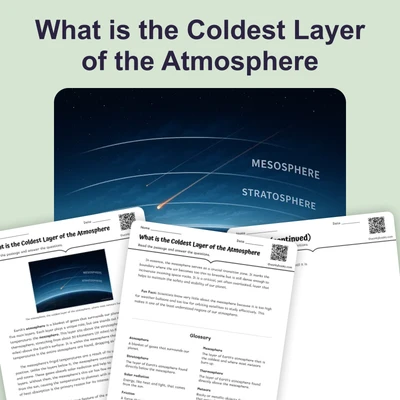
The troposphere is the layer closest to Earth's surface. It's where we live, where weather happens, and where most clouds form. In the troposphere, as you go higher, the temperature generally gets colder. This is because the ground absorbs sunlight and heats the air directly above it. As you move away from the warm ground, the air becomes less dense and holds less heat, so the temperature drops. Think about a campfire – it's hottest right next to the flames, and cooler as you move farther away. This is also where greenhouse gases, like carbon dioxide, trap heat, making our planet warm enough to live on.
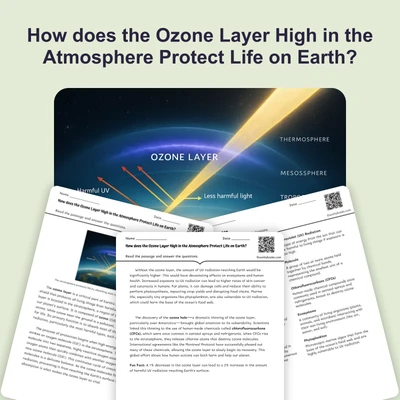
Above the troposphere is the stratosphere. This layer behaves differently. In the stratosphere, as you go higher, the temperature actually gets warmer! This might seem strange, but there's a good reason for it: the ozone layer. The ozone layer is a special part of the stratosphere that contains a lot of ozone gas. Ozone is very important because it absorbs harmful ultraviolet (UV) radiation from the Sun. When ozone molecules absorb this UV radiation, they get warmer. This warming effect is strongest at the top of the stratosphere, where the most UV radiation is absorbed, causing temperatures to increase with altitude.
So, the main difference comes down to where the heat comes from. In the troposphere, heat comes mostly from the Earth's surface. In the stratosphere, heat comes from the ozone layer absorbing UV radiation directly from the Sun. Understanding these differences helps us comprehend how our planet's temperature changes and how atmospheric and oceanic circulation patterns determine regional climates, a key concept in Earth science.
Interesting Fact: If all the ozone in the stratosphere were compressed into a pure layer at the Earth's surface, it would be only about 3 millimeters thick, roughly the size of a pea!
Which layer is closest to Earth's surface?
TroposphereStratosphereOzone layerThermosphere
What absorbs UV radiation?
GroundOzone layerGreenhouse gasesClouds
True or False: Weather happens in the stratosphere.
TrueFalse
Why does temperature get colder as you go higher in the troposphere?
Less ozone presentAway from ground heatMore UV radiationFewer greenhouse gases
What makes the stratosphere warmer at higher altitudes?
Closer to SunOzone absorbing UVVolcanic activityMore greenhouse gases
Which layer traps heat with greenhouse gases?
StratosphereTroposphereMesosphereExosphere
How does the heating of the troposphere primarily occur?
Direct solar absorptionHeating from groundOzone layer activityCosmic rays
Imagine a new planet with no ozone layer. How would its stratosphere likely behave?
Warmer with altitudeColder with altitudeConstant temperatureNo stratosphere
If greenhouse gases disappeared, what would happen to Earth's surface temperature?
Increase greatlyDecrease greatlyStay the sameFluctuate wildly
Perfect For:
👩🏫 Teachers
• Reading comprehension practice
• Auto-graded assessments
• Literacy skill development
👨👩👧👦 Parents
• Reading practice at home
• Comprehension improvement
• Educational reading time
🏠 Homeschoolers
• Reading curriculum support
• Independent reading practice
• Progress monitoring
Reading Features:
📖
Reading Passage
Engaging fiction or nonfiction text
❓
Comprehension Quiz
Auto-graded questions
📊
Instant Feedback
Immediate results and scoring
📄
Printable Version
Download for offline reading
🔊
Read Aloud
Voice-over with word highlighting
Reviews & Ratings
No reviews yet. Be the first to share your experience!
Related Content
Tools and Technology in Earth Science
This middle school science reading passage explores the wide range of tools and technologies used in Earth science, from...
MS-ESS2-2MS-ESS3-2MS-ETS1-1MS-PS4-3
Scientific Inquiry in Earth Science
This passage explores scientific inquiry in Earth science for grades 6-8, aligned with NGSS standards MS-ESS1-4, MS-ESS2...
MS-ESS1-4MS-ESS2-1MS-ESS3-5SEP
What Is Earth Science?
This engaging middle school science passage introduces students to the field of Earth science, aligning with NGSS standa...
MS-ESS1MS-ESS2MS-ESS3SEP
Earth: Our Home in Space
This engaging Grade 4-5 science passage, aligned to NGSS, introduces students to Earth's special place in the solar syst...
Earth's Spheres
This middle school science passage introduces students to Earth's four major spheres: the geosphere, hydrosphere, atmosp...
MS-ESS2-4MS-ESS2-6
What Is Space Weather and How Does It Affect the Earth?
This NGSS-aligned science passage for middle school explains what space weather is and how it affects Earth. Students le...
MS-ESS2-2
Earth's Energy Balance
This engaging, NGSS-aligned science passage for grades 6–8 explores Earth's energy balance, a key process that keeps our...
MS-ESS2-6
Earth's Rotation
This middle school science passage, aligned with NGSS standard MS-ESS1-1, focuses on Earth's rotation—how Earth spins on...
MS-ESS1-1
Earth's Interior
This comprehensive passage for grades 6-8 explores Earth's layered interior, including the crust, mantle, outer core, an...
MS-ESS2-1MS-ESS2-2
Facts About Earth
This engaging science reading passage introduces Grade 4 and 5 students to Earth, our home planet. Aligned with NGSS sta...
Meteorite Impacts on Earth
This engaging science reading passage for Grades 4-5 explores meteorite impacts on Earth, aligning with NGSS standards. ...
Venus: Earth's Twin?
This comprehensive science passage for grades 6-8 examines Venus—often called Earth's twin—by exploring its similarities...
MS-ESS1-2MS-ESS1-3
Earth Changes Over Millions of Years
This engaging, audio-integrated science passage for Grade 4-5 students explores how Earth has changed over millions of y...
Earth's Moon Facts
This engaging science passage, 'The Moon: Earth's Companion,' is designed for Grade 4-5 students and aligns with NGSS ge...
Earth's Revolution
This middle school science passage explores the science behind Earth's revolution around the Sun, closely aligned with N...
MS-ESS1-1
Earth's Quick and Slow Changes
In 'Earth's Quick and Slow Changes,' students categorize 12 Earth events by their speed of occurrence, enhancing underst...
Earth: Our Home Planet
This comprehensive science passage for grades 6-8 explores Earth’s unique characteristics and the interconnected systems...
MS-ESS1-2
Earth's Seasons
This comprehensive reading passage for grades 6-8 explains why Earth has seasons, revealing the scientific mechanisms be...
MS-ESS1-1
Earth's Place in the Universe
This reading passage explains Earth's place in the universe, supporting NGSS 1-ESS1-1. It describes how Earth is one of ...
1-ESS1-1
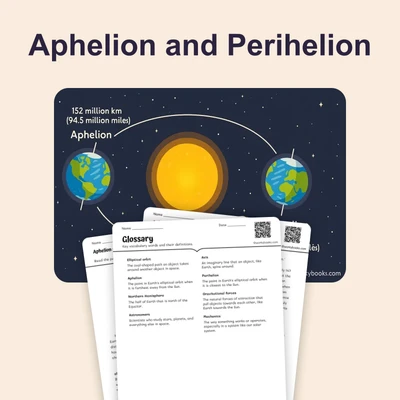
Aphelion and Perihelion
This engaging reading passage, 'Aphelion and Perihelion,' delves into the fascinating aspects of Earth's elliptical orbi...
MS-ESS1-1: DEVELOP AND USE A MODEL OF THE EARTH-SUN-MOON SYSTEM TO DESCRIBE THE CYCLIC PATTERNS OF LUNAR PHASESECLIPSES OF THE SUN AND MOONAND SEASONS.