This 400-500 word informational science reading passage explains why stars appear to move across the night sky for middle school students in grades 6-8. Aligned with NGSS standards MS-ESS1-1 and disciplinary core idea MS-ESS1.B, the passage uses cause-and-effect reasoning to help students understand that Earth's rotation on its axis creates the illusion of stellar motion. The content clarifies that stars rise in the east and set in the west, just like the Sun, and that the stars themselves barely move during a human lifetime. Students explore the concept of apparent motion versus actual motion through clear explanations and real-world examples. The passage includes audio integration for enhanced accessibility, a Spanish translation, a simplified differentiated version for struggling readers and English Language Learners, and engaging activities including multiple-choice questions, writing prompts, and graphic organizers. Key vocabulary terms are highlighted throughout to support science literacy development.
Written by Workybooks TeamPublished by Workybooks
Preview
Sample passage and quiz content
CONTENT PREVIEW
Expand content preview
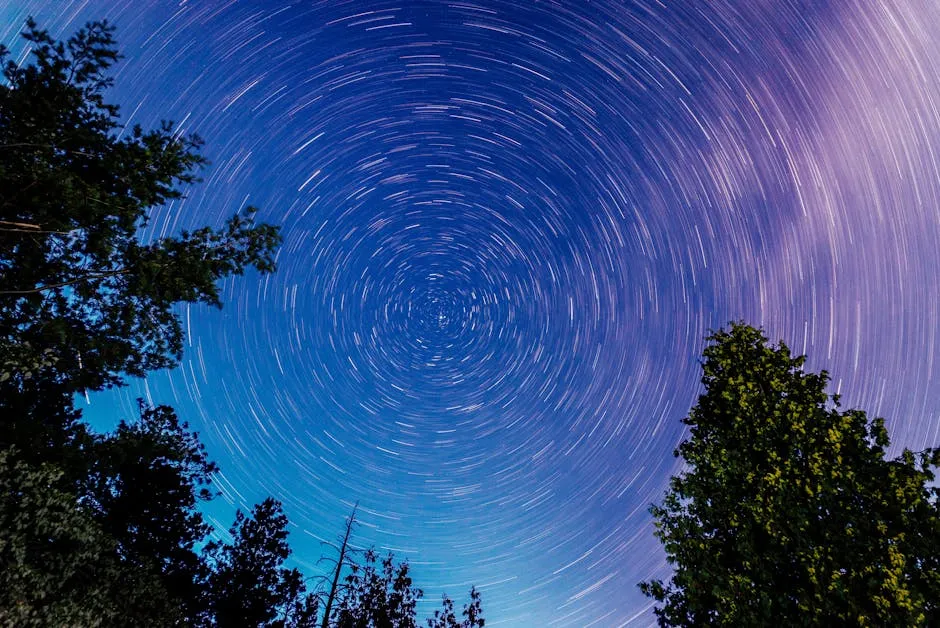
"Beautiful long exposure of star trails creating a spiral effect over a forest in Barry's Bay, Ontario, Canada." Image by Harrison Haines / Pexels.
Have you ever watched the stars at night and noticed they seem to move? Stars appear to move across the night sky because Earth rotates on its axis. This spinning motion creates an illusion that makes the stars look like they are moving. In reality, the stars themselves barely move during a human lifetime.
Earth completes one full rotation every 24 hours. As our planet spins from west to east, objects in the sky appear to move in the opposite direction. Stars rise in the east and set in the west, just like the Sun and Moon. Scientists explain this phenomenon as apparent motion. The stars are not actually traveling across the sky. Instead, Earth's rotation carries us along, changing our view of the celestial sphere.
Think of it like riding in a car. When you look out the window, trees and buildings seem to rush past you. The trees are not moving, but you are. The same principle applies to stargazing. As Earth spins beneath the stars, they appear to trace curved paths across the night sky. Evidence shows that stars maintain nearly fixed positions relative to each other. Ancient astronomers noticed that star patterns, called constellations, stay the same shape over many generations.
Observers at different locations on Earth see different parts of the sky. For example, people near the North Pole can watch stars circle around Polaris, the North Star. Polaris appears almost motionless because it sits nearly above Earth's axis. Meanwhile, stars near the horizon rise and set more dramatically. Scientists use telescopes and cameras to track these patterns. Time-lapse photography reveals beautiful circular star trails that demonstrate Earth's continuous rotation.
Understanding why stars appear to move helps us comprehend Earth's place in space. This knowledge allows astronomers to predict celestial events and navigate using the stars. Ancient sailors used stellar motion to guide their ships across oceans. Today, this same principle helps us understand our rotating planet and its relationship to the universe.
Interesting Fact: If you could stand at Earth's North Pole, you would see stars moving in perfect circles around Polaris throughout the night. At the equator, stars appear to rise straight up and set straight down.
Why do stars appear to move across the night sky?
Because Earth rotates on its axisBecause the stars are actually moving rapidly through spaceBecause the Moon's gravity pulls them across the skyBecause the Sun pushes them from east to west
How long does it take Earth to complete one full rotation?
12 hours24 hours48 hours365 days
What does the term 'apparent motion' mean in the passage?
Motion that is very obvious and clearMotion that happens only during the dayMotion that appears to happen but is caused by the observer's movementMotion that can only be seen with a telescope
What is the celestial sphere?
A real glass sphere that surrounds EarthThe atmosphere around our planetAn imaginary sphere on which stars appear to be locatedThe Moon's orbit around Earth
Why does Polaris appear almost motionless in the night sky?
Because it is the closest star to EarthBecause it sits nearly above Earth's axisBecause it does not emit any lightBecause it moves at the same speed as Earth
According to the passage, in which direction does Earth spin?
From east to westFrom north to southFrom west to eastFrom south to north
What evidence shows that stars maintain nearly fixed positions relative to each other?
Stars change color throughout the nightConstellations keep the same shape over many generationsStars get brighter as the night goes onDifferent stars appear each season
How did ancient sailors use knowledge of star motion?
To predict the weather accuratelyTo measure the depth of the oceanTo guide their ships across oceansTo communicate with other ships
True or False: Stars actually travel across the sky during the night.
TrueFalse
True or False: Stars rise in the east and set in the west, just like the Sun.
TrueFalse
Who it's for
Perfect for the way you teach
Teachers
Build comprehension skills
Auto-graded quiz
Differentiated reading
Parents
Read together at home
Improve fluency
Quiet reading time
Homeschoolers
Reading curriculum support
Independent practice
Track Lexile growth
Topics
stars appear to moveEarth's rotationapparent motioncelestial sphereaxisnight skyNGSS MS-ESS1-1middle school science
Reviews & Ratings
No reviews yet. Be the first to share your experience!
More reading you might love
20 more
What is Solar Radiation
This NGSS-aligned science reading passage for middle school students explores the concept of solar radiation. Solar radi...
MS-ESS1-1
How Incoming Solar Radiation Changes with Latitude
This NGSS-aligned science reading passage helps middle school students understand how solar radiation, or insolation, ch...
MS-ESS1-1
Tides and Tidal Forces
This middle school science passage explores the mechanisms of tides and tidal forces, aligning with NGSS standards MS-ES...
MS-ESS1-1MS-ESS1-2
The Night Sky
This comprehensive science reading passage for grades 6-8 aligns with NGSS standard MS-ESS1-1 and explores the systems a...
MS-ESS1-1
Ancient Astronomy
This engaging passage for grades 6-8 explores the history of astronomy through the lens of ancient observations. Student...
MS-ESS1-1
Tools of Modern Astronomy
This passage introduces middle school students to modern astronomy, aligning with NGSS standard MS-ESS1-1. It explains h...
MS-ESS1-1
How Astronomy Became a Science
This passage explores the transformative period known as the Scientific Revolution, with a special focus on the history ...
MS-ESS1-1
Earth's Rotation
This middle school science passage, aligned with NGSS standard MS-ESS1-1, focuses on Earth's rotation—how Earth spins on...
MS-ESS1-1
Earth's Revolution
This middle school science passage explores the science behind Earth's revolution around the Sun, closely aligned with N...
MS-ESS1-1
Why We Have Seasons
This comprehensive middle school science reading passage explains the mechanisms behind Earth's seasons, directly addres...
MS-ESS1-1
Earth's Seasons
This comprehensive reading passage for grades 6-8 explains why Earth has seasons, revealing the scientific mechanisms be...
MS-ESS1-1
Phases of the Moon
This comprehensive middle school science passage explains the phases of the Moon, focusing on the mechanisms behind the ...
MS-ESS1-1
Tides
This comprehensive middle school science reading passage explores the phenomenon of ocean tides, aligned to NGSS standar...
MS-ESS1-1MS-ESS1-2
Eclipses
This comprehensive passage for grades 6-8 explores the science behind eclipses, including solar and lunar eclipses, thei...
MS-ESS1-1
The Moon's Characteristics
This comprehensive science reading passage for grades 6-8 examines the Moon's physical characteristics, including its si...
MS-ESS1-1MS-ESS1-2
Lunar Eclipses
This passage introduces middle school students to the phenomenon of lunar eclipses, connecting observable events to the ...
MS-ESS1-1
The Sun's Characteristics
This engaging science passage introduces middle school students to the Sun’s key characteristics, such as its classifica...
MS-ESS1-1MS-ESS1-2
What Is a Galaxy?
This comprehensive middle school science passage answers the question: What is a galaxy? Aligned to NGSS standard MS-ESS...
MS-ESS1-1
The Milky Way: Our Home Galaxy
This comprehensive science passage introduces middle school students to the Milky Way, the barred spiral galaxy that is ...
MS-ESS1-1
Types of Galaxies
This comprehensive middle school science passage introduces students to the classification and characteristics of galaxi...