Reading PassagePremium

Why Earth's Core Is So Hot

Interactive passage with audio narration, comprehension questions, and printable PDF.

No ratings yet|
1
Grades 5–8ScienceElaEnglish · SpanishInteractive · Printable
Aligned toMS-ESS2-1
Just this resource
$1.50
One-time purchase
Best value
Unlock everything
$49.99$29.99/yr
40% off until Aug 1 — 10,000+ resources
Renews at $49.99/year.
Unlock above to use these actions

What's included

Reading passage
Audio narration
Comprehension quiz
Writing activity
Glossary & flashcards
Differentiated version
Spanish translation

Why Earth's Core Is So Hot preview and details

About this printable Why Earth's Core Is So Hot science reading passage, NGSS-aligned (Grades 5-8)

science,ela
Written by Workybooks TeamPublished by Workybooks
Preview

Sample passage and quiz from Why Earth's Core Is So Hot

Reading passage and comprehension quiz preview

Why Earth's Core Is So Hot
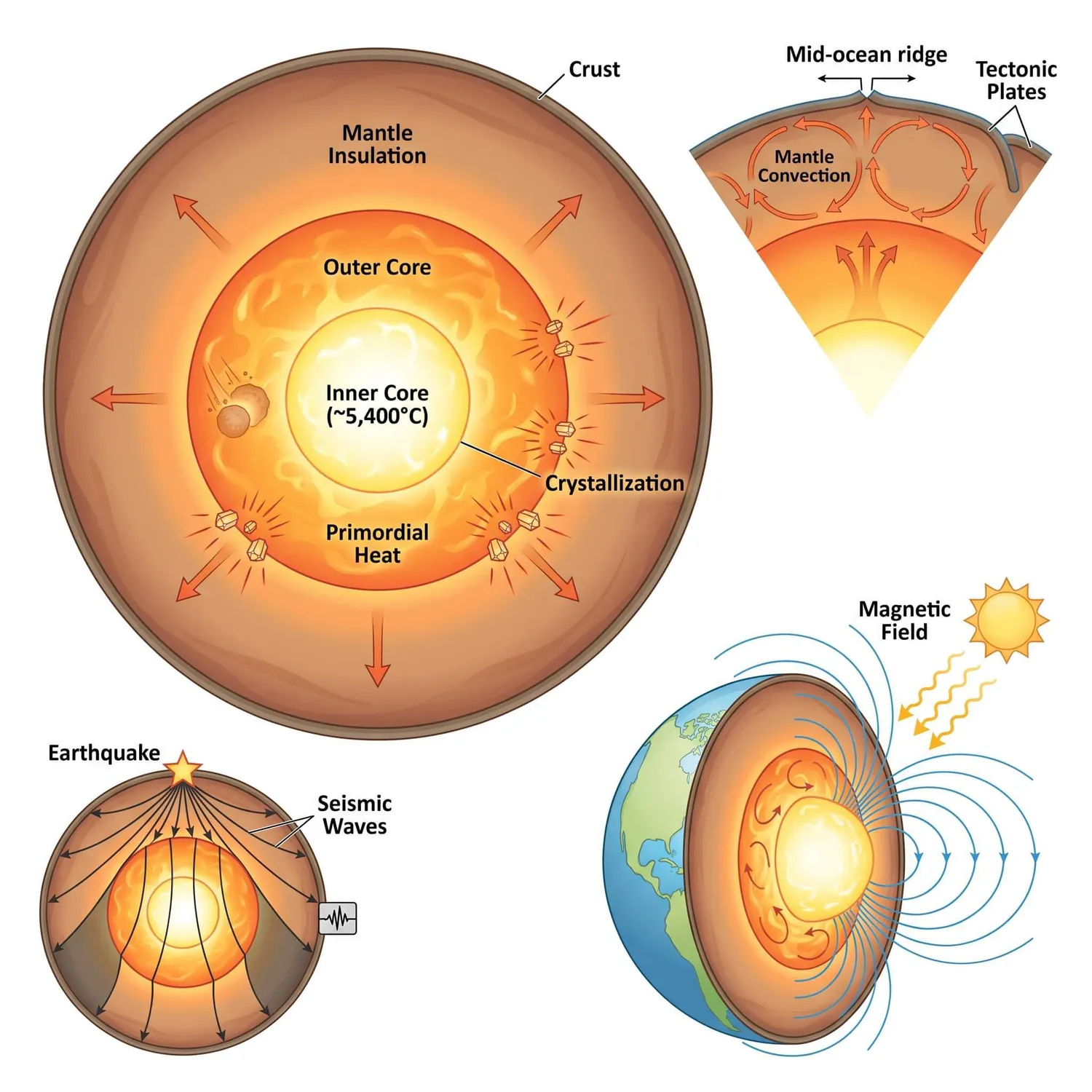
Earth's internal heat sources showing primordial heat, radioactive decay, mantle convection, plate tectonics
Earth's internal heat powers plate tectonics, earthquakes, volcanoes, and magnetic field

Earth's core is one of the hottest places in our planet. The inner core reaches temperatures around 5,400 degrees Celsius. That is roughly as hot as the surface of the Sun. Scientists explain that the core stays this hot for several important reasons.

The core sits at Earth's center, buried under about 2,900 kilometers of rock. This thick layer of rock is called the mantle. The mantle acts like a giant insulating blanket. It traps heat inside the core and allows it to escape only very slowly. Evidence shows that this insulation has kept the core extremely hot for billions of years. Without the mantle's insulating effect, the core would have cooled down long ago.

Heat is also released inside the core through a process called crystallization. The core has two parts: the solid inner core and the liquid outer core. Both are made mostly of iron and nickel. As Earth slowly cools over time, iron in the outer core crystallizes and joins the inner core. This process releases energy as heat. Scientists observe that this crystallization has been happening for billions of years and continues today.

The core also contains primordial heat—original heat left over from Earth's formation. About 4.6 billion years ago, Earth formed from colliding rocks and dust. These collisions generated enormous amounts of heat. Some of that heat is still trapped deep inside the core. The mantle's insulation prevents this ancient heat from escaping quickly into space.

The core's extreme heat has important effects on our planet. The heat keeps the outer core molten, or liquid. This molten iron moves and generates Earth's magnetic field. The magnetic field protects us from harmful solar radiation. Heat from the core also rises into the mantle above. This rising heat creates slow movements called convection currents in the mantle. These currents can drive the movement of Earth's tectonic plates.

Scientists use seismic waves from earthquakes to study the core. These waves travel through Earth and reveal information about temperature and composition. Evidence from seismic studies confirms that the core remains incredibly hot. Understanding core heat helps scientists explain how Earth's interior works and why our planet has a protective magnetic field.

Interesting Fact: The inner core grows by about one millimeter per year as iron crystallizes from the outer core. Over millions of years, the inner core has grown to about 1,200 kilometers in radius!

Comprehension quiz (10 questions)

1. What is the approximate temperature of Earth's inner core?

2,900 degrees Celsius
5,400 degrees Celsius
1,200 degrees Celsius
4,600 degrees Celsius

2. How does the mantle help keep the core hot?

It generates heat through chemical reactions
It reflects heat back to the core
It acts like an insulating blanket that traps heat
It absorbs cold from the surface

3. What does the term 'crystallization' mean in the context of Earth's core?

The melting of solid iron into liquid
The process of liquid iron turning solid and releasing heat
The cooling of the mantle
The formation of rocks on Earth's surface

4. What is primordial heat?

Heat from the Sun absorbed by Earth
Heat generated by volcanic eruptions
Original heat left over from Earth's formation billions of years ago
Heat created by earthquakes

5. Based on the passage, what can you infer about what would happen if the core cooled completely?

Earth's magnetic field would disappear
The mantle would become hotter
More earthquakes would occur
The Sun would get brighter

6. Why is the movement of molten iron in the outer core important?

It creates mountains on Earth's surface
It generates Earth's protective magnetic field
It causes the seasons to change
It makes the inner core grow faster

7. If scientists wanted to study a planet's core temperature, which method mentioned in the passage would be most useful?

Measuring surface temperature
Observing the planet's color
Analyzing seismic waves from earthquakes
Counting the number of volcanoes

8. How does heat from the core affect the mantle above it?

It freezes the mantle solid
It creates convection currents that can move tectonic plates
It has no effect on the mantle
It makes the mantle turn into liquid water

9. True or False: The inner core is liquid and the outer core is solid.

True
False

10. True or False: The core has stayed hot for billions of years partly because the mantle insulates it.

True
False
Who it's for

Perfect for the way you teach

Teachers
  • Build comprehension skills
  • Auto-graded quiz
  • Differentiated reading
Parents
  • Read together at home
  • Improve fluency
  • Quiet reading time
Homeschoolers
  • Reading curriculum support
  • Independent practice
  • Track Lexile growth
Topics

Reviews & Ratings

No reviews yet. Be the first to share your experience!

More reading you might love

20 more
Passage
Frost Wedging: How Ice Splits Rock - reading educational content
Grades 5–8

Frost Wedging: How Ice Splits Rock

earth and space science · MS-ESS2-1

$1.50
Passage
Limestone Caves: Nature’s Underground Wonders - reading educational content
Grades 5–8

Limestone Caves: Nature’s Underground Wonders

science · MS-ESS2-1

Free
Passage
Chemical Weathering: The Breakdown of Rocks Through Chemical Reactions - reading educational content
Grades 5–8

Chemical Weathering: The Breakdown of Rocks Through Chemical Reactions

earth and space science · MS-ESS2-1

Free
Passage
Talus Slopes: Formation and Features - reading educational content
Grades 5–8

Talus Slopes: Formation and Features

science · MS-ESS2-1

Free
Passage
Biological Weathering: Types and Examples - reading educational content
Grades 5–8

Biological Weathering: Types and Examples

science · MS-ESS2-1

Free
Passage
The Coldest City in the World: Yakutsk - reading educational content
Grades 5–8

The Coldest City in the World: Yakutsk

weather and climate · MS-ESS2-1

$1.50
Passage
Igneous Rocks - reading educational content
Grades 5–8

Igneous Rocks

earth and space science · MS-ESS2-1

$1.50
Passage
Sedimentary Rocks - reading educational content
Grades 5–8

Sedimentary Rocks

earth and space science · MS-ESS2-1

$1.50
Passage
Metamorphic Rocks - reading educational content
Grades 5–8

Metamorphic Rocks

earth and space science · MS-ESS2-1

Free
Passage
Scientific Inquiry in Earth Science - reading educational content
Grades 5–8

Scientific Inquiry in Earth Science

earth and space science · MS-ESS1-4

$1.50
Passage
Contour Lines and Elevation - reading educational content
Grades 5–8

Contour Lines and Elevation

earth and space science · MS-ESS2-2

$1.50
Passage
Weathering - reading educational content
Grades 5–8

Weathering

earth and space science · MS-ESS2-1

$1.50
Passage
Erosion - reading educational content
Grades 5–8

Erosion

earth and space science · MS-ESS2-1

$1.50
Passage
Stream Erosion and Deposition - reading educational content
Grades 5–8

Stream Erosion and Deposition

earth and space science · MS-ESS2-1

$1.50
Passage
Wind Erosion and Deposition - reading educational content
Grades 5–8

Wind Erosion and Deposition

earth and space science · MS-ESS2-1

$1.50
Passage
Glacial Erosion and Deposition - reading educational content
Grades 5–8

Glacial Erosion and Deposition

earth and space science · MS-ESS2-1

$1.50
Passage
Mass Movements - reading educational content
Grades 5–8

Mass Movements

science · MS-ESS2-1

$1.50
Passage
Soil Formation and Composition - reading educational content
Grades 5–8

Soil Formation and Composition

earth and space science · MS-ESS2-1

$1.50
Passage
Constructive and Destructive Forces - reading educational content
Grades 5–8

Constructive and Destructive Forces

earth and space science · MS-ESS2-1

Free
Passage
Mountains and Mountain Building - reading educational content
Grades 5–8

Mountains and Mountain Building

earth and space science · MS-ESS2-1

$1.50
Copyright © 2026 Workybooks. Made with ♥ in California.