Why Earth's Magnetic Field Reverses
Interactive passage with audio narration, comprehension questions, and printable PDF.
By completing this purchase you agree to our Terms of Use and Privacy Policy. Your subscription renews automatically until you cancel. You can cancel anytime from your account settings. All sales are final and non-refundable. Digital content is available for download in your account immediately upon purchase.
What's included
Why Earth's Magnetic Field Reverses preview and details
About this printable Why Earth's Magnetic Field Reverses science reading passage, NGSS-aligned (Grades 5-8)
Sample passage and quiz from Why Earth's Magnetic Field Reverses
Reading passage and comprehension quiz preview
Why Earth's Magnetic Field Reverses
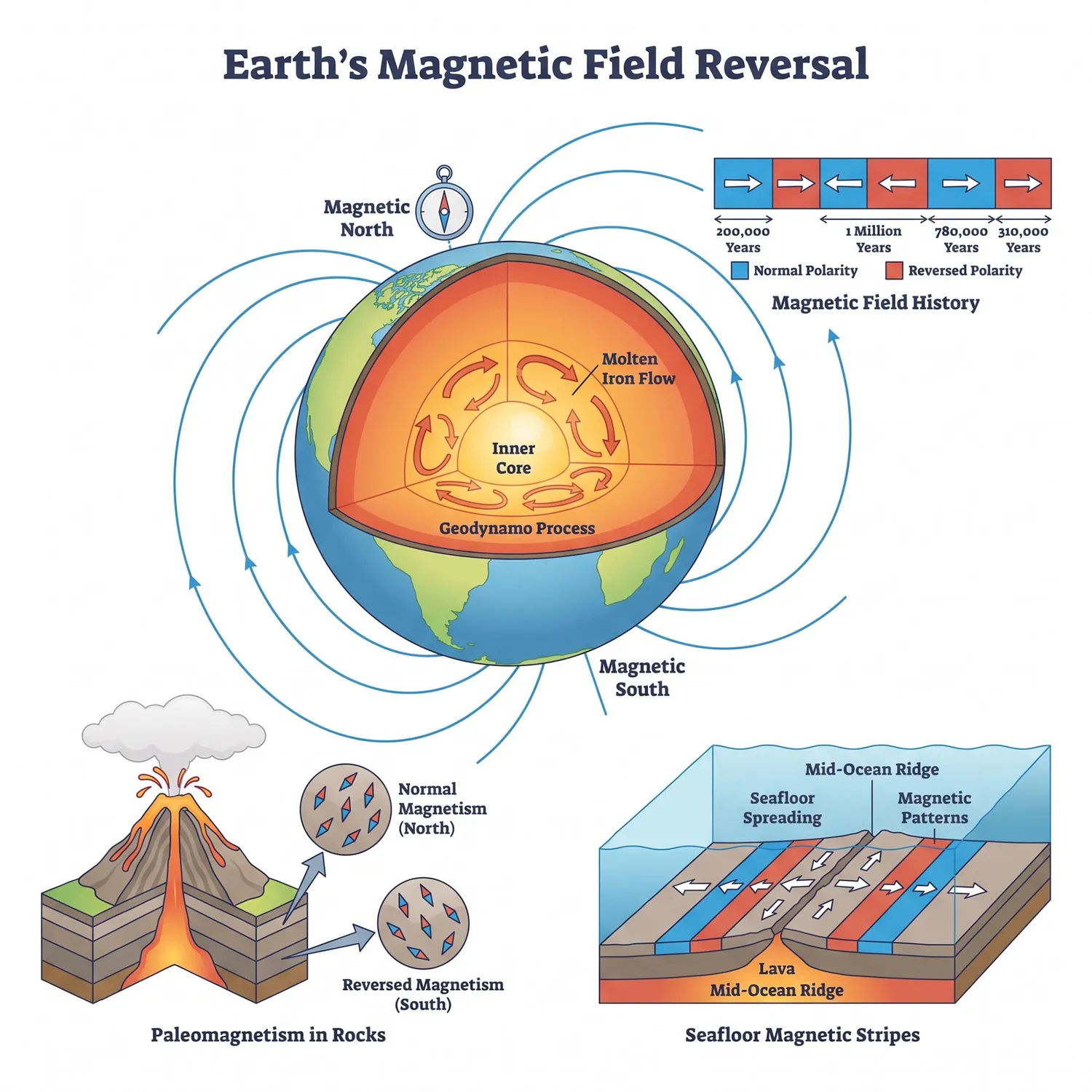
Earth's magnetic field reverses because of changes in the liquid outer core. Every few hundred thousand years, the field flips completely. A compass that pointed north would suddenly point south instead. Scientists explain that this happens because the outer core is made of molten iron and nickel. These metals move and swirl constantly, creating electric currents. These currents generate Earth's magnetic field through a process called the geodynamo.
The outer core's churning motion is not steady or predictable. Sometimes the flow patterns change dramatically. When this happens, the magnetic field weakens and can flip direction. Evidence shows that reversals occur irregularly. Some happen after 200,000 years, while others take more than a million years. Scientists cannot predict exactly when the next reversal will occur. The process can take thousands of years to complete.
How do scientists know about these ancient reversals? The answer lies in rocks. When lava erupts from a volcano and cools, it hardens into solid rock. Tiny magnetic minerals in the lava line up with Earth's magnetic field at that moment. They freeze in place like a snapshot. Scientists call this paleomagnetism. By studying rocks of different ages, researchers can read the history of Earth's magnetic field.
The most important discovery came from studying the ocean floor. Scientists found matching stripes of rock on either side of underwater mountain ranges called mid-ocean ridges. Some stripes show normal magnetism, pointing north. Other stripes show reversed magnetism, pointing south. These patterns form because new seafloor forms at the ridges. As lava erupts and cools, it records the magnetic field direction at that time. The seafloor then spreads outward in both directions. This creates mirror-image patterns of magnetic stripes. This evidence strongly supports the theory of seafloor spreading and plate tectonics.
Understanding magnetic reversals matters for several reasons. It helps scientists learn about Earth's interior structure and processes. The connection between magnetic stripes and seafloor spreading provided key evidence that Earth's surface moves. This discovery changed how we understand our planet. Magnetic reversals also affect navigation systems and may influence animal migration patterns that rely on Earth's magnetic field.
Interesting Fact: The last major magnetic reversal happened about 780,000 years ago. Scientists estimate we are overdue for another flip based on average patterns from the past.
Comprehension quiz (10 questions)
1. What causes Earth's magnetic field to reverse?
2. How often do magnetic field reversals typically occur?
3. What is paleomagnetism?
4. How do magnetic minerals in lava preserve information about Earth's magnetic field?
5. What pattern did scientists discover on the ocean floor near mid-ocean ridges?
6. Why are the magnetic stripe patterns important evidence for plate tectonics?
7. What creates Earth's magnetic field according to the passage?
8. Based on the passage, can scientists predict exactly when the next magnetic reversal will happen?
9. True or False: The last major magnetic reversal happened about 780,000 years ago.
10. True or False: Magnetic reversals have no effect on navigation systems or animal migration.
Perfect for the way you teach
- Build comprehension skills
- Auto-graded quiz
- Differentiated reading
- Read together at home
- Improve fluency
- Quiet reading time
- Reading curriculum support
- Independent practice
- Track Lexile growth