Why San Andreas Fault Forms
Interactive passage with audio narration, comprehension questions, and printable PDF.
By completing this purchase you agree to our Terms of Use and Privacy Policy. Your subscription renews automatically until you cancel. You can cancel anytime from your account settings. All sales are final and non-refundable. Digital content is available for download in your account immediately upon purchase.
What's included
Why San Andreas Fault Forms preview and details
About this printable Why San Andreas Fault Forms science reading passage, NGSS-aligned (Grades 5-8)
Sample passage and quiz from Why San Andreas Fault Forms
Reading passage and comprehension quiz preview
Why San Andreas Fault Forms
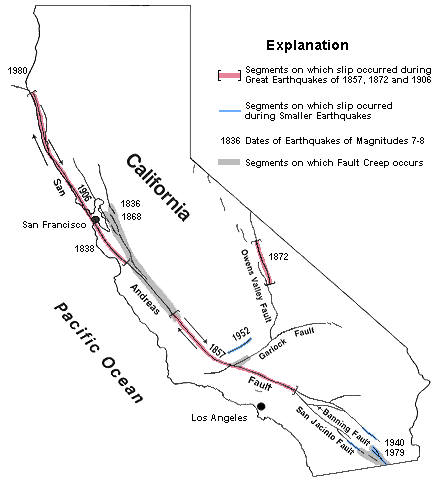
"San Andreas Fault Map" by USGS / Wikimedia Commons
The San Andreas Fault in California forms because two massive tectonic plates slide past each other. The Pacific Plate and the North American Plate meet along this famous crack in Earth's crust. Unlike subduction zones where plates collide and one dives beneath the other, these two plates grind horizontally alongside each other. Scientists call this type of boundary a transform boundary.
Evidence shows that the Pacific Plate moves northwest while the North American Plate shifts southeast. This opposite motion creates tremendous friction where the plates meet. The rocks along the fault get stuck together for years or even decades. Pressure builds up slowly as the plates continue trying to move. When the stress becomes too great, the rocks suddenly break free and slip. This rapid movement releases energy as an earthquake. Scientists observe that this process repeats over and over, which explains why California experiences frequent seismic activity.
The San Andreas Fault stretches about 1,200 kilometers through California. It runs from the Salton Sea in the south to Cape Mendocino in the north. The 1906 San Francisco earthquake occurred when a section of this fault ruptured. Scientists measured the ground displacement at up to six meters in some locations. This event demonstrated the powerful forces at work along transform boundaries. Geologists can track the fault's movement using GPS technology. Measurements show the Pacific Plate moves roughly five centimeters per year relative to the North American Plate.
Understanding why the San Andreas Fault forms helps scientists predict earthquake hazards. The lithosphere consists of rigid plates that constantly move across Earth's surface. Transform boundaries like the San Andreas represent one of three main types of plate boundaries. Unlike subduction zones that create deep trenches, transform faults produce linear valleys and offset streams. This fault system connects to other plate boundaries in the Pacific Ocean. The interactions between these boundaries shape California's landscape and create ongoing geological change.
Interesting Fact: If the Pacific Plate continues moving at its current rate, Los Angeles will eventually slide northward past San Francisco in about 15 million years!
Comprehension quiz (10 questions)
1. What type of plate boundary is the San Andreas Fault?
2. Which two tectonic plates meet at the San Andreas Fault?
3. In the passage, what does 'friction' mean?
4. What does the term 'lithosphere' refer to in the passage?
5. Why does the San Andreas Fault cause frequent earthquakes?
6. Based on the passage, how does a transform boundary differ from a subduction zone?
7. What evidence do scientists use to track the movement of the San Andreas Fault?
8. If the Pacific Plate moves about 5 centimeters per year, what might happen over millions of years?
9. True or False: At the San Andreas Fault, one plate dives beneath the other plate.
10. True or False: The 1906 San Francisco earthquake demonstrated the powerful forces at transform boundaries.
Perfect for the way you teach
- Build comprehension skills
- Auto-graded quiz
- Differentiated reading
- Read together at home
- Improve fluency
- Quiet reading time
- Reading curriculum support
- Independent practice
- Track Lexile growth