This learning resource is available in interactive and printable formats. The interactive worksheet can be played online and assigned to students. The Printable PDF version can be downloaded and printed for completion by hand.
This Grade 4-5 science passage explores the fascinating process of how wind picks up and carries sand, changing the surface of the Earth. Students will learn about important concepts such as erosion, deposition, and how landforms like sand dunes are created and shaped by the wind. The passage provides clear explanations of key vocabulary, real-world examples, and ends with an interesting science fact. Designed to meet NGSS standards, this resource includes an English and Spanish reading passage, a glossary, a multiple-choice quiz, and writing activities to deepen understanding. The content is audio integrated and ideal for use in classrooms or at home to improve science comprehension and vocabulary. Keywords such as wind, sand, erosion, deposition, and dunes are emphasized for easy reference. This resource is perfect for helping students connect scientific concepts to everyday life and develop critical thinking skills.
CONTENT PREVIEW
Expand content preview
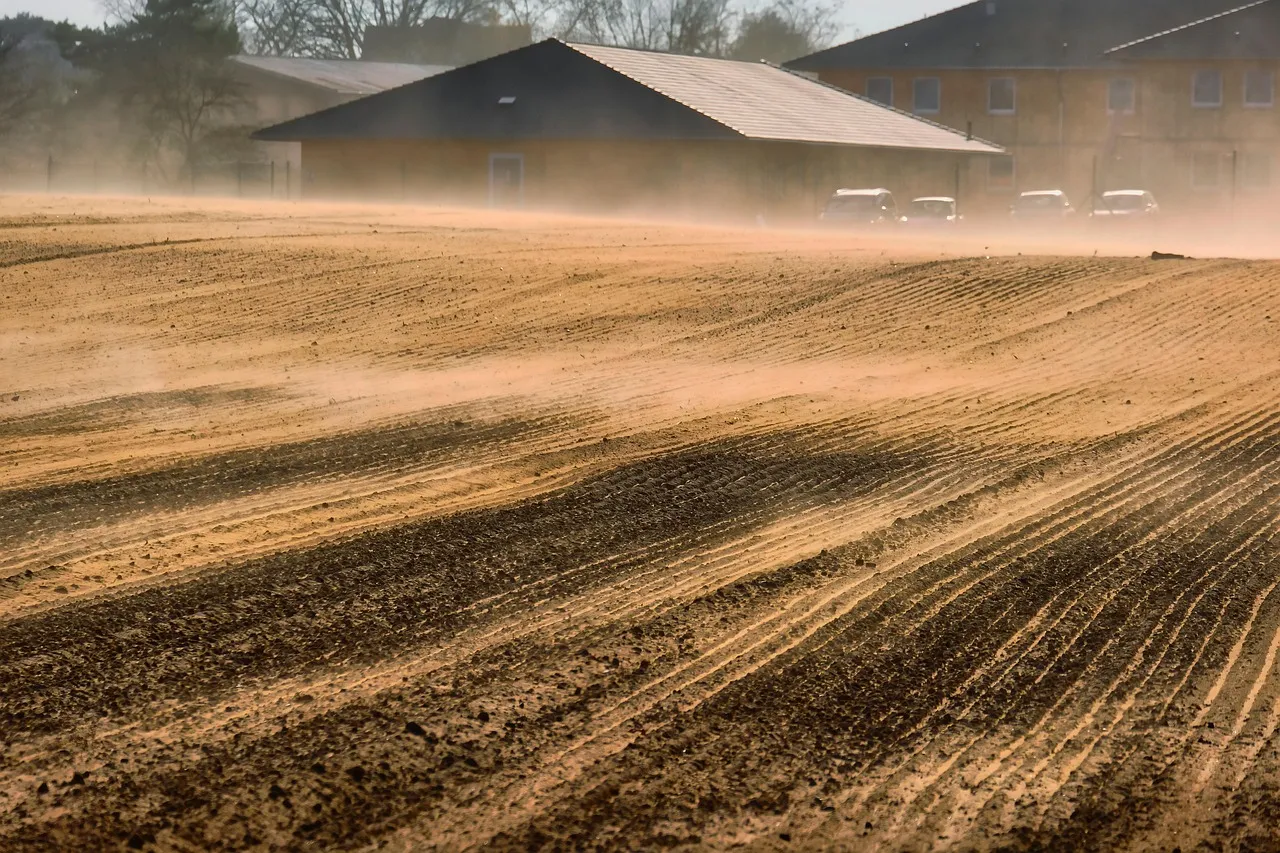
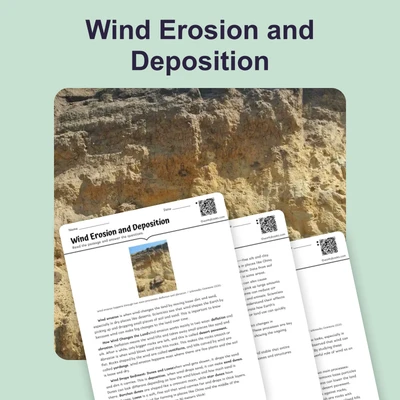
Wind erosion and deposition can also change landscapes. Image by music4life / Source: Pixabay.
Wind is moving air that can change the shape of Earth's surface. When wind blows across rocks, soil, and sand, it picks up tiny particles and carries them to new places. This process is called erosion, which means the wearing away and moving of Earth's materials.
Wind erosion happens slowly over time. As wind carries sand and small rocks, these particles act like sandpaper, scraping against larger rocks and wearing them down. In deserts, where there are few plants to hold the soil in place, wind can move huge amounts of sand. This creates sand dunes, which are hills of sand that can grow very tall. Sand dunes are always changing shape as wind continues to move the sand.
Wind can also create unusual rock formations. In places like the American Southwest, you can see rocks with strange shapes and smooth surfaces. These rocks were carved by millions of years of wind carrying sand particles that slowly wore away the softer parts of the rock. The harder parts remained, creating interesting shapes like arches and towers.
Plants help protect the land from wind erosion. Their roots hold soil in place, and their leaves block some of the wind. Without plants, wind can remove the top layer of soil, which is important for growing food.
Interesting Fact: Some sand dunes can be as tall as a 30-story building and make a humming or booming sound when the wind blows across them!
What is erosion?
Building up new mountainsWearing away and moving Earth's materialsPlanting trees and grassMaking rain clouds
What are sand dunes?
Hills made of sandTypes of plantsLarge rocksUnderground caves
How do plants help prevent erosion?
They make more windThey create sand dunesTheir roots hold soil in placeThey break down rocks
Why does wind cause more erosion in deserts?
Deserts have stronger windsThere are few plants to hold soilDesert rocks are softerDeserts have more rain
How do sand particles shape rocks?
They melt the rocksThey polish rocks smoothThey act like sandpaper and scrape rocksThey glue rocks together
What creates unusual rock formations like arches?
People carving the rocksWind erosion over millions of yearsEarthquakes shaking the groundAnimals digging tunnels
Wind erosion happens quickly in just days.
TrueFalse
What does the word 'particles' mean?
Very large bouldersTypes of plantsVery small pieces of materialStrong wind storms
Perfect For:
👩🏫 Teachers
• Reading comprehension practice
• Auto-graded assessments
• Literacy skill development
👨👩👧👦 Parents
• Reading practice at home
• Comprehension improvement
• Educational reading time
🏠 Homeschoolers
• Reading curriculum support
• Independent reading practice
• Progress monitoring
Reading Features:
📖
Reading Passage
Engaging fiction or nonfiction text
❓
Comprehension Quiz
Auto-graded questions
📊
Instant Feedback
Immediate results and scoring
📄
Printable Version
Download for offline reading
🔊
Read Aloud
Voice-over with word highlighting
Reviews & Ratings
No reviews yet. Be the first to share your experience!
Related Content
Tools and Technology in Earth Science
This middle school science reading passage explores the wide range of tools and technologies used in Earth science, from...
MS-ESS2-2MS-ESS3-2MS-ETS1-1MS-PS4-3
Scientific Inquiry in Earth Science
This passage explores scientific inquiry in Earth science for grades 6-8, aligned with NGSS standards MS-ESS1-4, MS-ESS2...
MS-ESS1-4MS-ESS2-1MS-ESS3-5SEP
What Is Earth Science?
This engaging middle school science passage introduces students to the field of Earth science, aligning with NGSS standa...
MS-ESS1MS-ESS2MS-ESS3SEP
Earth: Our Home in Space
This engaging Grade 4-5 science passage, aligned to NGSS, introduces students to Earth's special place in the solar syst...
Earth's Spheres
This middle school science passage introduces students to Earth's four major spheres: the geosphere, hydrosphere, atmosp...
MS-ESS2-4MS-ESS2-6
What Is Space Weather and How Does It Affect the Earth?
This NGSS-aligned science passage for middle school explains what space weather is and how it affects Earth. Students le...
MS-ESS2-2
Earth's Energy Balance
This engaging, NGSS-aligned science passage for grades 6–8 explores Earth's energy balance, a key process that keeps our...
MS-ESS2-6
Earth's Rotation
This middle school science passage, aligned with NGSS standard MS-ESS1-1, focuses on Earth's rotation—how Earth spins on...
MS-ESS1-1
Earth's Interior
This comprehensive passage for grades 6-8 explores Earth's layered interior, including the crust, mantle, outer core, an...
MS-ESS2-1MS-ESS2-2
Facts About Earth
This engaging science reading passage introduces Grade 4 and 5 students to Earth, our home planet. Aligned with NGSS sta...
Meteorite Impacts on Earth
This engaging science reading passage for Grades 4-5 explores meteorite impacts on Earth, aligning with NGSS standards. ...
Venus: Earth's Twin?
This comprehensive science passage for grades 6-8 examines Venus—often called Earth's twin—by exploring its similarities...
MS-ESS1-2MS-ESS1-3
Earth Changes Over Millions of Years
This engaging, audio-integrated science passage for Grade 4-5 students explores how Earth has changed over millions of y...
Earth's Quick and Slow Changes
In 'Earth's Quick and Slow Changes,' students categorize 12 Earth events by their speed of occurrence, enhancing underst...
Earth's Moon Facts
This engaging science passage, 'The Moon: Earth's Companion,' is designed for Grade 4-5 students and aligns with NGSS ge...
Earth: Our Home Planet
This comprehensive science passage for grades 6-8 explores Earth’s unique characteristics and the interconnected systems...
MS-ESS1-2
Earth's Revolution
This middle school science passage explores the science behind Earth's revolution around the Sun, closely aligned with N...
MS-ESS1-1
Earth's Seasons
This comprehensive reading passage for grades 6-8 explains why Earth has seasons, revealing the scientific mechanisms be...
MS-ESS1-1
Earth's Place in the Universe
This reading passage explains Earth's place in the universe, supporting NGSS 1-ESS1-1. It describes how Earth is one of ...
1-ESS1-1
Aphelion and Perihelion
This engaging reading passage, 'Aphelion and Perihelion,' delves into the fascinating aspects of Earth's elliptical orbi...
MS-ESS1-1: DEVELOP AND USE A MODEL OF THE EARTH-SUN-MOON SYSTEM TO DESCRIBE THE CYCLIC PATTERNS OF LUNAR PHASESECLIPSES OF THE SUN AND MOONAND SEASONS.