How People Prevent Erosion — Reading Comprehension
Rate this|
1
Premium Resource
Present
Present in classroom. No work saved
Assign
Classroom with student accounts, Track progress
Quick Play
No student accounts, assign with a link
Grades
3
4
5
6
PRINT+DIGITAL RESOURCE
This learning resource is available in interactive and printable formats. The interactive worksheet can be played online and assigned to students. The Printable PDF version can be downloaded and printed for completion by hand.
This Grade 4-5 science passage focuses on 'Ways to Prevent Erosion Problems' and aligns with NGSS standards. Students will discover how erosion affects the environment, why it is important to protect soil, and what methods people and nature use to stop erosion. Key scientific terms such as erosion, soil, roots, vegetation, mulch, and terrace are explained and bolded for clarity. The passage includes real-world examples and ends with an interesting science fact. The content is audio integrated and comes with a glossary, reading comprehension questions, writing activities, and a full Spanish translation. This resource helps students connect science to everyday life and supports vocabulary building, scientific thinking, and language development.
CONTENT PREVIEW
Expand content preview
Ways-to-Prevent-Erosion-Problems
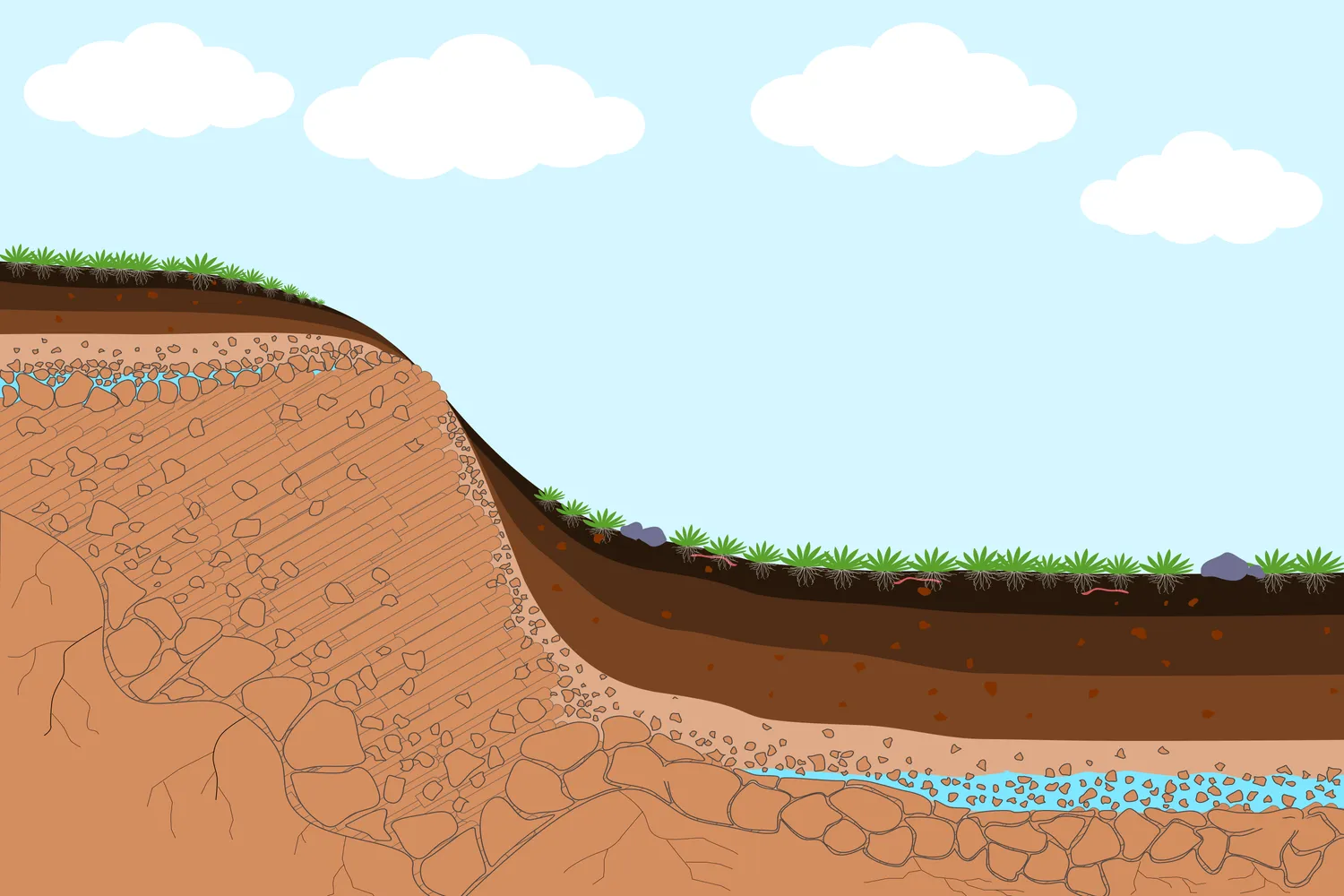
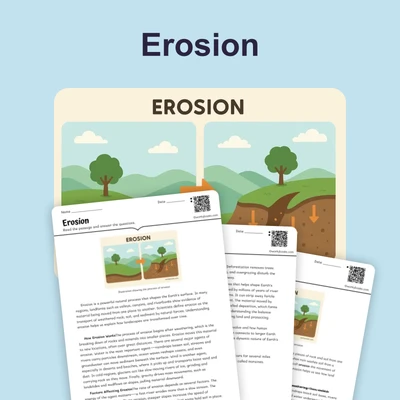
Erosion is the process of soil and rock being worn away and moved to new places by wind or water. Erosion can damage farmland, cause landslides, and harm buildings and roads. People have developed many methods to prevent or slow down erosion and protect the land.
One important way to prevent erosion is by planting vegetation, which means plants like grass, trees, and shrubs. Plant roots hold soil in place like anchors hold a boat steady. When rain falls, the leaves and stems slow down the water so it doesn't rush across the ground and carry soil away. Farmers often plant cover crops between growing seasons to keep soil from washing or blowing away.
On steep hills and mountains, people build terraces, which are flat steps cut into the slope. Terraces work like stairs that catch rainwater and soil before they can rush downhill. This method has been used for thousands of years in places where people farm on mountainsides.
To stop wind erosion, people plant rows of trees or build fences called windbreaks. These barriers block strong winds and protect soil from being blown away. In cities, people build walls called retaining walls to hold soil in place on slopes.
Interesting Fact: The Dust Bowl of the 1930s taught Americans important lessons about erosion prevention. After terrible dust storms destroyed farmland, the government planted over 200 million trees in long rows across the Great Plains to stop wind erosion!
What is erosion?
Planting trees and grassSoil being worn away and movedBuilding walls on hillsGrowing crops on farms
How do plant roots help prevent erosion?
They make the soil wetThey hold soil in placeThey block the windThey create terraces
What are terraces used for?
Blocking wind on flat landPlanting trees in rowsCatching water on steep slopesBuilding houses on mountains
Why do farmers plant cover crops?
To keep soil from washing awayTo make the land steeperTo create more windTo build terraces
What do windbreaks protect soil from?
Rain and floodingAnimals eating plantsStrong winds blowing it awayToo much sunlight
How do terraces work like stairs?
They help people climb mountainsThey catch water at each levelThey are made of woodThey block the wind
Erosion can damage farmland and buildings.
TrueFalse
What does vegetation mean?
Flat steps on a hillPlants like grass and treesStrong winds that blow soilWalls that hold soil
Perfect For:
👩🏫 Teachers
• Reading comprehension practice
• Auto-graded assessments
• Literacy skill development
👨👩👧👦 Parents
• Reading practice at home
• Comprehension improvement
• Educational reading time
🏠 Homeschoolers
• Reading curriculum support
• Independent reading practice
• Progress monitoring
Reading Features:
📖
Reading Passage
Engaging fiction or nonfiction text
❓
Comprehension Quiz
Auto-graded questions
📊
Instant Feedback
Immediate results and scoring
📄
Printable Version
Download for offline reading
🔊
Read Aloud
Voice-over with word highlighting
Reviews & Ratings
No reviews yet. Be the first to share your experience!
Related Content
Tools and Technology in Earth Science
This middle school science reading passage explores the wide range of tools and technologies used in Earth science, from...
MS-ESS2-2MS-ESS3-2MS-ETS1-1MS-PS4-3
Scientific Inquiry in Earth Science
This passage explores scientific inquiry in Earth science for grades 6-8, aligned with NGSS standards MS-ESS1-4, MS-ESS2...
MS-ESS1-4MS-ESS2-1MS-ESS3-5SEP
What Is Earth Science?
This engaging middle school science passage introduces students to the field of Earth science, aligning with NGSS standa...
MS-ESS1MS-ESS2MS-ESS3SEP
Earth: Our Home in Space
This engaging Grade 4-5 science passage, aligned to NGSS, introduces students to Earth's special place in the solar syst...
Earth's Spheres
This middle school science passage introduces students to Earth's four major spheres: the geosphere, hydrosphere, atmosp...
MS-ESS2-4MS-ESS2-6
What Is Space Weather and How Does It Affect the Earth?
This NGSS-aligned science passage for middle school explains what space weather is and how it affects Earth. Students le...
MS-ESS2-2
Earth's Energy Balance
This engaging, NGSS-aligned science passage for grades 6–8 explores Earth's energy balance, a key process that keeps our...
MS-ESS2-6
Earth's Rotation
This middle school science passage, aligned with NGSS standard MS-ESS1-1, focuses on Earth's rotation—how Earth spins on...
MS-ESS1-1
Earth's Land and Water
This 250-word reading passage introduces fourth-grade students to the fundamental concept of how land and water are dist...
NGSS 4-ESS2-2ESS2.B
Earth's Interior
This comprehensive passage for grades 6-8 explores Earth's layered interior, including the crust, mantle, outer core, an...
MS-ESS2-1MS-ESS2-2
Facts About Earth
This engaging science reading passage introduces Grade 4 and 5 students to Earth, our home planet. Aligned with NGSS sta...
Meteorite Impacts on Earth
This engaging science reading passage for Grades 4-5 explores meteorite impacts on Earth, aligning with NGSS standards. ...
Earth Changes Over Millions of Years
This engaging, audio-integrated science passage for Grade 4-5 students explores how Earth has changed over millions of y...
Venus: Earth's Twin?
This comprehensive science passage for grades 6-8 examines Venus—often called Earth's twin—by exploring its similarities...
MS-ESS1-2MS-ESS1-3
Volcano Patterns on Earth
This Grade 4 science reading passage introduces students to volcano patterns on Earth, aligned with NGSS standard 4-ESS2...
NGSS 4-ESS2-2
Earth's Quick and Slow Changes
In 'Earth's Quick and Slow Changes,' students categorize 12 Earth events by their speed of occurrence, enhancing underst...
Earth: Our Home Planet
This comprehensive science passage for grades 6-8 explores Earth’s unique characteristics and the interconnected systems...
MS-ESS1-2
Earth's Moon Facts
This engaging science passage, 'The Moon: Earth's Companion,' is designed for Grade 4-5 students and aligns with NGSS ge...
Earth's Revolution
This middle school science passage explores the science behind Earth's revolution around the Sun, closely aligned with N...
MS-ESS1-1
Earthquake Patterns on Earth
This engaging 250-word reading passage introduces fourth-grade students to earthquake patterns on Earth, aligned with NG...