Famous Discoveries of Early Humans
Standards-aligned learning resource — interactive and printable.
By completing this purchase you agree to our Terms of Use and Privacy Policy. Your subscription renews automatically until you cancel. You can cancel anytime from your account settings. All sales are final and non-refundable. Digital content is available for download in your account immediately upon purchase.
What's included
Famous Discoveries of Early Humans preview and details
About this worksheet
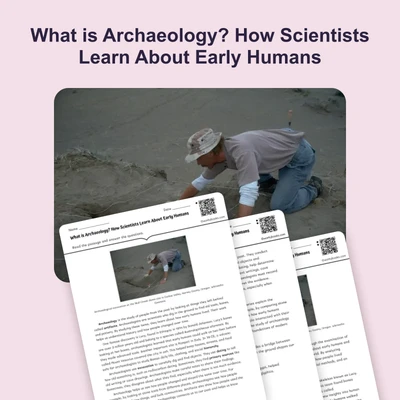
This comprehensive History Resource is expertly designed to help students master the remarkable archaeological finds and scientific methods used to uncover early human history.
Use this engaging material to take students on a journey through time, exploring groundbreaking discoveries that changed how scientists understand our past, including Mary and Louis Leakey's fossil excavations, the Turkana Boy skeleton, and Ötzi the Iceman.
About this Resource
The material provides a clear, conceptual framework using accessible language to make complex historical and paleoanthropological topics easy to understand. Each topic features differentiated reading passages with two leveled versions (Simplified and Detailed) to support mixed-ability classrooms, available in both English and Spanish.
The topics included in this resource are:
- Mary Leakeys at Olduvai Gorge
- Turkana Boy Discovery
- Ötzi the Iceman
This Phygital — Print and Interactive Version — gives you more options in your classroom. Available as both a print-and-go worksheet and an interactive digital lesson via QR code, it ensures a smooth, customized, and engaging learning experience with features like built-in read-aloud audio, auto-graded quizzes, and digital flashcards.
What's Included:
- Differentiated Reading Passages: Leveled texts (Simplified and Detailed) in English and Spanish detailing three famous early human discoveries, providing rich evidence about hominid development, ancient technology, and adaptation.
- Glossaries: Dedicated sections defining key vocabulary words such as Archaeologists, Hominids, Australopithecus boisei, Stratigraphy, Paleoanthropology, Homo erectus, Radiometric Dating, Fossil, Mummy, and Copper Age.
- Quizzes: 8-question multiple-choice assessments for each topic to evaluate student comprehension of the text and vocabulary.
- Writing Activities: Open-ended comprehension and analytical questions that challenge students to synthesize details and explain archaeological significance in their own words.
- Graphic Organizers: Custom Cause-and-Effect Tables and Chronological Development Timelines to help students visually structure historical events, developments, and their broader importance.
- Answer Keys: Complete direct and suggested answers for all quiz questions, writing activities, and tables to save you valuable grading time.
Learning Objectives
Students will be able to:
- Explain how major discoveries—such as the Australopithecus boisei skull, the Laetoli footprints, the Turkana Boy, and Ötzi the Iceman—provided vital evidence regarding early human physical traits, behavior, and evolution.
- Differentiate between scientific dating techniques, specifically understanding how stratigraphy relies on layers of earth and how radiometric dating utilizes carbon isotopes or radioactive materials to establish timelines.
- Analyze the impact of geographic and environmental factors on the preservation of ancient remains, referencing the volcanic ash of Laetoli, the rock sediment of the Great Rift Valley, and the high-altitude ice of the Alps.
- Identify early human innovations and adaptations, including stone tools, early copper metalworking, animal-skin clothing, and evidence of hunting or social structures.
- Recognize the critical importance of archaeological context and primary sources when reconstructuring past human migration, health, conflict, and daily life.
Perfect for the way you teach
- Assign in one click
- Track progress per student
- Auto-graded results
- Practice at home
- Print or do on-screen
- Build skill mastery
- Standards-aligned
- Self-paced
- Ready-to-use today