13th Amendment
Interactive passage with audio narration, comprehension questions, and printable PDF.
By completing this purchase you agree to our Terms of Use and Privacy Policy. Your subscription renews automatically until you cancel. You can cancel anytime from your account settings. All sales are final and non-refundable. Digital content is available for download in your account immediately upon purchase.
What's included
13th Amendment preview and details
About this printable 13th Amendment reading passage (Grades 6-8)
Sample passage and quiz from 13th Amendment
Reading passage and comprehension quiz preview
13th Amendment
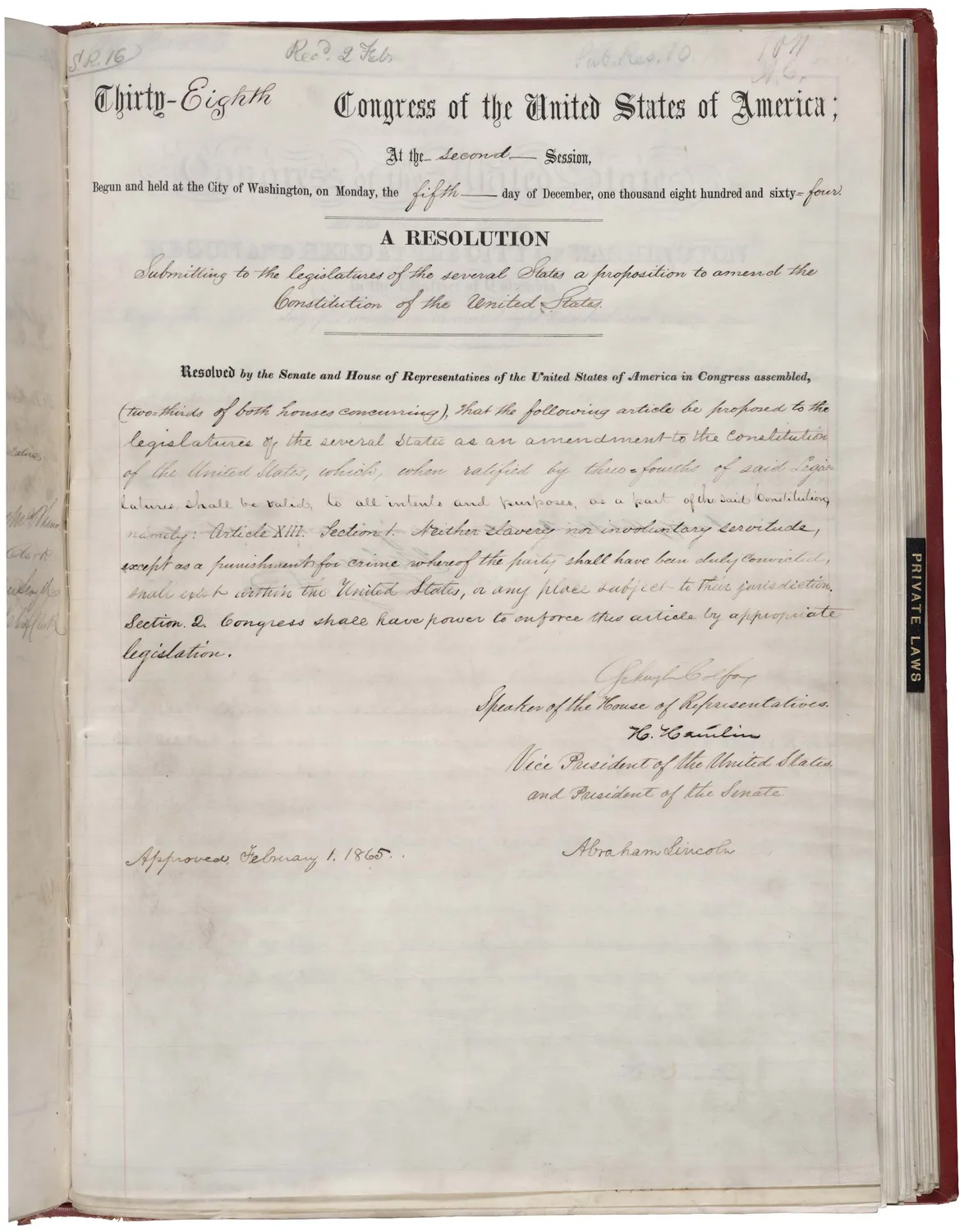
"13th Amendment Pg1of1 AC" by Nationalbdgf Archives of the Unites States
Source: Wikimedia Commons (Public domain).
The 13th Amendment to the United States Constitution was ratified in 1865 and brought a permanent end to slavery in the country. Before its passage, millions of African Americans were forced to work as slaves, denied their freedom and basic rights. The struggle to abolish slavery was a central issue of the American Civil War, which divided the nation and led to violent conflict between the North and South.
The problem of slavery had existed since the founding of the United States. While the Declaration of Independence spoke of liberty for all, the reality was that enslaved people had no legal rights. Some states, especially in the South, depended on slavery for their economy. This created a sharp contrast between states that wanted to keep slavery and those that sought abolition, or the complete ending of slavery. As tensions grew, debates over whether new territories would allow slavery led to major conflicts in Congress.
The Civil War, fought from 1861 to 1865, was the result of these unresolved issues. President Abraham Lincoln, though cautious at first, came to see emancipation—the freeing of enslaved people—as a necessary step to win the war and reunite the nation. He issued the Emancipation Proclamation in 1863, which declared freedom for slaves in rebelling states, but this did not end slavery everywhere. A more lasting solution was needed to guarantee rights for all people.
In response, Congress passed the 13th Amendment. An amendment is a formal change to the Constitution. This amendment stated, “Neither slavery nor involuntary servitude, except as a punishment for crime…shall exist within the United States.” Supporters of the amendment argued that true equality could not exist while slavery remained legal. However, not everyone agreed. Some Southern states resisted, fearing loss of economic power and social order. After much debate and political pressure, enough states ratified the amendment by December 1865, making it law across the nation.
The passage of the 13th Amendment was a turning point in American history. It was a solution to a centuries-old problem that had divided the country and caused untold suffering. Yet, the challenges did not end with its adoption. Many freed people still faced discrimination, lack of economic opportunity, and new laws that tried to limit their rights. The amendment was an important victory, but the nation’s struggle for true racial equality and citizenship for all would continue during the era known as Reconstruction and beyond.
Although the 13th Amendment did not solve every problem, it set a foundation for future change. Later amendments, such as the 14th and 15th, continued the work by guaranteeing citizenship and voting rights. The 13th Amendment remains a symbol of the nation’s commitment to freedom and the ongoing journey toward justice.
Interesting Fact: The original document of the 13th Amendment was signed by the Speaker of the House and Vice President before being sent to the states for approval.
Comprehension quiz (8 questions)
1. What year was the 13th Amendment ratified?
2. Which President issued the Emancipation Proclamation?
3. What war led to the 13th Amendment?
4. Why did some Southern states resist the amendment?
5. What did the amendment make illegal?
6. What continued after the amendment passed?
7. The 13th Amendment ended slavery. True or false?
8. What does 'abolition' mean?
Perfect for the way you teach
- Build comprehension skills
- Auto-graded quiz
- Differentiated reading
- Read together at home
- Improve fluency
- Quiet reading time
- Reading curriculum support
- Independent practice
- Track Lexile growth