This learning resource is available in interactive and printable formats. The interactive worksheet can be played online and assigned to students. The Printable PDF version can be downloaded and printed for completion by hand.
This rigorous, standards-aligned reading passage explores the development, challenges, and impact of the 15th Amendment, which was ratified in 1870 to protect African American men's right to vote in the United States. Students will analyze the historical context, the role of Reconstruction, and the ways in which the amendment aimed to address the problems of discrimination, disenfranchisement, and inequality following the Civil War. The passage supports critical thinking and historical reasoning, integrating key vocabulary such as amendment, suffrage, and prohibition, and aligns with HSS 8.11.1 and CCSS.RI.6-8.1, RI.6-8.2. Differentiated versions and Spanish translations are included to support diverse learners. Additional activities include multiple-choice and writing questions, as well as graphic organizers and a timeline to deepen student understanding. This resource is ideal for students examining the ongoing struggle for civil rights and the significance of constitutional change in American society, and includes read aloud audio and Spanish translation.
CONTENT PREVIEW
Expand content preview
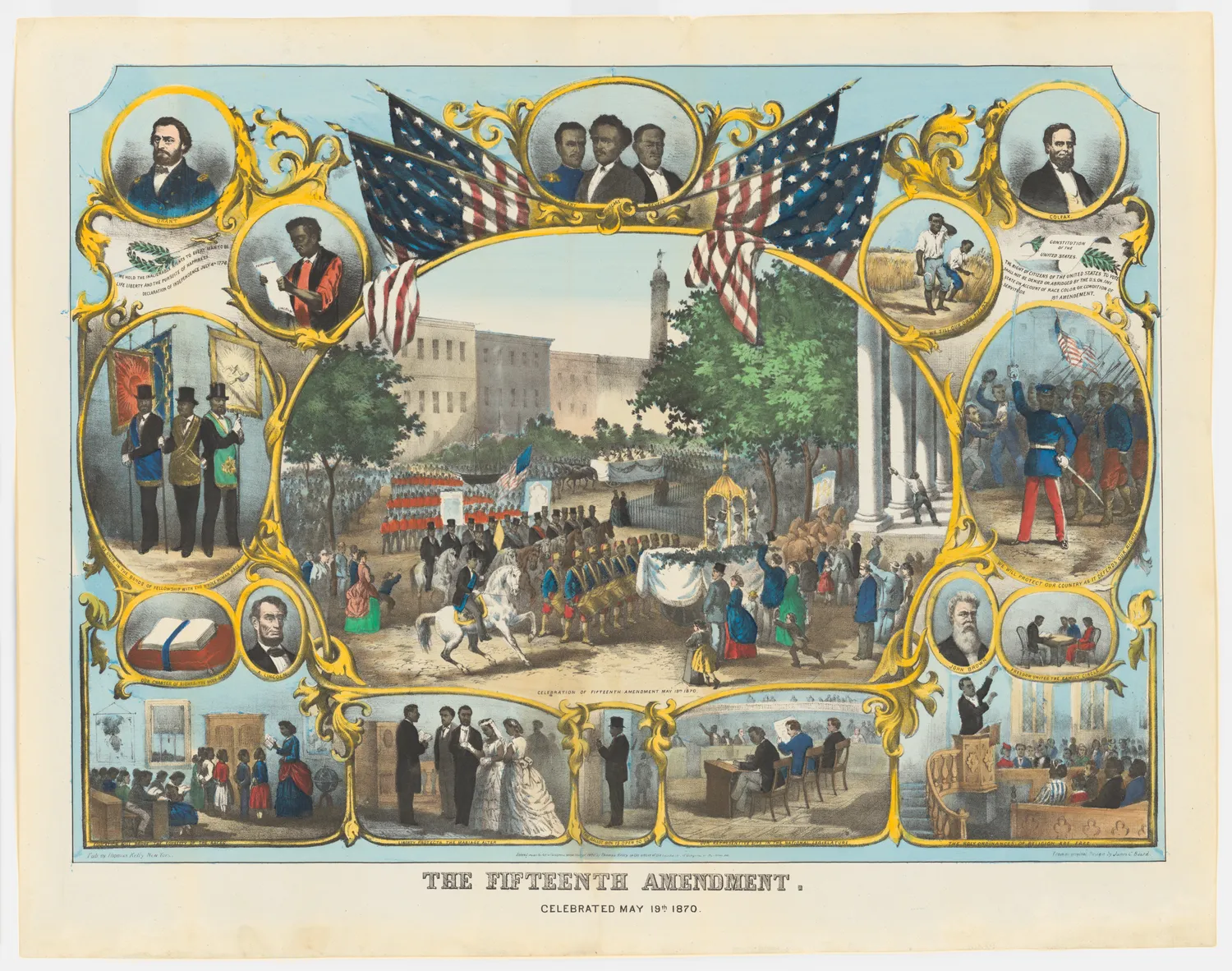
"Fifteenth Amendment by an unidentified artist after James Carter Beard, 1870, hand-colored lithograph on paper, from the National Portrait Gallery - NPG-8700112B 1" by Unidentified artist after James Carter Beard. Source: Wikimedia Commons (Public domain)
The 15th Amendment to the United States Constitution, ratified in 1870, was a significant milestone in American history. This amendment stated that the right to vote could not be denied or limited by the United States or any state because of a person’s race, color, or previous condition of servitude. The amendment was designed to address the injustices faced by African American men, who had been denied the right to vote even after the end of the Civil War.
Before the 15th Amendment, most African Americans, especially those who had been enslaved, were excluded from suffrage, or the right to vote. Although the 13th and 14th Amendments had ended slavery and granted citizenship, many states still created barriers to prevent African Americans from participating in elections. These barriers included unfair literacy tests, poll taxes, and threats of violence. Therefore, the problem was not just legal restrictions, but also social and economic pressures that limited true voting rights.
The Reconstruction period after the Civil War was a time of hope and uncertainty. Congress wanted to rebuild the nation and ensure that newly freed people could take part in democracy. The 15th Amendment was a solution meant to guarantee equal voting rights for all men, regardless of race or history of enslavement. However, some states strongly resisted these changes. They found ways to continue disenfranchisement, or the removal of the right to vote, through new laws and intimidation.
Despite the amendment’s promise, enforcement was inconsistent. Federal legislation was needed to try to protect voters, but many local governments ignored or resisted these rules. The federal government sometimes sent troops to the South to protect African American voters, but when this support ended, states quickly found new methods to limit participation. For many decades after 1870, African American men continued to face obstacles, and the amendment’s goals were not fully realized until much later, especially with the passage of the Voting Rights Act of 1965.
The 15th Amendment’s legacy is a reminder of both progress and ongoing challenges. It showed that constitutional change could open new doors for democracy, but also that laws alone could not immediately solve deep social divisions or ensure equality. Historians examine the evidence of continued discrimination to understand why further reforms were necessary and how the struggle for civil rights continued into the 20th century.
Interesting Fact: The 15th Amendment only protected voting rights for men. Women of all races would not gain the right to vote in federal elections until the 19th Amendment was passed in 1920.
What year was the 15th Amendment ratified?
1870186519201965
Which group did the 15th Amendment aim to help?
African American menAll womenChildrenImmigrants
What was one barrier to voting?
Literacy testsFree landPublic schoolsOpen borders
Why was federal legislation needed?
States ignored new rulesTo lower taxesTo end the Civil WarTo create new states
How did some states continue disenfranchisement?
New laws and intimidationBuilding schoolsLowering taxesIncreasing pay
What was the significance of the 15th Amendment?
Expanded voting rightsEnded all warsBuilt new citiesStarted Reconstruction
The 15th Amendment gave women the right to vote.
TrueFalse
What is suffrage?
The right to voteA government jobA reading testA new law
Perfect For:
👩🏫 Teachers
• Reading comprehension practice
• Auto-graded assessments
• Literacy skill development
👨👩👧👦 Parents
• Reading practice at home
• Comprehension improvement
• Educational reading time
🏠 Homeschoolers
• Reading curriculum support
• Independent reading practice
• Progress monitoring
Reading Features:
📖
Reading Passage
Engaging fiction or nonfiction text
❓
Comprehension Quiz
Auto-graded questions
📊
Instant Feedback
Immediate results and scoring
📄
Printable Version
Download for offline reading
🔊
Read Aloud
Voice-over with word highlighting
Reviews & Ratings
No reviews yet. Be the first to share your experience!
Related Content
Lincoln's Ten Percent Plan
This passage explores the contrasting Reconstruction plans presented by President Abraham Lincoln and the U.S. Congress ...
HSS 8.11.1RI.6-8.1RI.6-8.6
13th Amendment
This history reading passage explores the 13th Amendment of 1865, which ended slavery throughout the United States. Stud...
HSS 8.11.1RI.6-8.1RI.6-8.6
14th Amendment
This passage provides an in-depth overview of the 14th Amendment, ratified in 1868, which granted citizenship to all per...
HSS 8.11.1RI.6-8.1RI.6-8.3
President Andrew Johnson
This history reading passage explores the presidency of Andrew Johnson, who took office after Abraham Lincoln's assassin...
HSS 8.11.1RI.6-8.1RI.6-8.3
Pocahontas: Myth vs. Historical Reality
This passage explores the nuanced history of Pocahontas, moving beyond the myth made popular by movies and stories. Stud...
HSS 5.3.1RI.6-8.1RI.6-8.8
Roger Williams Religious Freedom
This passage explores the life and legacy of Roger Williams, a key figure in Colonial America who was banished from Mass...
HSS 5.4.38.2.2RI.6-8.1RI.6-8.6
Benjamin Franklin in Colonial America
This U.S. History reading passage explores the life and influence of Benjamin Franklin, a key colonial leader whose idea...
HSS 5.58.1RI.6-8.1RI.6-8.3
Colonial Apprenticeship System
This comprehensive passage explores the Colonial Apprenticeship System and its role in education during Colonial America...
HSS 5.4.6RI.6-8.1RI.6-8.2
Cities in Colonial America
This engaging U.S. history reading passage explores the rise of colonial American cities such as Boston, Philadelphia, a...
HSS 5.4.68.1RI.6-8.1RI.6-8.7
Frontier Life in Colonial America
This passage examines the realities of frontier life in colonial America, highlighting both the promise and peril faced ...
HSS 5.4.68.1RI.6-8.1RI.6-8.2
Colonial Printing Press
This passage explores the revolutionary impact of the colonial printing press in America, examining how it enabled the s...
HSS 5.58.1RI.6-8.1RI.6-8.2
Mercy Otis Warren: Political Writer
This passage explores the life and impact of Mercy Otis Warren, a significant political writer during the American Revol...
HSS 5.6.38.1RI.6-8.1RI.6-8.6
Crispus Attucks
This comprehensive U.S. History reading passage examines the life and legacy of Crispus Attucks, the first person killed...
HSS 5.5.38.1RI.6-8.1RI.6-8.3
Lewis and Clark Expedition
This comprehensive U.S. History reading passage explores the Lewis and Clark Expedition (1804-1806), a pivotal journey l...
HSS 8.4.18.8.2RI.6-8.1RI.6-8.3
Exodusters
This passage explores the migration of Exodusters—African Americans who left the South in the 1870s to escape discrimina...
HSS 8.12.1RI.6-8.1RI.6-8.2
Uncle Tom's Cabin
This passage explores the impact of Harriet Beecher Stowe’s Uncle Tom’s Cabin on American society in the 1850s. It exami...
HSS 8.9.48.10.2RI.6-8.1RI.6-8.6
Dred Scott Decision
This rigorous history reading passage delves into the 1857 Dred Scott Decision, a pivotal moment in the lead-up to the C...
HSS 8.9.48.10.3RI.6-8.1RI.6-8.8
Election of 1860
This passage explores Abraham Lincoln’s election in 1860 and the critical reactions from Southern states, which set the ...
HSS 8.10.4RI.6-8.1RI.6-8.6
Southern Secession
This passage explores the significant moment in U.S. history when seven Southern states seceded from the Union after Abr...