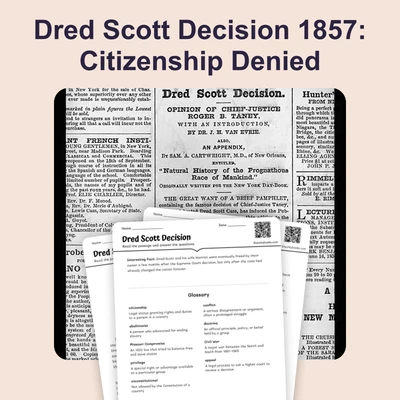
14th Amendment
Interactive passage with audio narration, comprehension questions, and printable PDF.
By completing this purchase you agree to our Terms of Use and Privacy Policy. Your subscription renews automatically until you cancel. You can cancel anytime from your account settings. All sales are final and non-refundable. Digital content is available for download in your account immediately upon purchase.
What's included
14th Amendment preview and details
About this printable 14th Amendment reading passage (Grades 6-8)
Sample passage and quiz from 14th Amendment
Reading passage and comprehension quiz preview
14th Amendment
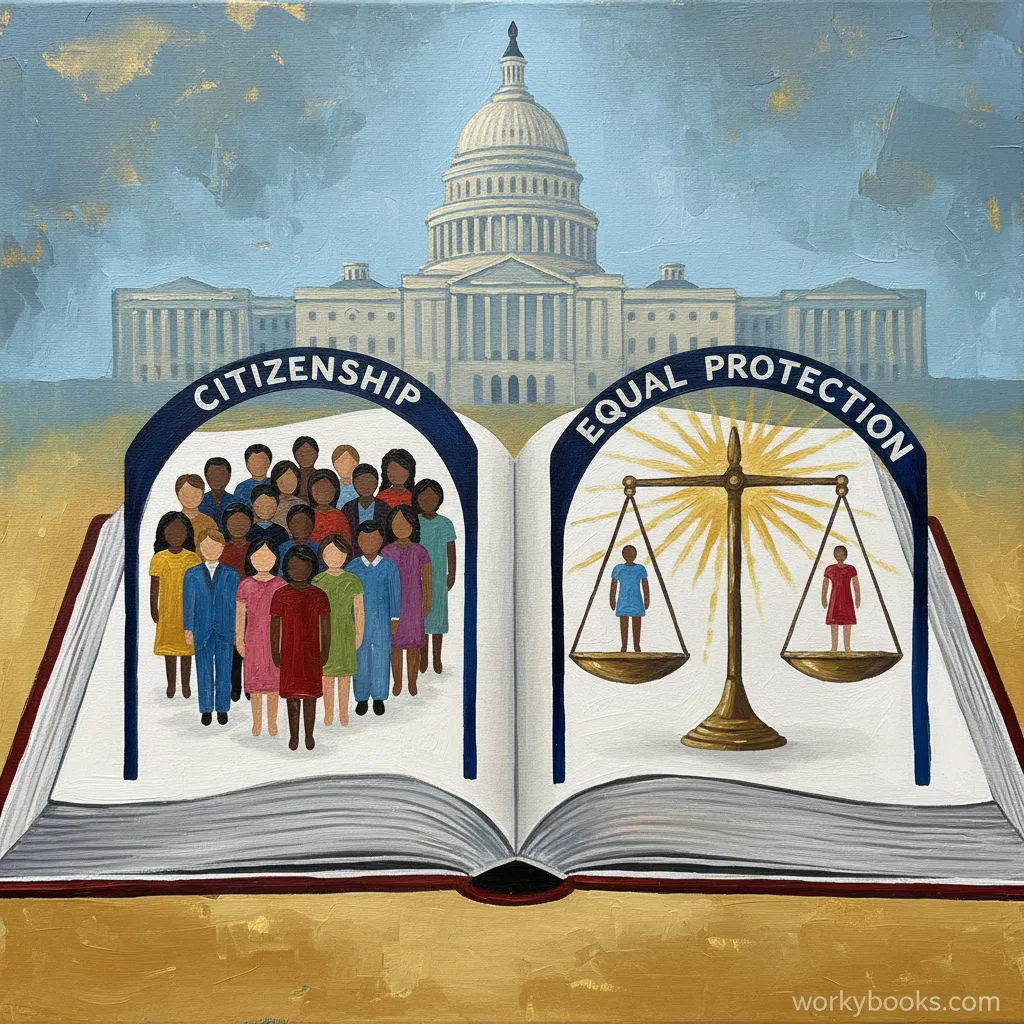
The 14th Amendment to the United States Constitution was adopted in 1868, following the end of the Civil War. This period, known as Reconstruction, was a time when the nation struggled to reunite and address the rights of formerly enslaved people. Before this amendment, there was intense debate over who should be considered a citizen and what rights should be protected by law.
The key problem after the Civil War was the status of millions of newly freed African Americans. Southern states often passed Black Codes, which limited the rights of Black people and attempted to maintain systems similar to slavery. The federal government recognized that a solution was needed to guarantee rights for all citizens, regardless of race or previous condition of servitude.
As a response, Congress proposed the 14th Amendment. The amendment declared that all persons born or naturalized in the United States are citizens of the country and of the state where they live. This crucial change meant that formerly enslaved people were now granted citizenship, overturning the 1857 Dred Scott decision, which had denied citizenship to African Americans.
The 14th Amendment also introduced two vital legal protections. First, it guaranteed equal protection under the law, meaning that state laws could not unfairly discriminate against individuals or groups. Second, it established due process rights, which required that legal proceedings must be fair and follow established rules.
Despite its clear language, the amendment sparked conflicts and resistance, especially in the South. Some states found ways to avoid fully enforcing its guarantees, leading to years of legal battles and further legislation. Over time, the Supreme Court became an important interpreter of the amendment, deciding cases that defined the meaning of civil rights and the scope of federal power.
The 14th Amendment has had a lasting impact on American society. It has served as the foundation for landmark Supreme Court decisions, such as Brown v. Board of Education, which ended racial segregation in public schools. The amendment’s principles continue to shape debates about equality, justice, and the responsibilities of government.
Interesting Fact: The 14th Amendment is cited more often in Supreme Court cases than any other part of the Constitution, showing its ongoing influence on American law and society.
Comprehension quiz (8 questions)
1. When was the 14th Amendment adopted?
2. What period followed the Civil War?
3. Which court case did the amendment overturn?
4. Why did Congress create the 14th Amendment?
5. What did 'equal protection' mean?
6. How did some southern states react?
7. The 14th Amendment still matters today. True or false?
8. What is 'due process'?
Perfect for the way you teach
- Build comprehension skills
- Auto-graded quiz
- Differentiated reading
- Read together at home
- Improve fluency
- Quiet reading time
- Reading curriculum support
- Independent practice
- Track Lexile growth