This learning resource is available in interactive and printable formats. The interactive worksheet can be played online and assigned to students. The Printable PDF version can be downloaded and printed for completion by hand.
This history reading passage explores the presidency of Andrew Johnson, who took office after Abraham Lincoln's assassination during a critical period in U.S. history. The text examines Johnson's Reconstruction policies, his frequent use of the veto, and his ongoing conflict with Congress over how to reunite the nation and secure civil rights for freed people. Students learn to analyze causation, interpret evidence, and understand the significance of government policies in shaping American society. The passage meets HSS 8.11.1 and CCSS.RI.6-8.1, RI.6-8.3 standards. It includes a read aloud audio feature, a Spanish translation, and a differentiated (simplified) version for accessibility. Activities encourage close reading, critical thinking, and analysis of historical events and vocabulary. This passage is ideal for students learning about U.S. history, the Civil War, and the complexities of Reconstruction.
CONTENT PREVIEW
Expand content preview
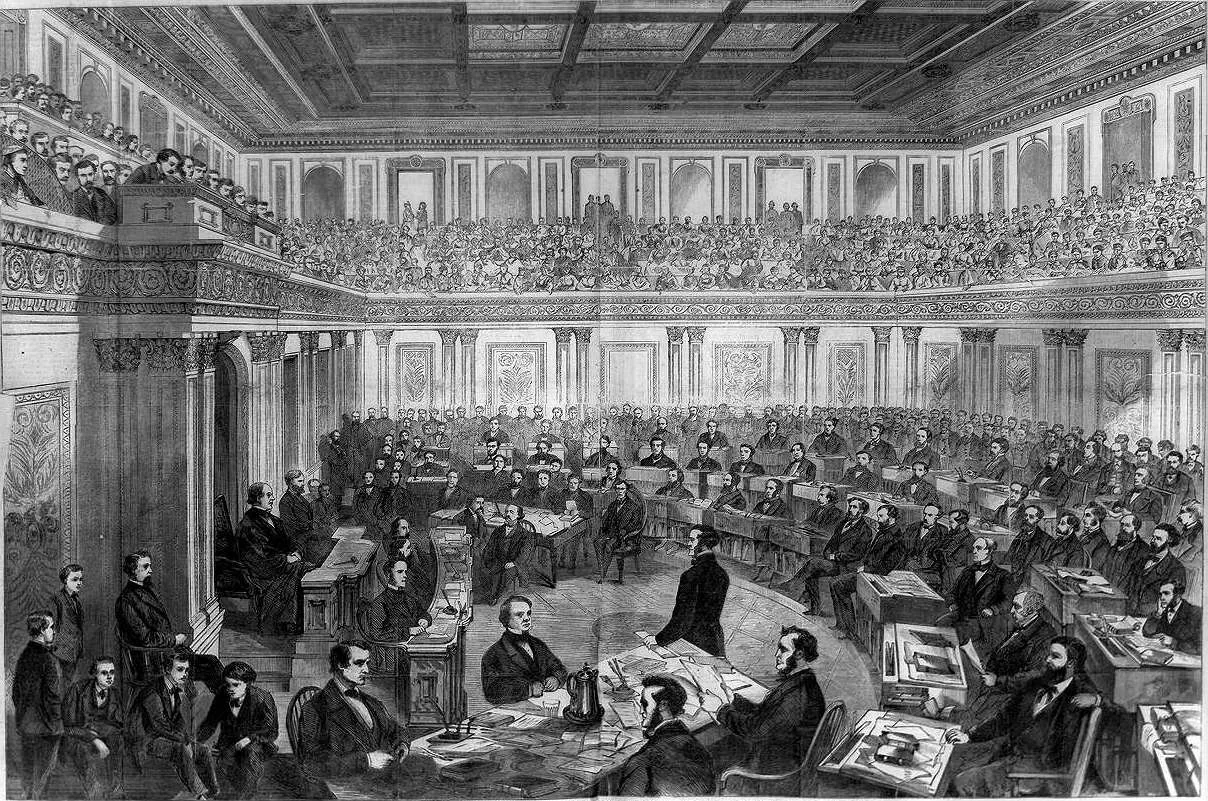
"Andrew Johnson impeachment trial" by Theodore Russel Davis. Source: Wikimedia Commons (Public domain)
President Andrew Johnson assumed office in April 1865 after the assassination of Abraham Lincoln. The United States was still healing from the devastation of the Civil War, and the nation faced the complex challenge of Reconstruction—the process of bringing the Southern states back into the Union and ensuring civil rights for newly freed African Americans. Johnson, a Southern Democrat who had remained loyal to the Union, brought his own ideas about how this process should unfold.
One of the most significant conflicts during Johnson’s presidency was between him and Congress. Johnson believed in a lenient approach to the Southern states. He quickly restored their governments and allowed many former Confederate leaders to return to power. Congress, however, was dominated by Radical Republicans who wanted to create strict policies to protect the rights of freedmen and prevent southern leaders from regaining control. This difference in approach led to serious disagreements and political battles.
President Johnson frequently used his veto power to block Congress’s efforts. For example, he vetoed the Civil Rights Act of 1866, which was designed to grant citizenship and equal protection under the law to all people born in the United States, including former slaves. Congress responded by overriding Johnson’s veto, making it clear that they disagreed with his policies. This was one of the first times in American history that Congress so often overrode a president’s vetoes, showing the intensity of the conflict.
Johnson’s actions and beliefs had important consequences. While he hoped that a quick reunion would help the nation recover, his leniency allowed many southern states to pass Black Codes—laws that restricted the freedoms of African Americans. These codes threatened the progress made during the Civil War and caused many in the North to lose trust in Johnson’s leadership. Congress responded by passing the Reconstruction Acts, which divided the South into military districts and required states to guarantee voting rights for black men before rejoining the Union.
The struggle between the President and Congress eventually led to Johnson being impeached. The House of Representatives charged him with violating the Tenure of Office Act, but the Senate fell just one vote short of removing him from office. Johnson finished his term as a weakened president, and his approach to Reconstruction is still debated by historians today.
Although Johnson’s presidency was marked by controversy and conflict, it played a crucial role in shaping the nation’s future. The disputes over policy and power during this period highlighted important questions about the balance between the branches of government and the meaning of citizenship and rights in America.
Interesting Fact: Andrew Johnson was the first U.S. president to be impeached, but he was not removed from office. The Senate vote was 35 to 19—one vote short of the two-thirds needed for removal.
Who became president after Lincoln?
Andrew JohnsonUlysses S. GrantRutherford HayesTheodore Roosevelt
What is Reconstruction?
Rebuilding the South after the Civil WarA war in the WestA new voting systemLincoln’s assassination
What did Johnson often use to stop laws?
VetoFilibusterPardonAmendment
Why did Congress disagree with Johnson?
He was too lenientHe wanted warHe ended slaveryHe joined the Confederacy
What did the Black Codes do?
Limited rights of African AmericansFreed all slavesGave land to everyoneStarted a new war
What was the result of Johnson’s impeachment trial?
He stayed in officeHe resignedHe was removedHe was arrested
Johnson was the first president impeached.
TrueFalse
What does veto mean?
To reject a lawTo pass a lawTo debate a lawTo ignore a law
Perfect For:
👩🏫 Teachers
• Reading comprehension practice
• Auto-graded assessments
• Literacy skill development
👨👩👧👦 Parents
• Reading practice at home
• Comprehension improvement
• Educational reading time
🏠 Homeschoolers
• Reading curriculum support
• Independent reading practice
• Progress monitoring
Reading Features:
📖
Reading Passage
Engaging fiction or nonfiction text
❓
Comprehension Quiz
Auto-graded questions
📊
Instant Feedback
Immediate results and scoring
📄
Printable Version
Download for offline reading
🔊
Read Aloud
Voice-over with word highlighting
Reviews & Ratings
No reviews yet. Be the first to share your experience!
Related Content
Lincoln's Ten Percent Plan
This passage explores the contrasting Reconstruction plans presented by President Abraham Lincoln and the U.S. Congress ...
HSS 8.11.1RI.6-8.1RI.6-8.6
13th Amendment
This history reading passage explores the 13th Amendment of 1865, which ended slavery throughout the United States. Stud...
HSS 8.11.1RI.6-8.1RI.6-8.6
14th Amendment
This passage provides an in-depth overview of the 14th Amendment, ratified in 1868, which granted citizenship to all per...
HSS 8.11.1RI.6-8.1RI.6-8.3
15th Amendment 1870: Voting
This rigorous, standards-aligned reading passage explores the development, challenges, and impact of the 15th Amendment,...
HSS 8.11.1RI.6-8.1RI.6-8.2
Pocahontas: Myth vs. Historical Reality
This passage explores the nuanced history of Pocahontas, moving beyond the myth made popular by movies and stories. Stud...
HSS 5.3.1RI.6-8.1RI.6-8.8
Roger Williams Religious Freedom
This passage explores the life and legacy of Roger Williams, a key figure in Colonial America who was banished from Mass...
HSS 5.4.38.2.2RI.6-8.1RI.6-8.6
Benjamin Franklin in Colonial America
This U.S. History reading passage explores the life and influence of Benjamin Franklin, a key colonial leader whose idea...
HSS 5.58.1RI.6-8.1RI.6-8.3
Colonial Apprenticeship System
This comprehensive passage explores the Colonial Apprenticeship System and its role in education during Colonial America...
HSS 5.4.6RI.6-8.1RI.6-8.2
Cities in Colonial America
This engaging U.S. history reading passage explores the rise of colonial American cities such as Boston, Philadelphia, a...
HSS 5.4.68.1RI.6-8.1RI.6-8.7
Frontier Life in Colonial America
This passage examines the realities of frontier life in colonial America, highlighting both the promise and peril faced ...
HSS 5.4.68.1RI.6-8.1RI.6-8.2
Colonial Printing Press
This passage explores the revolutionary impact of the colonial printing press in America, examining how it enabled the s...
HSS 5.58.1RI.6-8.1RI.6-8.2
Mercy Otis Warren: Political Writer
This passage explores the life and impact of Mercy Otis Warren, a significant political writer during the American Revol...
HSS 5.6.38.1RI.6-8.1RI.6-8.6
Crispus Attucks
This comprehensive U.S. History reading passage examines the life and legacy of Crispus Attucks, the first person killed...
HSS 5.5.38.1RI.6-8.1RI.6-8.3
Lewis and Clark Expedition
This comprehensive U.S. History reading passage explores the Lewis and Clark Expedition (1804-1806), a pivotal journey l...
HSS 8.4.18.8.2RI.6-8.1RI.6-8.3
Exodusters
This passage explores the migration of Exodusters—African Americans who left the South in the 1870s to escape discrimina...
HSS 8.12.1RI.6-8.1RI.6-8.2
Uncle Tom's Cabin
This passage explores the impact of Harriet Beecher Stowe’s Uncle Tom’s Cabin on American society in the 1850s. It exami...
HSS 8.9.48.10.2RI.6-8.1RI.6-8.6
Dred Scott Decision
This rigorous history reading passage delves into the 1857 Dred Scott Decision, a pivotal moment in the lead-up to the C...
HSS 8.9.48.10.3RI.6-8.1RI.6-8.8
Election of 1860
This passage explores Abraham Lincoln’s election in 1860 and the critical reactions from Southern states, which set the ...
HSS 8.10.4RI.6-8.1RI.6-8.6
Southern Secession
This passage explores the significant moment in U.S. history when seven Southern states seceded from the Union after Abr...