Lincoln's Ten Percent Plan
Interactive passage with audio narration, comprehension questions, and printable PDF.
By completing this purchase you agree to our Terms of Use and Privacy Policy. Your subscription renews automatically until you cancel. You can cancel anytime from your account settings. All sales are final and non-refundable. Digital content is available for download in your account immediately upon purchase.
What's included
Lincoln's Ten Percent Plan preview and details
About this printable Lincoln's Ten Percent Plan reading passage (Grades 6-8)
Sample passage and quiz from Lincoln's Ten Percent Plan
Reading passage and comprehension quiz preview
Lincoln's Ten Percent Plan
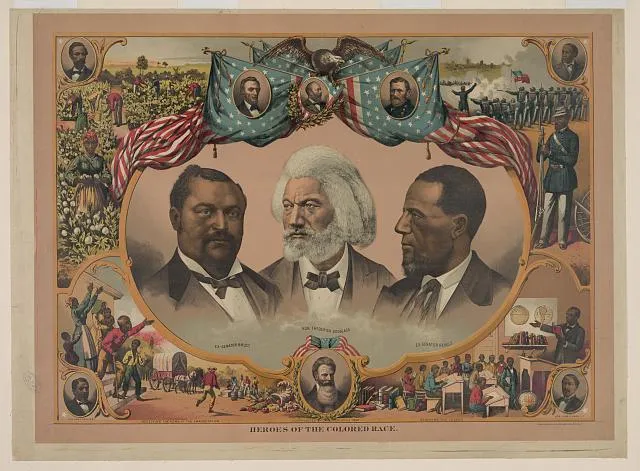
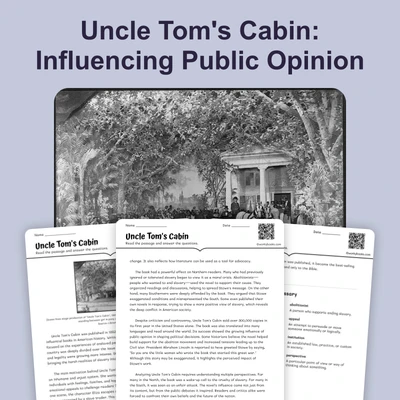
"Heroes of the colored race" by Hoover, Joseph, 1830-1913 / Library of Congress.
The period after the U.S. Civil War is known as Reconstruction. The main goal was to reunite the country and help the Southern states recover. However, there were major disagreements about how this process should happen. President Abraham Lincoln and Congress each created their own plan for bringing the Southern states back into the Union. These plans differed in their approach, especially about how strict or lenient they should be and what requirements should be set for the former Confederate states.
President Lincoln introduced his Ten Percent Plan in 1863, even before the war ended. This plan stated that if 10% of the voters in a Southern state took an oath of loyalty to the Union and accepted the end of slavery, that state could form a new government and rejoin the United States. Lincoln believed that a lenient approach would make it easier for the South to return and help heal the nation quickly. He wanted to forgive, not punish, to encourage unity. His plan did not require Southern states to grant full civil rights to newly freed African Americans, which troubled some lawmakers.
Many members of Congress, known as Radical Republicans, disagreed with Lincoln. They thought his plan was too easy on the South and did not protect the rights of former slaves. Congress wanted to set stricter requirements. In 1864, they proposed the Wade-Davis Bill, which demanded that a majority of white men in a Southern state swear loyalty and that states guarantee equal rights under the law. Congress also wanted to make sure that former Confederate leaders could not easily regain power. Lincoln vetoed this bill, which increased the conflict between the President and Congress.
The debate between Lincoln and Congress showed a deeper struggle over who should control Reconstruction. The Constitution did not say exactly who had the authority—the President or Congress. This led to a power struggle. After Lincoln's assassination in 1865, Vice President Andrew Johnson became President. Johnson tried to follow a plan similar to Lincoln's, but Congress refused to accept it. Congress eventually took control, passing the Reconstruction Acts of 1867. These laws divided the South into military districts and required Southern states to write new constitutions guaranteeing African American men the right to vote before rejoining the Union.
The different policies and conflicts during Reconstruction had lasting effects. The struggle over how strict to be and how much to protect the rights of freed people shaped the future of the South and the nation. The Reconstruction Amendments—the 13th, 14th, and 15th—were passed to abolish slavery, define citizenship, and protect voting rights. However, many challenges remained, including resistance in the South and ongoing debates about equality and federal power.
In summary, Reconstruction was a time of difficult decisions. The competing plans of Lincoln and Congress reflected different ideas about justice, forgiveness, and the nation’s future. Their actions and debates influenced American history for generations.
Interesting Fact: President Lincoln was assassinated just days after General Lee’s surrender at Appomattox Court House, before he could fully carry out his Reconstruction plan.
Comprehension quiz (8 questions)
1. Who created the Ten Percent Plan?
2. What was the goal of Reconstruction?
3. Which bill did Congress propose in 1864?
4. Why did Congress oppose Lincoln's plan?
5. What did the Reconstruction Acts require?
6. What happened after Lincoln’s assassination?
7. Reconstruction ended slavery. True or false?
8. What does 'lenient' mean in the passage?
Perfect for the way you teach
- Build comprehension skills
- Auto-graded quiz
- Differentiated reading
- Read together at home
- Improve fluency
- Quiet reading time
- Reading curriculum support
- Independent practice
- Track Lexile growth