Alexander Hamilton Federalist Papers — Reading Comprehension
Rate this
Premium Resource
Present
Present in classroom. No work saved
Assign
Classroom with student accounts, Track progress
Quick Play
No student accounts, assign with a link
Grades
6
7
8
PRINT+DIGITAL RESOURCE
This learning resource is available in interactive and printable formats. The interactive worksheet can be played online and assigned to students. The Printable PDF version can be downloaded and printed for completion by hand.
This passage explores Alexander Hamilton and his pivotal contribution to The Federalist Papers, a collection of essays that played a crucial role in convincing Americans to ratify the U.S. Constitution. Students will learn how Hamilton, along with James Madison and John Jay, used persuasive writing to address concerns about the new government and explain the principles of federalism. The text is structured to meet HSS 8.2.5 and CCSS.RI.6-8.1, RI.6-8.3 standards and includes key academic vocabulary, a glossary, differentiated and Spanish versions, as well as engaging activities and graphic organizers. With read aloud audio and support for all learners, this resource is ideal for deepening understanding of early American government and the power of persuasive historical writing.
CONTENT PREVIEW
Expand content preview
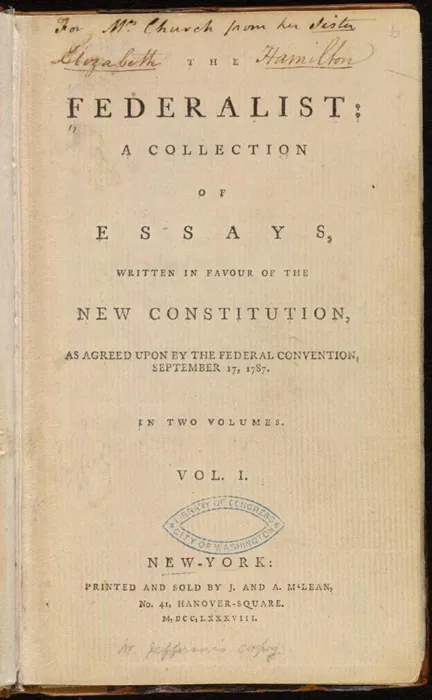
"The Federalist (1st ed, 1788, vol I, title page) - 02" by Publius (pseudonym) [Alexander Hamilton, John Jay, James Madison]. / Source: Wikimedia Commons (Public domain).
Alexander Hamilton was one of the most influential leaders during the early years of the United States. After the American Revolution, the country needed a strong government to unite the states. The original plan, known as the Articles of Confederation, was too weak. Many Americans worried that a new Constitution would give the government too much power. This created a fierce debate across the nation.
To address these concerns, Hamilton, along with James Madison and John Jay, wrote a series of essays called The Federalist Papers. These essays were published in newspapers between 1787 and 1788. The main purpose of The Federalist Papers was to explain the new Constitution and persuade people to support its ratification. Hamilton wrote 51 of the 85 essays, making him the most prolific author among the three writers.
The Federalist Papers used logical arguments and examples from history to show why a strong federal government was necessary. Hamilton argued that a system of checks and balances would prevent any one branch from becoming too powerful. He emphasized the importance of a unified nation for both security and economic growth. The essays also addressed fears about individual rights, assuring readers that the new government would protect their liberties.
Hamilton and his co-authors faced a major challenge: convincing skeptical Americans. Many people worried that the new government would threaten their freedom, just as the British King once had. Through clear writing and persuasive reasoning, The Federalist Papers helped many people understand the Constitution’s benefits. They provided evidence that the new government would be strong but limited by law.
The debate over the Constitution was intense. Anti-Federalists published their own essays, warning of the dangers of a powerful central government. The Federalist Papers responded to these arguments, demonstrating the value of compromise and debate in a democracy. Ultimately, the Constitution was ratified in 1788, and the essays became an important part of American political thought.
The influence of The Federalist Papers did not end with ratification. Judges, lawmakers, and historians continue to study them for insight into the framers’ intentions. Alexander Hamilton’s leadership and his belief in a strong, fair government helped shape the United States into the nation it is today.
Interesting Fact: Hamilton, Madison, and Jay wrote The Federalist Papers under the shared pen name “Publius” to keep their identities secret and focus attention on the arguments, not the authors.
Who wrote most Federalist Papers?
Alexander HamiltonGeorge WashingtonThomas JeffersonBen Franklin
What was the main purpose of The Federalist Papers?
Explain the ConstitutionDeclare warRaise taxesWrite new laws
When was the Constitution ratified?
1788177618001791
Why did Hamilton support checks and balances?
Limit government powerStop electionsRaise moneyCreate more taxes
What did Anti-Federalists fear?
Strong central governmentMore freedomTrade with BritainToo many states
How did The Federalist Papers persuade people?
Logical argumentsThreatsPromises of moneyIgnoring debate
The Federalist Papers are still studied today. True or false?
TrueFalse
What does 'ratification' mean?
Official approvalDebateWritingElection
Perfect For:
👩🏫 Teachers
• Reading comprehension practice
• Auto-graded assessments
• Literacy skill development
👨👩👧👦 Parents
• Reading practice at home
• Comprehension improvement
• Educational reading time
🏠 Homeschoolers
• Reading curriculum support
• Independent reading practice
• Progress monitoring
Reading Features:
📖
Reading Passage
Engaging fiction or nonfiction text
❓
Comprehension Quiz
Auto-graded questions
📊
Instant Feedback
Immediate results and scoring
📄
Printable Version
Download for offline reading
🔊
Read Aloud
Voice-over with word highlighting
Reviews & Ratings
No reviews yet. Be the first to share your experience!
Related Content
New Nation America
This history reading passage, 'New Nation America,' covers how the United States struggled to become a united country af...
HSS 5.6.1RI.4.2
The Cherokee Nation: History and Culture
This reading passage explores the rich history and culture of the Cherokee Nation, one of the largest Native American tr...
D2.HIS.2.3-5D2.HIS.14.3-5RI.4.3RI.4.4RI.4.10
New Orleans: An Important Port
This engaging U.S. history reading passage explores the crucial role of New Orleans and the Louisiana Purchase in shapin...
D2.HIS.3.3-5D2.HIS.14.3-5RI.4.3RI.4.4
American Indians and U.S. Citizenship
This reading passage explores the complex history of American Indians and U.S. citizenship, focusing on the period after...
Battle of New Orleans 1815
This passage explores the pivotal Battle of New Orleans in 1815, focusing on Andrew Jackson’s leadership and the complex...
D2.HIS.2.3-5D2.HIS.3.3-5RI.4.3RI.4.4
Hamilton vs Jefferson
This engaging U.S. history reading passage explores the contrasting visions of Alexander Hamilton and Thomas Jefferson, ...
National Bank Debate
This engaging U.S. history passage explores the National Bank Debate and the constitutional disagreement between Alexand...
D2.HIS.2.3-5D2.HIS.3.3-5RI.4.3RI.4.4
Leaders Call for a New Constitution
This reading passage explores the pivotal moment in U.S. history when American leaders recognized the weaknesses of the ...
Lewis and Clark Expedition
This comprehensive U.S. History reading passage explores the Lewis and Clark Expedition (1804-1806), a pivotal journey l...
HSS 8.4.18.8.2RI.6-8.1RI.6-8.3
The Iroquois Influence on the Constitution
This comprehensive U.S. history reading passage investigates the possible influence of the Iroquois Confederacy’s Great ...
James Madison Early Life
This passage explores the formative years of James Madison—his upbringing in Virginia, his education, and his early expe...
The Louisiana Purchase Deal of 1803
This engaging U.S. history reading passage explores the Louisiana Purchase of 1803, when the United States doubled in si...
D2.HIS.1.3-5D2.HIS.3.3-5RI.4.3RI.4.4
Star-Spangled Banner Origins
This passage explores the complex history of the Star-Spangled Banner, focusing on its origins during the War of 1812, t...
D2.HIS.2.3-5D2.HIS.3.3-5RI.4.3RI.4.4
Enslaved People Had No Citizenship Rights
This passage explores the realities faced by approximately four million enslaved people in the United States during the ...
Thomas Jefferson Biography
This engaging history reading passage provides a detailed look at Thomas Jefferson, one of America's most influential fo...
HSS 5.6.2RI.4.2
New Immigrants and New Jobs
This engaging reading passage explores the experiences of new immigrants and the rise of new jobs during the Progressive...
D2.HIS.2.3-5D2.HIS.3.3-5RI.4.3RI.4.4
George Washington First President
This passage explores how George Washington became the first President of the United States in 1789 and the crucial prec...
The First Political Parties Form
This engaging passage explores the formation of America's first political parties, highlighting the Federalists and Demo...
D2.HIS.1-4.3-5RI.4.3RI.4.4
Cherokee Nation v Georgia
This detailed reading passage explores the pivotal Supreme Court case Cherokee Nation v Georgia (1831), a turning point ...
D2.HIS.2.3-5D2.HIS.3.3-5RI.4.3RI.4.4
James Monroe and the Monroe Doctrine
This engaging U.S. history reading passage introduces students to President James Monroe and the Monroe Doctrine, a key ...