This learning resource is available in interactive and printable formats. The interactive worksheet can be played online and assigned to students. The Printable PDF version can be downloaded and printed for completion by hand.
This engaging 250-word reading passage helps Grade 4 students understand how the human body is organized from its smallest parts to complex systems. Aligned with NGSS 4-LS1-1 and DCI LS1.A, the passage uses a building analogy to explain how cells are like bricks that form tissues (walls), which combine to create organs (rooms), and how organs work together in body systems (buildings). Students explore real-world examples including muscle tissue, the heart, and the digestive system. The passage includes audio integration for accessibility, bold vocabulary terms with immediate definitions, and an interesting fact about cell numbers in the human body. Supplementary activities include multiple-choice comprehension questions testing recall and application, writing prompts requiring explanations and connections, and graphic organizers for comparing structures and understanding sequences. The content is specifically designed for fourth-grade reading levels with simplified differentiated versions and complete Spanish translations available. This resource builds foundational understanding of biological organization without overwhelming students with microscopic details, preparing them for hands-on investigations and deeper discussions about how living things are structured.
CONTENT PREVIEW
Expand content preview
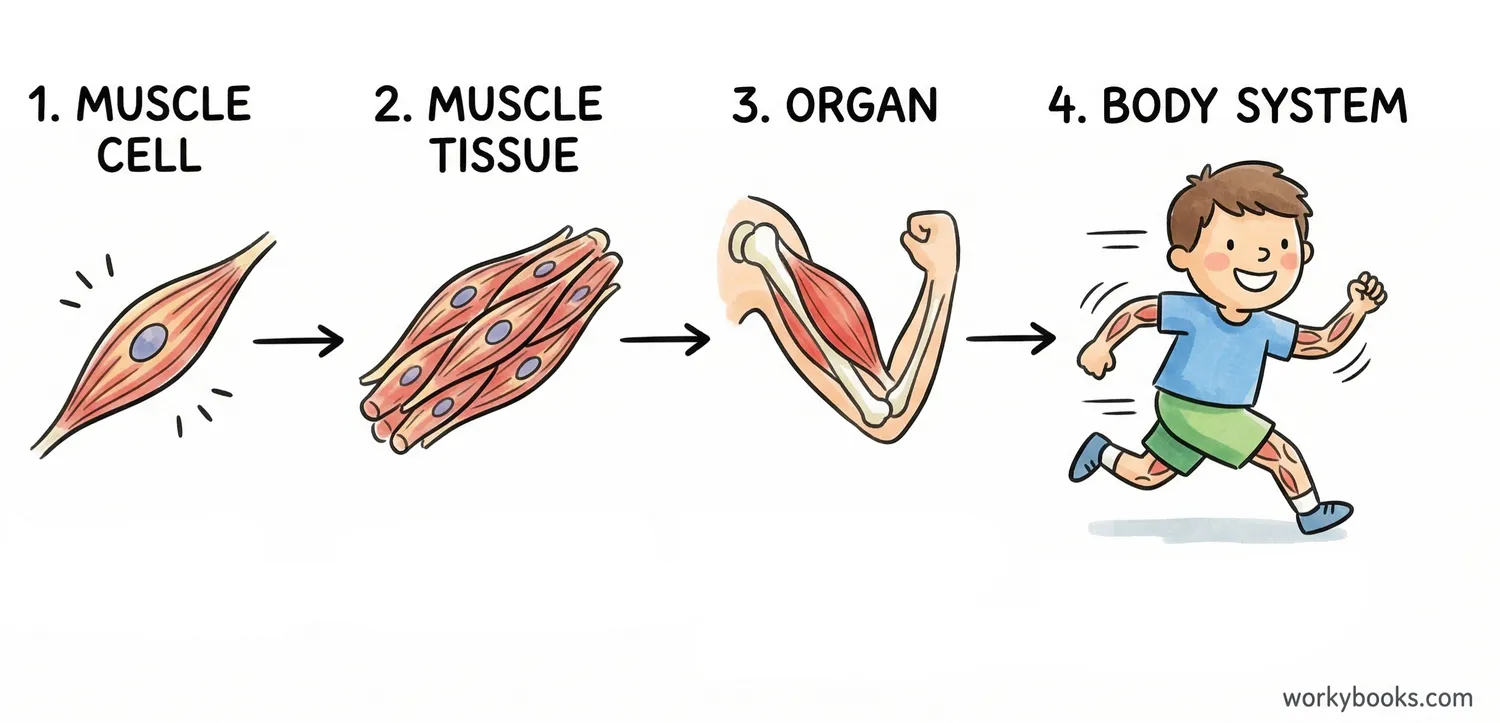
Hierarchical levels of biological organization from individual cells to complex body systems.
Your body is made of tiny building blocks called cells. A cell is the smallest living part of your body. You cannot see cells without a microscope because they are so small. Every part of your body—your skin, bones, blood, and brain—is made of cells. Understanding how cells work together helps us know how our bodies stay healthy and grow.
Cells that do the same job group together to form tissue. Tissue is a group of similar cells working as a team. For example, muscle tissue is made of many muscle cells joined together. When these muscle cells work together, they help you move your arms and legs. Your body has different types of tissue, including skin tissue that covers your body and protects you.
Different tissues work together to form an organ. An organ is a body part that does a special job. Your heart is an organ made of muscle tissue and other tissues. The heart's job is to pump blood through your body. Your lungs are organs that help you breathe. Your stomach is an organ that breaks down food.
Organs that work together form a body system. A body system is a group of organs working together to do an important job. The digestive system includes your mouth, stomach, and intestines working together to break down food and give your body energy. Think of it this way: cells are like bricks, tissues are like walls, organs are like rooms, and a body system is like a whole building.
Interesting Fact: Your body contains about 37 trillion cells! If you could count one cell every second, it would take you over one million years to count them all.
What is the smallest living part of your body?
TissueCellOrganBody system
What is tissue made of?
Different organs working togetherSimilar cells working togetherDifferent body systemsBones and muscles only
What job does the heart do?
Helps you breatheBreaks down foodPumps blood through your bodyProtects your skin
Why do organs work together in systems?
To do important jobs for bodyTo make more cellsTo create new tissuesTo replace old organs
What happens when muscle cells work together?
They help you thinkThey help you moveThey help you digest foodThey help you see
Which example shows organs working as a system?
Muscle cells joining togetherSkin tissue covering your bodyMouth, stomach, intestines breaking down foodHeart made of muscle tissue
You can see cells without a microscope.
TrueFalse
What does the word organ mean?
A single cell in your bodyA body part doing a special jobA group of similar cellsThe smallest living part
Perfect For:
👩🏫 Teachers
• Reading comprehension practice
• Auto-graded assessments
• Literacy skill development
👨👩👧👦 Parents
• Reading practice at home
• Comprehension improvement
• Educational reading time
🏠 Homeschoolers
• Reading curriculum support
• Independent reading practice
• Progress monitoring
Reading Features:
📖
Reading Passage
Engaging fiction or nonfiction text
❓
Comprehension Quiz
Auto-graded questions
📊
Instant Feedback
Immediate results and scoring
📄
Printable Version
Download for offline reading
🔊
Read Aloud
Voice-over with word highlighting
Reviews & Ratings
No reviews yet. Be the first to share your experience!
Related Content
How Animals See Differently
This engaging 250-word reading passage introduces fourth-grade students to the fascinating world of animal vision and ey...
NGSS 4-LS1-1LS1.D
Animal Internal Structure
This engaging science passage for Grade 4-5 students explores animal internal structure and how organs work together to ...
NGSS 4-LS1-1
What Are Bones Made Of
This engaging 250-word reading passage introduces Grade 4 students to the structure and function of bones, aligned with ...
NGSS 4-LS1-1LS1.A
How Bones Protect Organs
This engaging 250-word reading passage helps Grade 4 students understand how bones protect organs, aligned with NGSS sta...
NGSS 4-LS1-1LS1.A
How Joints Connect Bones
This 250-word reading passage teaches fourth-grade students about joints and their role in the human skeletal system. Al...
NGSS 4-LS1-1LS1.A
How Muscles Move Bones
This comprehensive 250-word reading passage introduces fourth-grade students to the fundamental concept of how muscles a...
NGSS 4-LS1-1
Two Types of Muscles
This 250-word reading passage introduces fourth-grade students to the two main types of muscles in the human body: volun...
NGSS 4-LS1-1
What Are Muscles
This engaging 250-word reading passage introduces fourth-grade students to the essential concept of muscles and how they...
NGSS 4-LS1-1
How Skin Protects Body
This audio-integrated reading passage introduces fourth-grade students to the protective functions of skin, aligned with...
NGSS 4-LS1-1
Layers of the Skin
This engaging 250-word reading passage introduces fourth-grade students to the three layers of skin and their functions....
NGSS 4-LS1-1LS1.A
What Are Plant Structures
This engaging 250-word reading passage introduces fourth-grade students to the fundamental concept of plant structures a...
NGSS 4-LS1-1
Parts of Plant Stems
This engaging 250-word reading passage introduces fourth-grade students to the internal structure and function of plant ...
NGSS 4-LS1-1LS1.A
How Water Moves Inside Plants
This 250-word reading passage introduces fourth-grade students to the concept of water transport in plants, aligned with...
NGSS 4-LS1-1
Parts of a Flower
This comprehensive 250-word reading passage introduces fourth-grade students to the essential parts of a flower and thei...
NGSS 4-LS1-1LS1.A
How Fish Gills Work
This engaging 250-word reading passage introduces fourth-grade students to the concept of fish gills and how they functi...
NGSS 4-LS1-1
How Leaves Make Food
This engaging Grade 4 science reading passage explains how leaves make food through photosynthesis. Students discover th...
NGSS 4-LS1-1LS1.A
How Animal Hearts Work
This 250-word audio-integrated reading passage introduces fourth-grade students to the essential function of the heart a...
NGSS 4-LS1-1LS1.A
Animal Skeleton Structure
This 250-word reading passage introduces fourth grade students to animal skeleton structure, aligned with NGSS 4-LS1-1 a...
NGSS 4-LS1-1LS1.A
How Animal Lungs Work
This 250-word reading passage introduces fourth-grade students to how animal lungs work, aligned with NGSS standard 4-LS...
NGSS 4-LS1-1LS1.A
What Is Inside a Seed
This engaging 250-word reading passage helps Grade 4 students understand the internal structure of seeds, aligned with N...