This 400-500 word informational science reading passage for grades 6-8 examines how climate change threatens freshwater availability. Aligned with NGSS standard MS-ESS3-5, the passage explains four key ways climate disrupts water supplies: prolonged droughts that empty rivers and reservoirs, shrinking mountain glaciers and earlier snowmelt reducing dry-season water flow, shifting precipitation patterns leaving regions parched, and rising sea levels pushing saltwater into coastal freshwater sources. Students explore how competition for limited water among agriculture, drinking water, sanitation, and industry affects communities worldwide. The passage connects to water cycle concepts and drought mechanisms from Earth Science units, helping students understand how climate disruptions impact daily human life. Audio-integrated features support diverse learners. Includes Spanish translation, simplified differentiated version, glossary of key terms like precipitation, reservoir, and aquifer, plus comprehension activities and graphic organizers for deeper understanding of cause-and-effect relationships in Earth systems.
Written by Workybooks TeamPublished by Workybooks
Preview
Sample passage and quiz content
CONTENT PREVIEW
Expand content preview
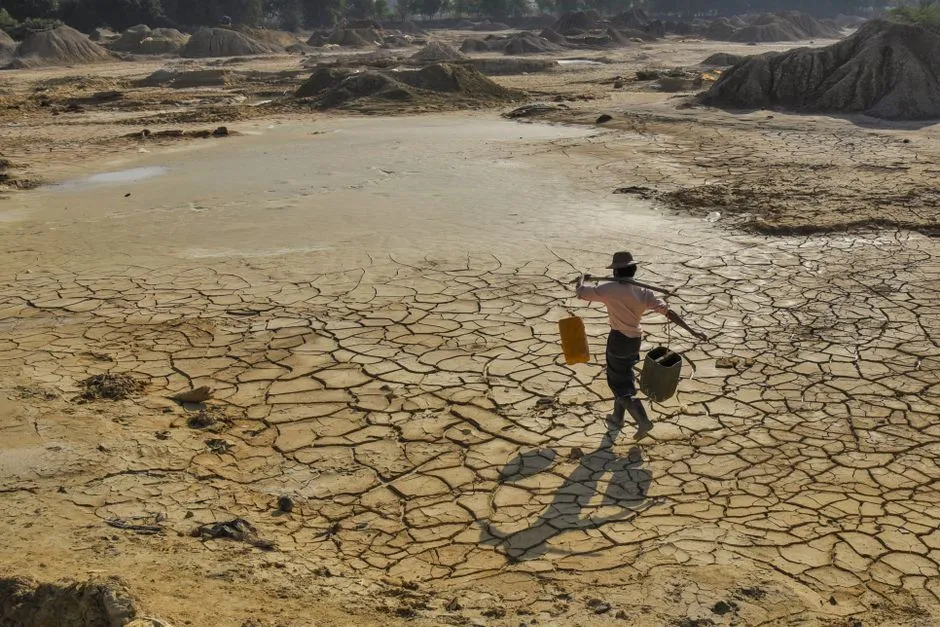
"A man carries water across a parched landscape in Sagaing, revealing drought impact." by Pyae Phyo Aung / Pexels.
Freshwater is essential for life, but only about 3 percent of Earth's water is fresh. Most of that is frozen in ice caps and glaciers. Climate change is making the small amount of available freshwater even less reliable. Evidence shows that warming temperatures disrupt the water cycle in ways that threaten supplies people depend on every day.
Climate change affects freshwater availability through several connected processes. First, higher temperatures cause more frequent and severe droughts. These dry periods last longer and cover larger areas than in the past. Rivers shrink and reservoirs drop to dangerously low levels. Second, mountain glaciers are melting faster than they can rebuild. These glaciers act like natural water towers, storing winter snow and releasing meltwater gradually through dry summer months. When glaciers shrink, less water flows downstream when communities need it most. Third, warmer air changes precipitation patterns around the world. Some regions receive less rainfall overall, while others get intense storms followed by long dry spells. Fourth, rising sea levels push saltwater into coastal aquifers and wells. This process, called saltwater intrusion, makes freshwater undrinkable without expensive treatment.
Scientists observe these impacts in real places today. Cape Town, South Africa, nearly ran out of water in 2018 after three years of severe drought. Reservoirs dropped to just 20 percent capacity. Residents could use only 50 liters per person each day, less than half a typical bathtub. The city avoided "Day Zero," when taps would shut off completely, only through strict conservation and emergency measures. This crisis showed how quickly water scarcity can affect millions of people.
Water scarcity matters because farming, drinking water, sanitation, and industry all compete for the same limited supply. Agriculture uses about 70 percent of available freshwater worldwide. When water becomes scarce, food production suffers. Cities struggle to provide clean drinking water and maintain sewage systems. Factories may shut down without enough water for cooling and processing. These impacts ripple through communities, affecting health, food security, and economic stability. Understanding how climate change disrupts the water cycle helps explain why protecting water sources is critical for human survival.
Interesting Fact: A person can survive only about three days without water, but the average American uses 80 to 100 gallons per day for drinking, cooking, bathing, and flushing toilets.
What percentage of Earth's water is freshwater?
About 3 percentAbout 30 percentAbout 50 percentAbout 70 percent
How do mountain glaciers help provide water during dry seasons?
They create rain cloudsThey store winter snow and release meltwater graduallyThey filter saltwater into freshwaterThey prevent droughts from occurring
What does the term 'saltwater intrusion' mean in the passage?
Ocean water evaporating into the atmosphereFreshwater flowing into the oceanSaltwater pushing into freshwater aquifers and wellsSalt dissolving in mountain glaciers
Based on the passage, what is an aquifer?
A type of glacier found in mountainsUnderground layers that hold and transmit groundwaterA large lake used to store waterA device that removes salt from water
Why did Cape Town, South Africa, nearly run out of water in 2018?
A tsunami destroyed the water treatment plantsThree years of severe drought dried up reservoirsAll the glaciers in the region melted completelySaltwater intrusion contaminated all the wells
What can be inferred about the relationship between climate change and precipitation patterns?
Climate change makes rainfall more predictableClimate change increases rainfall equally everywhereClimate change causes uneven distribution of rainfall across regionsClimate change stops all precipitation worldwide
According to the passage, approximately what percentage of available freshwater does agriculture use worldwide?
20 percent40 percent70 percent90 percent
If mountain glaciers continue to shrink, what is the most likely effect on communities downstream?
They will receive more water during summer monthsThey will experience water shortages during dry seasonsThey will have better water quality year-roundThey will no longer need reservoirs
True or False: Most of Earth's freshwater is readily available for human use.
TrueFalse
True or False: Water scarcity can affect food production, health, and economic stability.
TrueFalse
Who it's for
Perfect for the way you teach
Teachers
Build comprehension skills
Auto-graded quiz
Differentiated reading
Parents
Read together at home
Improve fluency
Quiet reading time
Homeschoolers
Reading curriculum support
Independent practice
Track Lexile growth
Topics
climate changewater scarcityfreshwaterdroughtglacierswater cycleprecipitationsaltwater intrusionNGSS MS-ESS3-5middle school science
Reviews & Ratings
No reviews yet. Be the first to share your experience!
More reading you might love
20 more
Natural Disaster: Hurricanes
Hurricanes are massive storms with strong winds and rain. Tracking and preparing for them helps protect people in their ...
RI.3.1RI.4.4RI.4.2RI.5.2
Animal Migration and Climate Change
This engaging 400-500 word reading passage explores how climate change affects animal migration patterns across multiple...
MS-LS2-4MS-ESS3-5MS-LS4-4; RST.6-8.1RST.6-8.4
What Is Global Warming?
This NGSS-aligned reading passage explains global warming, the greenhouse effect, and how human activities like burning ...
MS-ESS3-5
What Causes Global Warming?
This NGSS-aligned reading passage explains what causes global warming, focusing on how human activities like burning fos...
MS-ESS3-5
How to Stop Global Warming
This NGSS-aligned reading passage helps students understand how to stop global warming by reducing greenhouse gases. It ...
MS-ESS3-5
Human Impacts: Climate Change
This standards-aligned science reading passage for grades 6-8 explains the mechanisms and effects of human-driven climat...
MS-LS2-4MS-ESS3-5
Climate Change: Vulnerable Ecosystems
This middle school science passage, aligned with NGSS standards MS-ESS3-5 and MS-LS2-4, helps students understand how cl...
MS-ESS3-5MS-LS2-4
Climate Change: Solutions and Mitigation
This passage explores scientific solutions and mitigation strategies for climate change, designed for middle school scie...
MS-ESS3-4MS-ESS3-5
Scientific Inquiry in Earth Science
This passage explores scientific inquiry in Earth science for grades 6-8, aligned with NGSS standards MS-ESS1-4, MS-ESS2...
MS-ESS1-4MS-ESS2-1MS-ESS3-5SEP
Great Barrier Reef
This passage introduces middle school students to the Great Barrier Reef, the world's largest coral reef system, located...
MS-LS2-1MS-LS2-4MS-ESS3-5
Siberian Taiga
This engaging middle school science passage explores the Siberian Taiga, the world’s largest forest ecosystem, stretchin...
MS-LS2-1MS-ESS3-5
The Greenhouse Effect
This comprehensive middle school science passage explores the greenhouse effect, a process essential to maintaining Eart...
MS-ESS2-6MS-ESS3-5
Melting Glaciers and Ice Sheets
This comprehensive middle school science reading passage examines the critical issue of melting glaciers and ice sheets,...
MS-ESS3-5
Sea Level Rise and Climate Change
This 400-500 word informational science passage for grades 6-8 explores sea level rise and climate change, aligned with ...
MS-ESS3-5
Ice Cores
This passage, aligned with NGSS standards MS-ESS3-5 and MS-ESS1-4, explores the scientific process of extracting and ana...
MS-ESS3-5MS-ESS1-4
How Climate Change Affects Weather
This middle school science passage explores how and why weather patterns are changing globally. Students will learn abou...
MS-ESS3-5
How Climate Change Affects Oceans
This NGSS-aligned passage explores major changes occurring in Earth’s oceans, focusing on the mechanisms and impacts of ...
MS-ESS3-5
Carbon Footprint
This NGSS-aligned passage for grades 6-8 explores the concept of a carbon footprint, focusing on how personal activities...
MS-ESS3-4MS-ESS3-5
El Niño
This middle school science passage provides an in-depth exploration of El Niño, the warm phase of the El Niño-Southern O...
MS-ESS2-6MS-ESS3-5
ENSO and Global Climate
This comprehensive passage explores the El Niño-Southern Oscillation (ENSO), a crucial driver of global climate variabil...