Climate Change: Species Responses — Reading Comprehension
Rate this
Premium Resource
Present
Present in classroom. No work saved
Assign
Classroom with student accounts, Track progress
Quick Play
No student accounts, assign with a link
Grades
5
6
7
8
Standards
MS-LS4-4
MS-LS4-6
PRINT+DIGITAL RESOURCE
This learning resource is available in interactive and printable formats. The interactive worksheet can be played online and assigned to students. The Printable PDF version can be downloaded and printed for completion by hand.
This middle school science passage explores how species respond to climate change, aligning with NGSS standards MS-LS4-4 and MS-LS4-6. Students will learn about adaptation, behavioral plasticity, migration, and extinction, with real-world examples like butterflies shifting ranges and birds altering migration timing. The passage explains scientific mechanisms, cause-and-effect relationships, and includes a glossary of key terms. Activities include comprehension questions, writing prompts, and graphic organizers to deepen understanding. This resource is ideal for grades 6-8 and integrates audio for accessibility. The content supports systems thinking and helps students understand how living things are affected by rapid environmental changes, encouraging analysis of both scientific evidence and ethical questions like assisted migration.
CONTENT PREVIEW
Expand content preview
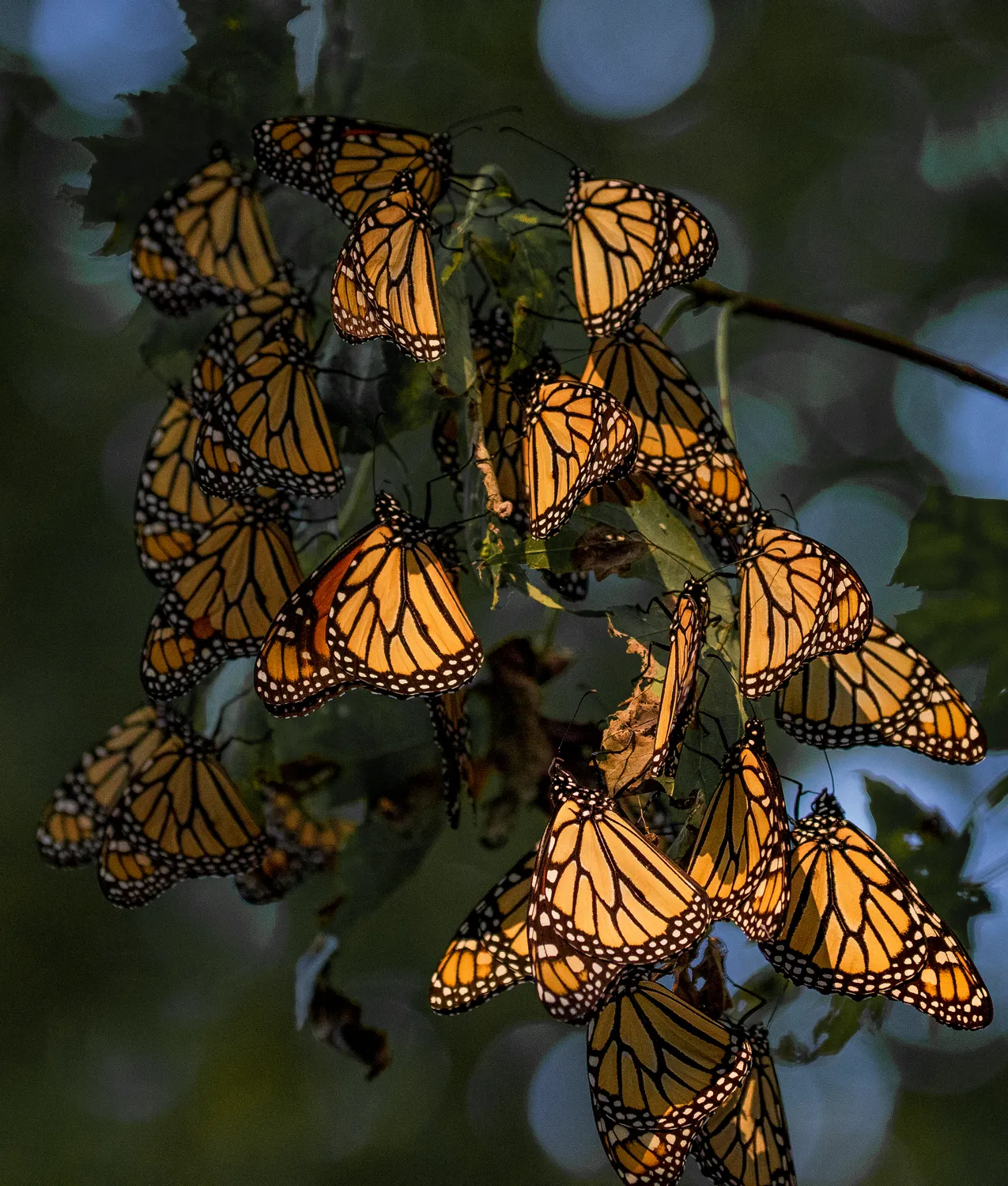
Warming temperatures can disrupt the Monarch's long journey, altering crucial migration and reproduction timing. Image by Midwest Region / Wikimedia Commons (Public domain).
Climate change is causing rapid changes in global temperatures, weather patterns, and ecosystems. Many species now face a challenge: they must adapt, move to new locations, or risk extinction. Scientists study these responses to understand how living things cope with environmental stress. The fate of countless species depends on the speed and nature of their responses to a rapidly changing world.
Mechanisms of Survival: Adapt, Move, or Die
When the environment changes, species have three main options. First, they can adapt by evolving new traits. This evolutionary process requires genetic variation and usually takes many generations. However, because climate is changing so quickly—at rates faster than most species have ever experienced—many organisms cannot evolve fast enough. Some species can use behavioral or physiological plasticity, which means individuals can alter their actions or body functions without genetic changes. For example, some birds may change what they eat or when they build nests.
Migration and Range Shifts
Many species are responding by moving to new habitats where conditions are more suitable. This is called a range shift. For instance, butterflies in Europe have shifted their ranges northward by about 35-240 kilometers in recent decades. Birds and fish are also moving to higher elevations or cooler waters. Plants, although rooted, can shift ranges over generations as seeds disperse further north or uphill. Another observed response is changes in migration timing. Birds now often arrive earlier in spring and leave later in fall. These changes can help them survive but also risk mismatches with food supplies or breeding partners.
Challenges, Risks, and Human Actions
Not all species can move or adapt easily. Those with small geographic ranges, slow reproduction, or specialized needs are most vulnerable to extinction. Scientific studies have documented evolutionary responses, such as some birds breeding earlier or mosquitoes evolving resistance to heat. However, many species cannot keep up. This has led to debates about assisted migration—the idea of humans moving species to safer habitats. While this could save some species, it might also disrupt new ecosystems. Another problem is ecological mismatch: for example, if plants flower earlier because of warmer springs but their pollinators do not arrive in time, both can suffer. Scientists use data on shifting ranges, timing, and population trends to predict which species are most at risk.
Understanding how species respond to climate change involves studying genetics, behavior, ecosystems, and even human ethics. The balance between adaptation, movement, and extinction will shape the future of Earth’s biodiversity. Protecting habitats and slowing climate change are crucial for giving species a chance to survive.
Interesting Fact: Some Arctic fish have shifted their ranges northward by up to 1,000 kilometers in the last 40 years, showing how quickly species can respond to environmental change.
What are the three main responses species have to climate change according to the passage?
Adapt, move, or dieEat, sleep, or migrateFly, swim, or walkHunt, gather, or rest
What does the term 'range shift' mean in the context of the passage?
A species moves its living area to a new locationA species changes its colorA species hibernates for winterA species becomes extinct
How much have some butterflies in Europe shifted their ranges in recent decades?
35-240 kilometers northward10-20 kilometers eastward1000 kilometers southwardThey have not moved at all
According to the passage, why can’t most species adapt fast enough to climate change?
Climate change is happening faster than most species can evolveThey do not want to adaptThey prefer to move insteadThey are nocturnal
What is 'assisted migration'?
When humans help move species to new habitatsWhen animals migrate naturallyWhen species hibernateWhen weather patterns change
What does 'mismatch' mean in this passage?
Timing or location of two dependent species no longer matchesSpecies look differentAnimals eat different foodsPlants grow taller
Why might assisted migration be controversial?
It could disrupt new ecosystemsIt always helps every speciesOnly birds need itIt is too expensive
What causes ecological mismatches according to the passage?
Changes in timing, like plants flowering before pollinators arriveSpecies living in waterBuilding more nestsGenetic variation increasing
True or False: All species can easily move to new habitats when climate changes.
TrueFalse
True or False: Evolutionary adaptation usually takes many generations.
TrueFalse
Perfect For:
👩🏫 Teachers
• Reading comprehension practice
• Auto-graded assessments
• Literacy skill development
👨👩👧👦 Parents
• Reading practice at home
• Comprehension improvement
• Educational reading time
🏠 Homeschoolers
• Reading curriculum support
• Independent reading practice
• Progress monitoring
Reading Features:
📖
Reading Passage
Engaging fiction or nonfiction text
❓
Comprehension Quiz
Auto-graded questions
📊
Instant Feedback
Immediate results and scoring
📄
Printable Version
Download for offline reading
🔊
Read Aloud
Voice-over with word highlighting
Reviews & Ratings
No reviews yet. Be the first to share your experience!
Related Content
The Giant Isopod: Biological Evolution
This NGSS passage examines how giant isopods evolved for deep-sea survival, including slow metabolism for food scarcity,...
MS-LS4-4RI.6.3RI.7.3RI.8.8
What Is Biodiversity?
This comprehensive science reading passage for grades 6-8 introduces students to biodiversity and explores its importanc...
MS-LS2-5MS-LS4-4
Vertebrates: Fishes
This middle school science reading passage offers an in-depth look at fishes, a major group of vertebrates. It covers fi...
MS-LS4-2MS-LS4-4
Vertebrates: Amphibians
This comprehensive middle school science passage dives into the fascinating world of amphibians, a group of vertebrates ...
MS-LS4-2MS-LS4-4
Vertebrates: Reptiles
This comprehensive science passage for grades 6-8 introduces students to reptiles, a fascinating class of vertebrates. A...
MS-LS4-2MS-LS4-4
Vertebrates: Birds
This middle school science passage explores birds as vertebrates, focusing on their unique adaptations such as feathers,...
MS-LS4-2MS-LS4-4
Vertebrates: Mammals
This comprehensive passage introduces middle school students to the class Mammalia and their defining characteristics, i...
MS-LS4-2MS-LS4-4
Invertebrates: Arthropods
This comprehensive science passage introduces middle school students to the phylum Arthropoda, the largest and most dive...
MS-LS4-2MS-LS4-4
Biodiversity and Its Importance
This comprehensive middle school science passage explores the concept of biodiversity at the genetic, species, and ecosy...
MS-LS4-4MS-LS2-5
Galápagos Islands
This engaging science passage explores the Galápagos Islands, a volcanic archipelago located off the coast of Ecuador in...
MS-LS2-1MS-LS4-4MS-ESS3-4
Intertidal Zone
This middle school science reading passage introduces students to the intertidal zone, the area between high and low tid...
MS-LS2-1MS-LS4-4
Natural Selection
This comprehensive passage introduces middle school students (grades 6-8) to the concept of natural selection, aligning ...
MS-LS4-4MS-LS4-6
Speciation
This comprehensive science passage introduces middle school students to the concept of speciation, the process by which ...
MS-LS4-4
Adaptation
This engaging middle school science passage explores adaptation, focusing on how inherited traits enable organisms to su...
MS-LS4-4MS-LS4-6
Extinction and Biodiversity
This comprehensive middle school science passage explores the concepts of extinction and biodiversity, aligned to NGSS s...
MS-LS4-1MS-LS4-4
Environmental Change and Species Survival
This middle school science passage explores how environmental changes, such as climate change, habitat destruction, the ...
MS-LS4-4MS-LS4-6
Coevolution
This passage for grades 6-8 introduces students to the concept of coevolution, where two or more species evolve in respo...
MS-LS4-4MS-LS4-6
Effects of Climate Change
This comprehensive middle school science passage explores the effects of climate change on Earth's systems and life, ali...
MS-ESS3-5MS-LS4-4
How Climate Change Affects Seasons
This passage explores the science of shifting seasons and their effects on ecosystems, aligning with NGSS standards MS-E...