This learning resource is available in interactive and printable formats. The interactive worksheet can be played online and assigned to students. The Printable PDF version can be downloaded and printed for completion by hand.
This comprehensive science passage introduces middle school students to the concept of speciation, the process by which new species arise from existing populations. The reading explains the mechanisms behind speciation, such as reproductive isolation, allopatric and sympatric speciation, and explores real-world examples like Galápagos finches, cichlid fish in African lakes, and Hawaiian honeycreepers. Students will learn about different types of reproductive barriers—geographic, behavioral, and temporal—and how these lead to genetic divergence and the formation of new species. The passage is carefully aligned with NGSS MS-LS4-4 and integrates academic vocabulary with accessible explanations. Activities include quizzes, writing prompts, and graphic organizers to reinforce understanding. Audio integration is available for all content, supporting diverse learning needs. This resource is ideal for classroom instruction, homework, or independent study and helps students connect speciation to broader scientific principles and real-world biodiversity.
CONTENT PREVIEW
Expand content preview
Speciation is the evolutionary process where new species arise from existing ones. This process explains the incredible diversity of life on Earth, from the different types of finches on the Galápagos Islands to the colorful cichlid fish in African lakes. Scientists study speciation to understand how populations of organisms become so different that they can no longer produce fertile offspring together. The main driver behind this process is reproductive isolation, which prevents groups of organisms from interbreeding.
Mechanisms of Speciation: How It Happens
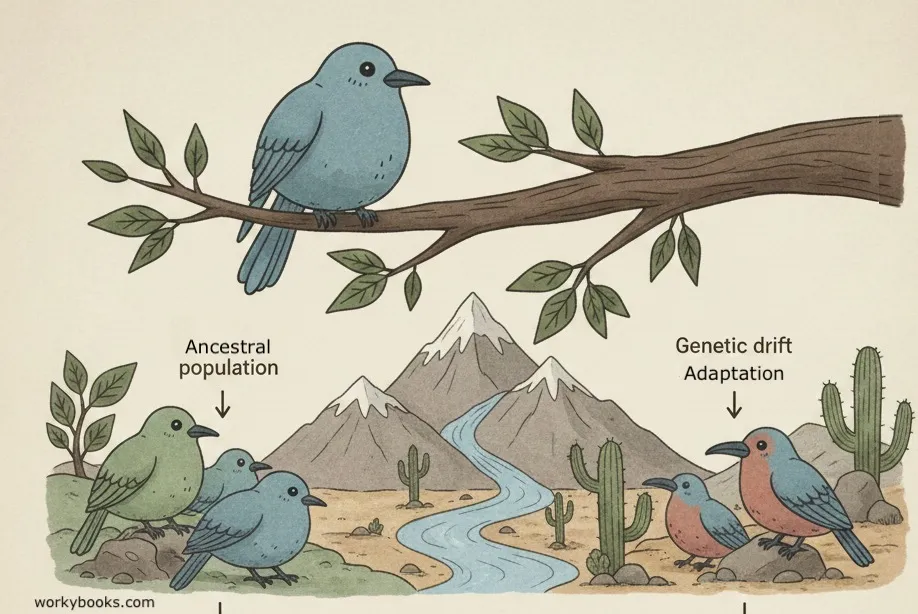
Reproductive isolation can occur in several ways. Geographic isolation happens when physical barriers like mountains, rivers, or oceans separate populations. Over time, each group adapts to its own environment, accumulating genetic differences. This is called allopatric speciation. For example, a population of birds might be divided by a river. After thousands of generations, these two groups may evolve into distinct species. In contrast, sympatric speciation occurs without physical barriers. Instead, differences in behaviors—like unique mating calls (behavioral isolation) or breeding at different times of year (temporal isolation)—prevent interbreeding, even though organisms live in the same area. Genetic mutations or changes in diet can also promote sympatric speciation, especially in environments with abundant resources.
Evidence and Examples: Nature’s Experiments
One famous example of allopatric speciation is the Galápagos finches. On different islands, finches evolved distinct beak shapes suited for specific foods. Over time, these differences became so large that the finches turned into separate species. In African lakes, over 500 species of cichlid fish arose in just a few thousand years, mostly through sympatric speciation. Some species feed at different depths or have unique courtship displays, creating reproductive barriers. Hawaiian honeycreepers, a group of birds, also show speciation in action after colonizing the islands. Scientists have even observed ring species, where neighboring populations can interbreed, but populations at the ends of the “ring” cannot, illustrating the gradual nature of speciation.
Broader Implications and Scientific Connections
Speciation is a key concept in evolution. It helps explain the branching “tree of life” and the patterns of biodiversity seen today. Understanding speciation is important for conservation biology, because it helps scientists protect endangered species by recognizing unique populations. Research on speciation also supports the use of genetic data to map relationships between species. As technology improves, scientists can measure genetic divergence more precisely, sometimes discovering hidden species that look almost identical on the outside.
Speciation shows how small genetic changes, combined with environmental and behavioral factors, can reshape life on Earth over millions of years. The study of this process gives us insight into our world’s past and helps us predict how life might change in the future.
Interesting Fact: Some salamander species in California form a ring around a valley, with neighboring groups able to breed, but the groups at the ends are so different they cannot interbreed—an example of a ring species.
What is speciation?
The process where new species form from existing speciesThe process of photosynthesis in plantsThe extinction of old speciesThe migration of animals across continents
Which of the following is an example of geographic isolation?
A population of birds separated by a mountain rangeFish using different courtship dancesPlants blooming at different timesWolves howling in different ways
What is the main cause of reproductive isolation mentioned in the passage?
Physical, behavioral, or temporal barriers that prevent breedingWeather changesFood shortagesPredator attacks
What does 'sympatric speciation' mean in the passage?
New species form without physical barriers, in the same areaNew species form after a group moves to a new areaSpecies go extinctSpecies migrate long distances
According to the passage, why are Galápagos finches a famous example of speciation?
They evolved different beak shapes on different islandsThey migrated to AfricaThey became extinct due to climate changeThey were all the same everywhere
What does the term 'ring species' refer to?
A group of populations that can interbreed with neighbors, but not with those at the endsA species that lives in a ring-shaped lakeA species that migrates in circlesA group of plants that bloom together
Why is understanding speciation important for conservation biology?
It helps scientists protect unique populations and endangered speciesIt helps plants grow fasterIt helps animals migrateIt prevents natural disasters
How do scientists use genetics to study speciation?
By measuring genetic differences and discovering hidden speciesBy counting the number of animals in a forestBy studying only the outside appearanceBy watching animal behavior only
True or False: Allopatric speciation always requires a physical barrier to separate populations.
TrueFalse
True or False: Sympatric speciation can happen even if organisms live in the same area.
TrueFalse
Perfect For:
👩🏫 Teachers
• Reading comprehension practice
• Auto-graded assessments
• Literacy skill development
👨👩👧👦 Parents
• Reading practice at home
• Comprehension improvement
• Educational reading time
🏠 Homeschoolers
• Reading curriculum support
• Independent reading practice
• Progress monitoring
Reading Features:
📖
Reading Passage
Engaging fiction or nonfiction text
❓
Comprehension Quiz
Auto-graded questions
📊
Instant Feedback
Immediate results and scoring
📄
Printable Version
Download for offline reading
🔊
Read Aloud
Voice-over with word highlighting
Reviews & Ratings
No reviews yet. Be the first to share your experience!
Related Content
The Giant Isopod: Biological Evolution
This NGSS passage examines how giant isopods evolved for deep-sea survival, including slow metabolism for food scarcity,...
MS-LS4-4RI.6.3RI.7.3RI.8.8
What Is Biodiversity?
This comprehensive science reading passage for grades 6-8 introduces students to biodiversity and explores its importanc...
MS-LS2-5MS-LS4-4
Vertebrates: Fishes
This middle school science reading passage offers an in-depth look at fishes, a major group of vertebrates. It covers fi...
MS-LS4-2MS-LS4-4
Vertebrates: Amphibians
This comprehensive middle school science passage dives into the fascinating world of amphibians, a group of vertebrates ...
MS-LS4-2MS-LS4-4
Vertebrates: Reptiles
This comprehensive science passage for grades 6-8 introduces students to reptiles, a fascinating class of vertebrates. A...
MS-LS4-2MS-LS4-4
Vertebrates: Birds
This middle school science passage explores birds as vertebrates, focusing on their unique adaptations such as feathers,...
MS-LS4-2MS-LS4-4
Vertebrates: Mammals
This comprehensive passage introduces middle school students to the class Mammalia and their defining characteristics, i...
MS-LS4-2MS-LS4-4
Invertebrates: Arthropods
This comprehensive science passage introduces middle school students to the phylum Arthropoda, the largest and most dive...
MS-LS4-2MS-LS4-4
Biodiversity and Its Importance
This comprehensive middle school science passage explores the concept of biodiversity at the genetic, species, and ecosy...
MS-LS4-4MS-LS2-5
Galápagos Islands
This engaging science passage explores the Galápagos Islands, a volcanic archipelago located off the coast of Ecuador in...
MS-LS2-1MS-LS4-4MS-ESS3-4
Intertidal Zone
This middle school science reading passage introduces students to the intertidal zone, the area between high and low tid...
MS-LS2-1MS-LS4-4
Natural Selection
This comprehensive passage introduces middle school students (grades 6-8) to the concept of natural selection, aligning ...
MS-LS4-4MS-LS4-6
Adaptation
This engaging middle school science passage explores adaptation, focusing on how inherited traits enable organisms to su...
MS-LS4-4MS-LS4-6
Extinction and Biodiversity
This comprehensive middle school science passage explores the concepts of extinction and biodiversity, aligned to NGSS s...
MS-LS4-1MS-LS4-4
Environmental Change and Species Survival
This middle school science passage explores how environmental changes, such as climate change, habitat destruction, the ...
MS-LS4-4MS-LS4-6
Coevolution
This passage for grades 6-8 introduces students to the concept of coevolution, where two or more species evolve in respo...
MS-LS4-4MS-LS4-6
Climate Change: Species Responses
This middle school science passage explores how species respond to climate change, aligning with NGSS standards MS-LS4-4...
MS-LS4-4MS-LS4-6
Effects of Climate Change
This comprehensive middle school science passage explores the effects of climate change on Earth's systems and life, ali...
MS-ESS3-5MS-LS4-4
How Climate Change Affects Seasons
This passage explores the science of shifting seasons and their effects on ecosystems, aligning with NGSS standards MS-E...