Environmental Change and Survival
Interactive passage with audio narration, comprehension questions, and printable PDF.
By completing this purchase you agree to our Terms of Use and Privacy Policy. Your subscription renews automatically until you cancel. You can cancel anytime from your account settings. All sales are final and non-refundable. Digital content is available for download in your account immediately upon purchase.
What's included
Environmental Change and Survival preview and details
About this printable Environmental Change and Survival science reading passage, NGSS-aligned (Grades 5-8)
Sample passage and quiz from Environmental Change and Survival
Reading passage and comprehension quiz preview
Environmental Change and Survival
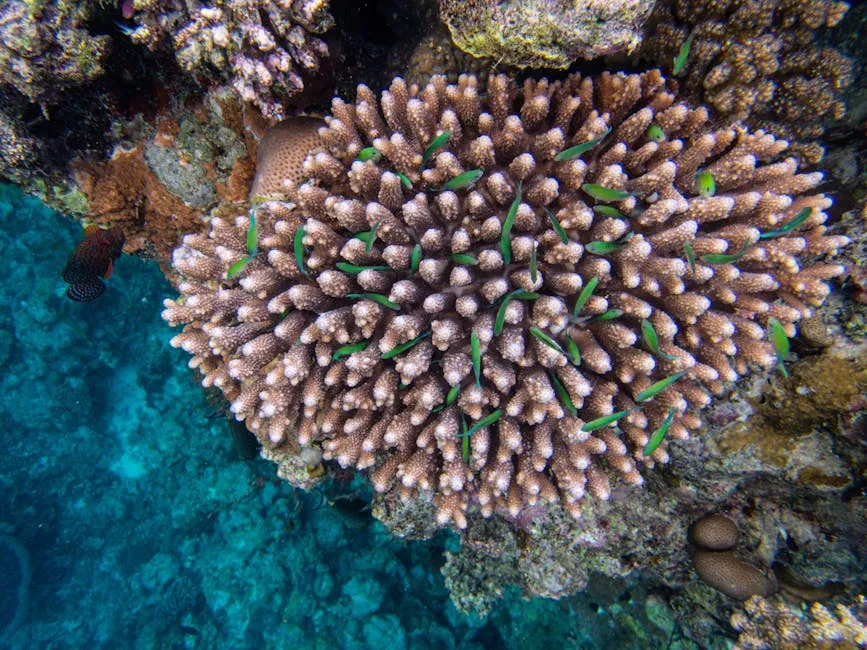
Environmental change is putting immense pressure on coral reefs. Image by Francesco Ungaro / Pexels.
Environmental change can disrupt entire ecosystems, affecting which species thrive and which may disappear. Scientists observe that rapid changes in climate or habitat can cause significant shifts in species populations. The survival of a species depends on how well it can respond to new selection pressures created by changing environments. These pressures include climate change, habitat destruction, new predators or competitors, disease, and natural disasters. Understanding these mechanisms helps explain why some species adapt, some migrate to new areas, and others become extinct.
How Environmental Changes Create Selection Pressures
When the environment changes, it can alter the conditions that species rely on for survival. For example, rising temperatures in the Arctic reduce the amount of sea ice, affecting polar bears’ ability to hunt for seals. This is a selection pressure because only bears with specific traits, such as strong swimming ability or efficient fat storage, may survive. If the change is gradual and there is enough genetic variation within the species, natural selection can favor individuals with traits that help them survive. Over generations, these traits become more common, and the species adapts. However, if the change is too fast or drastic, species may not have time to adapt and could face extinction.
Different Types of Environmental Change and Species Responses
There are several types of environmental changes that create new challenges for species. Climate change can cause droughts, floods, or shifts in temperature. Habitat destruction, such as deforestation, removes essential resources and living space. The arrival of new predators or invasive species can disrupt food webs. Disease outbreaks can wipe out populations with low resistance. For example, coral reefs are threatened by rising sea temperatures, which cause coral bleaching. Invasive species like the brown tree snake in Guam have caused the extinction of many native birds. Species can respond by adapting, migrating to more suitable habitats, or, in some cases, becoming extinct if they cannot survive the new conditions.
The Rate of Change: Adaptation or Extinction?
The speed of environmental change is a critical factor. Gradual changes allow for adaptation through natural selection, as there is enough time for beneficial traits to spread in the population. However, rapid changes, such as sudden habitat loss from a wildfire or a new disease, often outpace a species’ ability to adapt. Human-caused changes, like pollution or climate change, are happening at rates much faster than most natural changes in the past. This increases the risk of extinction for many species. Scientists use data on population trends, genetic diversity, and environmental conditions to predict which species are most at risk and to guide conservation efforts.
In conclusion, environmental change is a powerful force shaping the survival of species. The process of natural selection determines whether a species adapts, migrates, or goes extinct, depending on the type and speed of change. Understanding these interactions helps people protect biodiversity and make decisions that support healthy ecosystems for the future.
Interesting Fact: Coral reefs support about 25% of all marine life, even though they cover less than 1% of the ocean floor!
Comprehension quiz (10 questions)
1. What is a selection pressure?
2. According to the passage, what is one example of environmental change?
3. What does the term 'genetic variation' mean in this passage?
4. What does 'coral bleaching' refer to?
5. Based on the passage, why is the rate of environmental change important?
6. How might a species respond if it cannot adapt to a new environment?
7. What is one consequence of introducing invasive species to a new habitat?
8. Which of the following is an example of adaptation?
9. True or False: Most environmental changes caused by humans happen slower than natural changes.
10. True or False: Coral reefs cover more than half of the ocean floor.
Perfect for the way you teach
- Build comprehension skills
- Auto-graded quiz
- Differentiated reading
- Read together at home
- Improve fluency
- Quiet reading time
- Reading curriculum support
- Independent practice
- Track Lexile growth