How Climate Change Affects Seasons — Reading Comprehension
Rate this
Premium Resource
Present
Present in classroom. No work saved
Assign
Classroom with student accounts, Track progress
Quick Play
No student accounts, assign with a link
Grades
5
6
7
8
Standards
MS-ESS3-5
MS-LS4-4
PRINT+DIGITAL RESOURCE
This learning resource is available in interactive and printable formats. The interactive worksheet can be played online and assigned to students. The Printable PDF version can be downloaded and printed for completion by hand.
This passage explores the science of shifting seasons and their effects on ecosystems, aligning with NGSS standards MS-ESS3-5 and MS-LS4-4. Students will learn about biological and phenological changes such as earlier leaf budding, flower blooming, and animal migrations. The passage explains mechanisms behind these shifts, including changes in temperature and growing season length, and illustrates cause-and-effect relationships through real-world examples like the cherry blossoms in Japan and coral bleaching events. It highlights the consequences of mismatches between plants and animals, range shifts, and ecosystem disruptions. Key vocabulary is integrated with context clues, supporting comprehension at a 6–8th grade level. The resource includes a glossary, Spanish translation, differentiated version, and multiple activities (quiz, writing, graphic organizers) to support understanding. Audio integration is available for accessible learning. This text is ideal for middle school science classrooms focusing on systems thinking, environmental change, and scientific analysis.
CONTENT PREVIEW
Expand content preview
"Cherry blossoms in Yoyogi Park Tokyo by ウィキ太郎 (Wiki Taro) / Wikimedia Commons (CC0).
Phenology is the study of the timing of natural events, such as when leaves bud, flowers bloom, and animals migrate. In recent decades, scientists have observed that spring is arriving earlier in many parts of the world. Leaves are budding and flowers are blooming two to three weeks sooner than in the past. These changes in seasonal timing are not just local curiosities—they have important effects on ecosystems and the relationships between living things.
Mechanisms of Shifting Seasons
The main driver of shifting seasons is an increase in global temperatures. As the climate warms, plants and animals respond by changing the timing of their life cycles. For example, some birds now migrate and lay eggs earlier than they did fifty years ago. Butterflies and other insects are emerging sooner as well. These shifts are measured by scientists using long-term data sets and field observations. A key term for this process is phenological shift, which means a change in the timing of biological events due to environmental factors. Quantitative studies show that the average growing season has lengthened by about two weeks in many regions, and some species are moving their ranges northward at an average rate of 11 miles per decade.
Consequences for Ecosystems
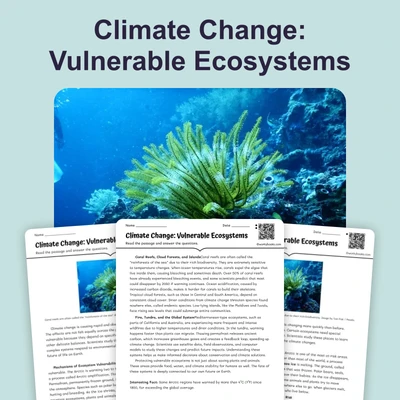
When species respond to shifting seasons at different rates, mismatches can occur. For instance, some caterpillars may hatch before the birds that feed on them arrive. Similarly, if flowers bloom before their pollinators emerge, pollination may not occur, affecting plant reproduction. These mismatches disrupt food webs and ecosystem interactions. In mountainous areas, tree lines are moving to higher elevations as temperatures rise. This creates new competition between species and may threaten those adapted to cooler habitats. Coral reefs are also vulnerable; when water temperatures rise, corals expel the algae they depend on in a process called coral bleaching, leading to massive die-offs.
Global and Local Examples
One famous example of phenological change is the cherry blossoms in Japan. Historical records show that cherry trees are blooming earlier now than at any other time in the past 1,200 years. In North America, scientists have documented tree lines moving higher up mountains, and bird species shifting their ranges toward the poles. These changes affect not only individual species but also entire communities, altering competition, predation patterns, and even human traditions tied to seasonal events.
Shifting seasons demonstrate how interconnected natural systems are. They show that changes in temperature can create chains of effects across populations, communities, and entire ecosystems. Understanding these patterns is essential for predicting future impacts of climate change and protecting biodiversity.
Interesting Fact: Some migratory birds now arrive at their breeding grounds up to 15 days earlier than they did just 40 years ago, showing how quickly nature can respond to a changing climate.
What is phenology the study of?
The timing of natural events like blooming and migrationHow rocks form undergroundThe chemical structure of plantsThe amount of rainfall in a year
According to the passage, how much earlier are leaves and flowers appearing in some places?
2-3 weeks2-3 days2-3 monthsThey are not appearing earlier
Which of the following best describes a phenological shift?
A change in the timing of biological events due to environmental factorsA plant growing taller than usualA new animal species being discoveredThe extinction of coral reefs
What is a potential consequence of a timing mismatch between plants and pollinators?
Pollination may not occur, affecting plant reproductionMore rainfall will happenPlants will grow fasterTrees will move to lower elevations
What does 'ecosystem' mean as used in the passage?
A community of living things and their environmentA single animal in its habitatA collection of rocks and mineralsA type of weather pattern
What does 'coral bleaching' refer to?
Corals losing their algae due to heat, causing die-offsCorals growing faster in warmer waterAlgae growing on rocksFish changing color
Why might mismatches between caterpillars and birds be a problem for ecosystems?
Birds may have less food to eat, affecting survivalCaterpillars will migrate northBirds will stop migratingTrees will not bud as early
If a species is moving its range northward at 11 miles per decade, what might this indicate about the environment?
Temperatures are rising, and species are seeking cooler conditionsThe Earth is spinning fasterThere is more rainfallBirds are getting larger
True or False: All species respond to changing seasons at the same speed.
TrueFalse
True or False: Cherry blossoms in Japan are blooming earlier than ever recorded.
TrueFalse
Perfect For:
👩🏫 Teachers
• Reading comprehension practice
• Auto-graded assessments
• Literacy skill development
👨👩👧👦 Parents
• Reading practice at home
• Comprehension improvement
• Educational reading time
🏠 Homeschoolers
• Reading curriculum support
• Independent reading practice
• Progress monitoring
Reading Features:
📖
Reading Passage
Engaging fiction or nonfiction text
❓
Comprehension Quiz
Auto-graded questions
📊
Instant Feedback
Immediate results and scoring
📄
Printable Version
Download for offline reading
🔊
Read Aloud
Voice-over with word highlighting
Reviews & Ratings
No reviews yet. Be the first to share your experience!
Related Content
Natural Disaster: Hurricanes
Hurricanes are massive storms with strong winds and rain. Tracking and preparing for them helps protect people in their ...
RI.3.1RI.4.4RI.4.2RI.5.2
The Giant Isopod: Biological Evolution
This NGSS passage examines how giant isopods evolved for deep-sea survival, including slow metabolism for food scarcity,...
MS-LS4-4RI.6.3RI.7.3RI.8.8
How Climate Change Affects Animal Migration
This NGSS-aligned science reading passage explains how climate change affects animal migration by altering seasonal cues...
MS-LS2-6MS-ESS3-5
What Is Global Warming?
This NGSS-aligned reading passage explains global warming, the greenhouse effect, and how human activities like burning ...
MS-ESS3-5
What Causes Global Warming?
This NGSS-aligned reading passage explains what causes global warming, focusing on how human activities like burning fos...
MS-ESS3-5
How to Stop Global Warming
This NGSS-aligned reading passage helps students understand how to stop global warming by reducing greenhouse gases. It ...
MS-ESS3-5
Human Impacts: Climate Change
This standards-aligned science reading passage for grades 6-8 explains the mechanisms and effects of human-driven climat...
MS-LS2-4MS-ESS3-5
What Is Biodiversity?
This comprehensive science reading passage for grades 6-8 introduces students to biodiversity and explores its importanc...
MS-LS2-5MS-LS4-4
Climate Change: Vulnerable Ecosystems
This middle school science passage, aligned with NGSS standards MS-ESS3-5 and MS-LS2-4, helps students understand how cl...
MS-ESS3-5MS-LS2-4
Climate Change: Solutions and Mitigation
This passage explores scientific solutions and mitigation strategies for climate change, designed for middle school scie...
MS-ESS3-4MS-ESS3-5
Vertebrates: Fishes
This middle school science reading passage offers an in-depth look at fishes, a major group of vertebrates. It covers fi...
MS-LS4-2MS-LS4-4
Vertebrates: Amphibians
This comprehensive middle school science passage dives into the fascinating world of amphibians, a group of vertebrates ...
MS-LS4-2MS-LS4-4
Vertebrates: Reptiles
This comprehensive science passage for grades 6-8 introduces students to reptiles, a fascinating class of vertebrates. A...
MS-LS4-2MS-LS4-4
Vertebrates: Birds
This middle school science passage explores birds as vertebrates, focusing on their unique adaptations such as feathers,...
MS-LS4-2MS-LS4-4
Vertebrates: Mammals
This comprehensive passage introduces middle school students to the class Mammalia and their defining characteristics, i...
MS-LS4-2MS-LS4-4
Invertebrates: Arthropods
This comprehensive science passage introduces middle school students to the phylum Arthropoda, the largest and most dive...
MS-LS4-2MS-LS4-4
Biodiversity and Its Importance
This comprehensive middle school science passage explores the concept of biodiversity at the genetic, species, and ecosy...
MS-LS4-4MS-LS2-5
Scientific Inquiry in Earth Science
This passage explores scientific inquiry in Earth science for grades 6-8, aligned with NGSS standards MS-ESS1-4, MS-ESS2...
MS-ESS1-4MS-ESS2-1MS-ESS3-5SEP
Galápagos Islands
This engaging science passage explores the Galápagos Islands, a volcanic archipelago located off the coast of Ecuador in...
MS-LS2-1MS-LS4-4MS-ESS3-4
Great Barrier Reef
This passage introduces middle school students to the Great Barrier Reef, the world's largest coral reef system, located...