Reading PassagePremium

Committees of Correspondence

Interactive passage with audio narration, comprehension questions, and printable PDF.

No ratings yet|
1
Grades 6–8ElaSocial-studiesHistoryEnglish · SpanishInteractive · Printable
Just this resource
$1.50
One-time purchase
Best value
Unlock everything
$49.99$29.99/yr
40% off until Aug 1 — 10,000+ resources
Renews at $49.99/year.
Unlock above to use these actions

What's included

Reading passage
Audio narration
Comprehension quiz
Writing activity
Glossary & flashcards
Differentiated version
Spanish translation

Committees of Correspondence preview and details

About this printable Committees of Correspondence reading passage (Grades 6-8)

This passage explores the rise of colonial protests and the formation of the Committees of Correspondence during the period of British rule in America. Students will learn how new British taxes and the presence of soldiers led colonists to feel oppressed and sparked organized resistance. The reading passage uses multiple perspectives, analyzes the causes and effects of colonial actions, and incorporates an authentic primary source quote. It models historical reasoning and aligns with CA HSS 5.5 and TEKS 8.4 as well as Common Core RI.6.3, RI.6.4, W.6.2. The resource includes a Spanish translation, a differentiated reading version for accessibility, glossary, multiple-choice quiz, writing prompts, graphic organizers, and a timeline. This is a comprehensive history reading passage with read aloud audio and Spanish translation, perfect for supporting literacy and social studies skills.
Written by Workybooks TeamPublished by Workybooks
Preview

Sample passage and quiz from Committees of Correspondence

Reading passage and comprehension quiz preview

Committees of Correspondence
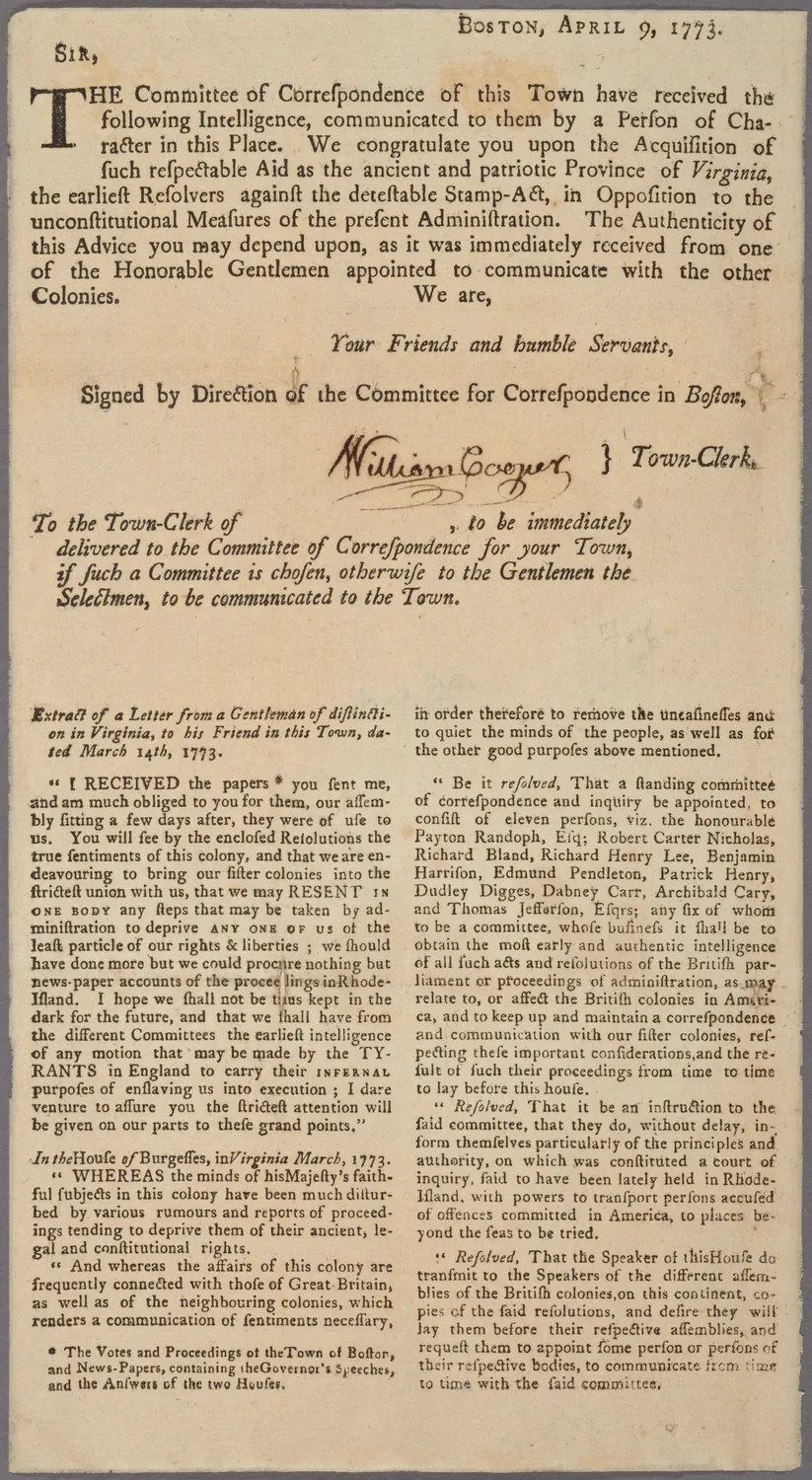
Boston Committee of Correspondence 9 April 1773
The Boston Committee of Correspondence published this circular letter, which includes the resolutions of the Virginia House of Burgesses to create a committee of correspondence.
 Wikimedia Commons (Public domain).

The Committees of Correspondence were groups organized by colonial leaders in the American colonies during the 1760s and 1770s. Their main purpose was to share important information about British policies and to coordinate responses among the colonies. At that time, the British government passed new laws and taxes, such as the Stamp Act and Townshend Acts, which many colonists believed were unfair. The committees became a solution to the problem of slow and unreliable communication between distant colonies.

Before the Committees of Correspondence, each colony often acted separately. This lack of coordination made it difficult for colonists to resist British actions effectively. News traveled slowly, and some colonies did not even know what others were doing. The committees created a communication network that allowed leaders to send letters, pamphlets, and reports quickly across great distances. In this way, information about protests and British actions could be shared, making it easier for the colonies to work together toward common goals.

One of the earliest and most influential committees was established in Boston in 1772, led by Samuel Adams. The Boston Committee of Correspondence wrote letters to other towns and colonies, explaining the dangers of British control and urging united action. Soon, other colonies formed similar committees, and by 1774, almost every colony had one. These committees helped organize mobilization—the process of preparing people for collective action—by encouraging colonists to boycott British goods or attend protests.

The Committees of Correspondence did not always agree on every issue. There were debates among colonial leaders about how far to go in resisting British authority. Some wanted peaceful petitions, while others supported more direct actions. However, the committees provided a structure for these discussions and helped build trust among the colonies. This unity was critical when the First Continental Congress met in 1774, as delegates from different colonies already had experience working together through the committees.

The British government viewed the Committees of Correspondence as a threat because they encouraged resistance and organized opposition. In response, British officials tried to suppress the committees and control the flow of information. However, the committees continued their work in secret when necessary, using trusted messengers and coded language to avoid detection. Their determination showed the colonists’ commitment to self-government and their willingness to defend their rights.

The long-term impact of the Committees of Correspondence was significant. They helped establish a sense of unity among the thirteen colonies and laid the foundation for larger revolutionary organizations. The skills and relationships developed through the committees were essential during the early years of the American Revolution. By sharing information, coordinating action, and building trust, the Committees of Correspondence helped turn separate colonies into a united movement for independence.

Interesting Fact: The Committees of Correspondence were sometimes called the "colonial internet" because they allowed information to spread rapidly long before modern technology existed.

Comprehension quiz (8 questions)

1. When did Boston form its committee?

1772
1765
1781
1790

2. Who led the Boston committee?

Samuel Adams
George Washington
Thomas Jefferson
Benjamin Franklin

3. What was a main goal of the committees?

Share information
Collect taxes
Sign treaties
Draft a constitution

4. Why did colonies need coordination?

To resist British control better
To build new cities
To trade with Spain
To avoid elections

5. How did the committees help unity?

By sharing news quickly
By hiring soldiers
By building forts
By planting crops

6. What did the British try to do?

Suppress the committees
Give money to the colonies
Send more letters
Support protests

7. Committees of Correspondence were called the 'colonial internet.'

True
False

8. What does 'mobilization' mean?

Getting people ready to act
Writing peaceful letters
Making maps
Building ships
Who it's for

Perfect for the way you teach

Teachers
  • Build comprehension skills
  • Auto-graded quiz
  • Differentiated reading
Parents
  • Read together at home
  • Improve fluency
  • Quiet reading time
Homeschoolers
  • Reading curriculum support
  • Independent practice
  • Track Lexile growth
Topics

Reviews & Ratings

No reviews yet. Be the first to share your experience!

More reading you might love

20 more
Passage
Great Awakening Colonial America - reading educational content

Great Awakening Colonial America

Reading Passage

$1.50
Passage
Quakers in Colonial America - reading educational content

Quakers in Colonial America

Reading Passage · D2.HIS.2.3-5

$1.50
Passage
Indentured Servants in Colonial America  - reading educational content

Indentured Servants in Colonial America

Reading Passage · D2.HIS.2.3-5

$1.50
Passage
Cities in Colonial America - reading educational content

Cities in Colonial America

Reading Passage · HSS 5.4.6

$1.50
Passage
Why Europeans Immigrated to Colonial America - reading educational content

Why Europeans Immigrated to Colonial America

Reading Passage · D2.HIS.2.3-5

$1.50
Passage
Colonial Social Classes - reading educational content

Colonial Social Classes

Reading Passage · D2.HIS.2.3-5

$1.50
Passage
Colonial Slave Resistance - reading educational content

Colonial Slave Resistance

Reading Passage · D2.HIS.2.3-5

$1.50
Passage
Benjamin Franklin in Colonial America - reading educational content

Benjamin Franklin in Colonial America

Reading Passage · HSS 5.5

$1.50
Passage
How the Middle Colonies Were Governed - reading educational content

How the Middle Colonies Were Governed

Reading Passage · D2.HIS.2.3-5

$1.50
Passage
Life in the Southern Colonies - reading educational content

Life in the Southern Colonies

Reading Passage · D2.HIS.4.3-5

$1.50
Passage
Colonial Printing Press - reading educational content

Colonial Printing Press

Reading Passage · HSS 5.5

$1.50
Passage
Frontier Life in Colonial America - reading educational content

Frontier Life in Colonial America

Reading Passage · HSS 5.4.6

$1.50
Passage
Colonial Jobs: Blacksmiths, Bakers, and Craftsmen - reading educational content

Colonial Jobs: Blacksmiths, Bakers, and Craftsmen

Reading Passage · D2.HIS.2.3-5

$1.50
Passage
Colonial Apprenticeship System  - reading educational content

Colonial Apprenticeship System

Reading Passage · HSS 5.4.6

$1.50
Passage
Native American Allies in Colonial Wars - reading educational content

Native American Allies in Colonial Wars

Reading Passage · D2.HIS.2.3-5

$1.50
Passage
Colonial Clothing and Homemade Goods - reading educational content

Colonial Clothing and Homemade Goods

Reading Passage · D2.HIS.2.3-5

$1.50
Passage
Colonial Labor Shortage - reading educational content

Colonial Labor Shortage

Reading Passage · CA HSS 8.1.2

$1.50
Passage
Colonial Women's Lives - reading educational content

Colonial Women's Lives

Reading Passage · D2.HIS.2.3-5

$1.50
Passage
African Diaspora in the Americas - reading educational content

African Diaspora in the Americas

Reading Passage · HSS 8.7

$1.50
Passage
Colonial Games and Entertainment - reading educational content

Colonial Games and Entertainment

Reading Passage · D2.HIS.1.3-5

$1.50
Copyright © 2026 Workybooks. Made with ♥ in California.