Light-Years and Cosmic Distances
Interactive passage with audio narration, comprehension questions, and printable PDF.
By completing this purchase you agree to our Terms of Use and Privacy Policy. Your subscription renews automatically until you cancel. You can cancel anytime from your account settings. All sales are final and non-refundable. Digital content is available for download in your account immediately upon purchase.
What's included
Light-Years and Cosmic Distances preview and details
About this printable Light-Years and Cosmic Distances science reading passage, NGSS-aligned (Grades 5-8)
Sample passage and quiz from Light-Years and Cosmic Distances
Reading passage and comprehension quiz preview
Light-Years and Cosmic Distances
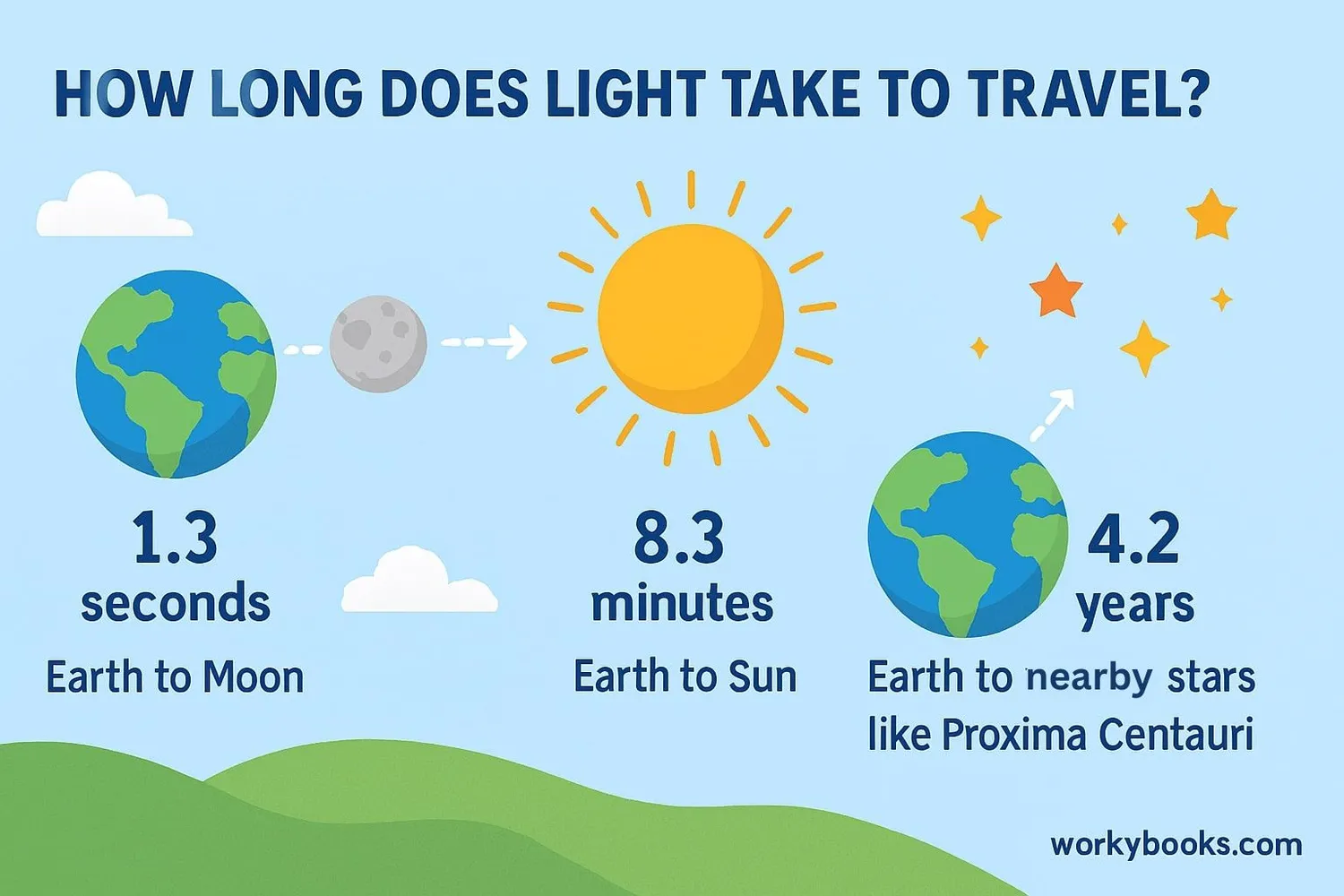
Light travels at a speed of about 300,000 kilometers per second, allowing it to cross enormous distances in space. When astronomers want to measure how far away stars and galaxies are, they use a special unit called a light-year. A light-year is the distance that light can travel in one year—about 9.5 trillion kilometers. This unit helps scientists describe the vastness of the universe in more manageable terms.
The concept of the light-year is essential for understanding cosmic distances. The space between objects in the universe is so immense that using kilometers or miles would result in numbers that are difficult to comprehend. For example, the nearest star to our solar system, Proxima Centauri, is about 4.2 light-years away. This means the light we see from Proxima Centauri left that star over four years ago. When we observe more distant objects, such as Betelgeuse, a bright red supergiant star about 700 light-years away, or the center of our Milky Way galaxy, which is around 26,000 light-years distant, we are actually seeing them as they were in the past. The Andromeda Galaxy, the nearest spiral galaxy to ours, is about 2.5 million light-years away, so its light began traveling toward us long before humans existed.
How Astronomers Measure Distances
Measuring cosmic distances is a challenge that requires creative methods. One approach is parallax, which involves observing how a nearby star appears to shift against the background of more distant stars as Earth orbits the Sun. The amount of shift lets astronomers use trigonometry to calculate the star’s distance. For more distant objects, scientists use standard candles, such as certain types of stars that always shine with a known brightness. By comparing their observed brightness to their true brightness, astronomers can estimate how far away they are. For the most remote galaxies, redshift is used: as the universe expands, light from distant galaxies stretches and shifts toward the red end of the spectrum. The amount of redshift tells scientists how far the galaxy is.
Looking Back in Time
Because light takes time to travel, looking at distant objects means looking back in time. When astronomers observe a galaxy 1 million light-years away, they see it as it was 1 million years ago. This allows scientists to study the history of the universe and understand how galaxies and stars have changed over billions of years. The observable universe—the part we can see—is about 46 billion light-years in radius. Even with the best telescopes, we can only study objects whose light has had time to reach us since the beginning of the universe.
Why Measuring Cosmic Distances Matters
Measuring distances in space helps scientists discover how the universe is structured and how it has evolved. By studying the positions and ages of stars and galaxies, astronomers can test theories about the origin and fate of the universe. These measurements also help us understand our place in the cosmos and inspire new technologies for exploring space.
Interesting Fact: The light from the Andromeda Galaxy that we see tonight left that galaxy about 2.5 million years ago—before modern humans existed on Earth!
Comprehension quiz (10 questions)
1. What is a light-year?
2. Why do astronomers use light-years instead of kilometers to measure space distances?
3. How far away is Proxima Centauri from Earth?
4. What does redshift tell scientists about a galaxy?
5. What is the observable universe?
6. In the passage, what does 'standard candle' mean?
7. When we see light from Andromeda Galaxy, what does it show us?
8. Which method do astronomers use to measure the distance to nearby stars?
9. True or False: Light from Betelgeuse takes about 700 years to reach Earth.
10. True or False: The center of the Milky Way is closer to Earth than Proxima Centauri.
Perfect for the way you teach
- Build comprehension skills
- Auto-graded quiz
- Differentiated reading
- Read together at home
- Improve fluency
- Quiet reading time
- Reading curriculum support
- Independent practice
- Track Lexile growth