This learning resource is available in interactive and printable formats. The interactive worksheet can be played online and assigned to students. The Printable PDF version can be downloaded and printed for completion by hand.
This engaging science passage for grades 6-8 introduces students to the outer planets—Jupiter, Saturn, Uranus, and Neptune—emphasizing their role as gas and ice giants in our solar system. Students will learn about the planets’ massive sizes, unique atmospheres, ring systems, and diverse moons such as Europa, Titan, and Enceladus. The text explores how these characteristics result from their distance from the Sun and different chemical makeups. It covers historical and recent space missions like Voyager, Juno, and Cassini, demonstrating how scientists gather evidence about these distant worlds. The passage is aligned with NGSS standards MS-ESS1-2 and MS-ESS1-3, focusing on planetary systems and scientific investigation. Activities include comprehension questions, writing prompts, graphic organizers, and vocabulary support. The passage is audio-integrated and available in both English and Spanish, making it accessible for diverse learners.
CONTENT PREVIEW
Expand content preview
The Outer Planets
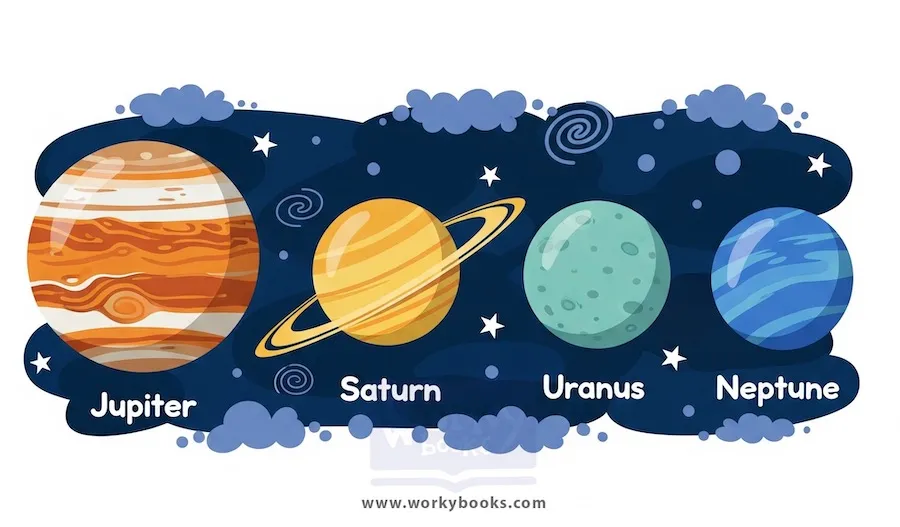
The outer planets of our solar system—Jupiter, Saturn, Uranus, and Neptune—stand out because of their large sizes, thick atmospheres, and fascinating systems of moons and rings. Unlike the rocky inner planets, these worlds are called gas giants and ice giants because they are made mostly of hydrogen, helium, and other light elements. Their great distance from the Sun keeps their temperatures extremely low, which affects their structure and the types of phenomena we observe. Scientists have used powerful telescopes and robotic spacecraft to gather information and answer questions about how these planets formed and how their complex systems work.
The Structure and Features of Gas and Ice Giants
Jupiter and Saturn are known as gas giants. Jupiter is the largest planet in our solar system, with a diameter of about 143,000 kilometers—over 11 times that of Earth. Its famous Great Red Spot is a giant storm bigger than our entire planet, demonstrating the extreme weather possible in such thick atmospheres. Jupiter has at least 95 known moons, including Europa, which is believed to have a liquid water ocean beneath its icy crust. Saturn, slightly smaller than Jupiter but still massive, is well-known for its spectacular ring system made of ice and rock particles. Saturn hosts over 146 moons, and one of them, Titan, has a thick nitrogen-rich atmosphere and lakes of liquid methane, unlike anywhere else in the solar system.
Ice Giants and Dynamic Systems
Uranus and Neptune are called ice giants because, in addition to hydrogen and helium, they contain more water, ammonia, and methane ices. Uranus is unique because it rotates on its side, likely due to a collision early in its history. Its blue-green color comes from methane in its atmosphere, which absorbs red light. Neptune, the farthest planet, is known for its intense winds—the fastest in the solar system, reaching speeds over 2,000 kilometers per hour. Neptune’s largest moon, Triton, orbits in the opposite direction of Neptune’s rotation and may be a captured object from the Kuiper Belt. Both Uranus and Neptune have faint rings and multiple moons, adding to their complexity.
Exploring the Outer Planets
Our understanding of the outer planets comes from both Earth-based observations and spacecraft missions. The Voyager 1 and 2 missions provided our first close-up views in the late 1970s and 1980s. More recently, the Juno spacecraft has been studying Jupiter’s magnetic field and storms, while the Cassini mission orbited Saturn for over a decade, revealing geysers on Enceladus and the methane lakes of Titan. These missions have helped scientists develop models to explain how the outer planets formed, how their atmospheres behave, and what their moons might be like. The study of these distant worlds helps us understand planet formation, weather systems, and the potential for life beyond Earth.
Understanding the outer planets and their moons is essential for building a complete picture of our solar system’s history and future. Their unique characteristics demonstrate how distance from the Sun and chemical composition shape planetary systems. Technological advances in space exploration continue to reveal new details and challenge our ideas about what is possible in the universe.
Interesting Fact: Saturn’s moon Enceladus shoots water geysers into space, suggesting a possible underground ocean that could support life.
Which planets are considered the outer planets in our solar system?
Jupiter, Saturn, Uranus, NeptuneMercury, Venus, Earth, MarsEarth and Mars onlyPluto and Ceres
What makes gas giants different from ice giants?
Gas giants have more hydrogen and helium, ice giants have more ices like water and methaneGas giants are smaller than ice giantsIce giants are closer to the SunIce giants have no moons
What is the Great Red Spot?
A giant storm on JupiterA mountain on SaturnA moon of NeptuneA ring around Uranus
Based on the passage, which moon is known for having lakes of methane?
TitanEuropaEnceladusTriton
What does the passage say about Neptune’s winds?
They are the fastest in the solar systemThey are slower than Earth’s windsThey do not existThey only blow at night
What does the word 'atmospheres' mean as used in the passage?
Thick layers of gas around a planetOceans on a planetRocks on a planetMountains on a moon
In the passage, what is the 'Kuiper Belt'?
A region beyond Neptune with icy objectsA ring around JupiterA type of moonA storm on Saturn
Why do scientists think Europa might have an ocean under its ice?
Because of evidence from spacecraft and its icy crustBecause it is redBecause it has volcanoesBecause it is close to the Sun
True or False: Saturn’s rings are made of ice and rock particles.
TrueFalse
True or False: All outer planets have the same number of moons.
FalseTrue
Perfect For:
👩🏫 Teachers
• Reading comprehension practice
• Auto-graded assessments
• Literacy skill development
👨👩👧👦 Parents
• Reading practice at home
• Comprehension improvement
• Educational reading time
🏠 Homeschoolers
• Reading curriculum support
• Independent reading practice
• Progress monitoring
Reading Features:
📖
Reading Passage
Engaging fiction or nonfiction text
❓
Comprehension Quiz
Auto-graded questions
📊
Instant Feedback
Immediate results and scoring
📄
Printable Version
Download for offline reading
🔊
Read Aloud
Voice-over with word highlighting
Reviews & Ratings
No reviews yet. Be the first to share your experience!
Related Content
Sunspots and Solar Flares
This quiz is designed to test your understanding of the fascinating phenomena of sunspots and solar flares, as described...
RI.4.1RI.4.4RI.5.1ESS1.A
The Hottest Planet in the Solar System
This NGSS-aligned middle school reading passage explains why Venus is the hottest planet in our solar system. Students l...
MS-ESS1-3
Comets
This middle school science passage explores the fascinating world of comets, commonly known as 'dirty snowballs.' Studen...
MS-ESS1-2
Mercury: Closest to the Sun
This comprehensive, standards-aligned passage explores Mercury—the smallest and closest planet to the Sun. Students in g...
MS-ESS1-2MS-ESS1-3
Venus: Earth's Twin?
This comprehensive science passage for grades 6-8 examines Venus—often called Earth's twin—by exploring its similarities...
MS-ESS1-2MS-ESS1-3
Earth: Our Home Planet
This comprehensive science passage for grades 6-8 explores Earth’s unique characteristics and the interconnected systems...
MS-ESS1-2
Mars: The Red Planet
This middle school science passage explores Mars, the Red Planet, providing students in grades 6-8 with a comprehensive ...
MS-ESS1-2MS-ESS1-3
What Is Gravity?
This comprehensive middle school science reading passage explores the concept of gravity, aligning with NGSS standards M...
MS-ESS1-2MS-PS2-4
Kepler's Laws of Planetary Motion
This comprehensive middle school science passage explores Kepler's Laws of Planetary Motion, meeting NGSS Standard MS-ES...
MS-ESS1-2
Tides and Tidal Forces
This middle school science passage explores the mechanisms of tides and tidal forces, aligning with NGSS standards MS-ES...
MS-ESS1-1MS-ESS1-2
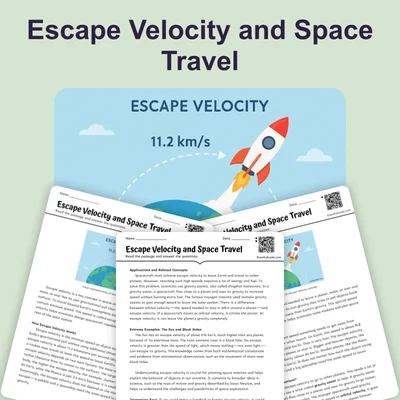
Escape Velocity and Space Travel
This middle school science passage introduces students to the concept of escape velocity—the minimum speed required to b...
MS-ESS1-2MS-PS2-4
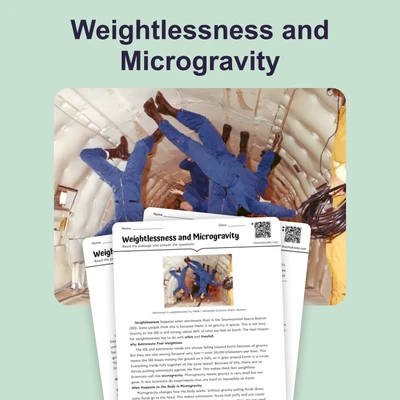
Weightlessness and Microgravity
This science reading passage for middle school students explores the phenomenon of weightlessness and microgravity. Alig...
MS-PS2-4MS-ESS1-2
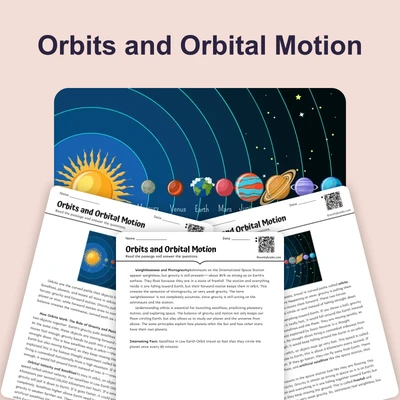
Orbits and Orbital Motion
This middle school science passage, aligned with NGSS MS-ESS1-2 and MS-PS2-4, explores the science of orbits and orbital...
MS-ESS1-2MS-PS2-4
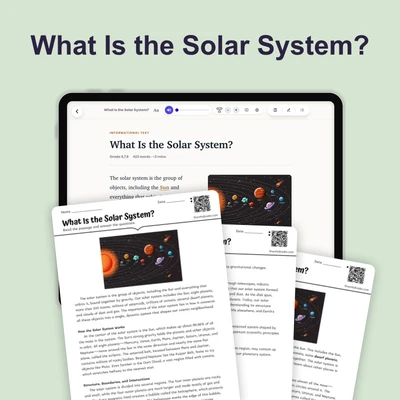
What Is the Solar System?
This passage provides a comprehensive overview of the solar system for grades 6-8, aligned with NGSS standards MS-ESS1-2...
MS-ESS1-2MS-ESS1-3
Structure of the Solar System
This comprehensive science reading passage introduces middle school students (grades 6-8) to the structure of the solar ...
MS-ESS1-2MS-ESS1-3
Moons of the Solar System
This comprehensive passage, designed for grades 6-8 and aligned to NGSS standard MS-ESS1-2, delves into the fascinating ...
MS-ESS1-2
Scale of the Solar System
This passage, aligned to NGSS standard MS-ESS1-3, helps middle school students grasp the immense scale of the solar syst...
MS-ESS1-3
Exploration of the Solar System
This comprehensive passage for grades 6-8 examines how humans explore the solar system, aligning with NGSS standards MS-...
MS-ESS1-3MS-ETS1-1
Optical Telescopes
This comprehensive passage explores the science of optical telescopes for middle school students, aligning with NGSS sta...
MS-ESS1-3MS-ETS1-1
Future of Alien Search
This informational passage for grades 6-8 explores how scientists are using cutting-edge missions and technology to sear...