This learning resource is available in interactive and printable formats. The interactive worksheet can be played online and assigned to students. The Printable PDF version can be downloaded and printed for completion by hand.
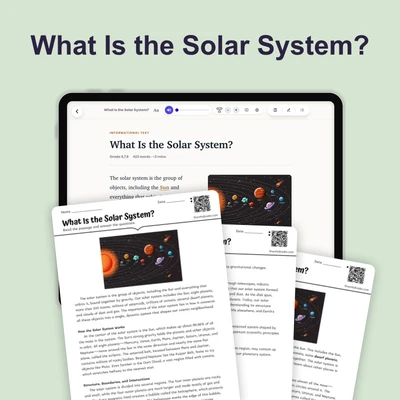
This middle school science passage introduces students to the solar system, aligning with NGSS standards MS-ESS1-2 and MS-ESS1-3. The passage explains the formation of the solar system, the roles of the Sun, planets, moons, dwarf planets, asteroids, comets, and meteoroids. Students will learn about the structure and interactions within the solar system, including the differences between inner and outer planets, and the regions such as the asteroid belt, Kuiper Belt, and Oort Cloud. The text integrates scientific thinking, real-world implications, and connections to larger scientific principles. Activities include a quiz, writing prompts, classification and compare/contrast graphic organizers, and are designed for audio integration. This resource builds vocabulary and comprehension while fostering scientific inquiry and analysis.
CONTENT PREVIEW
Expand content preview
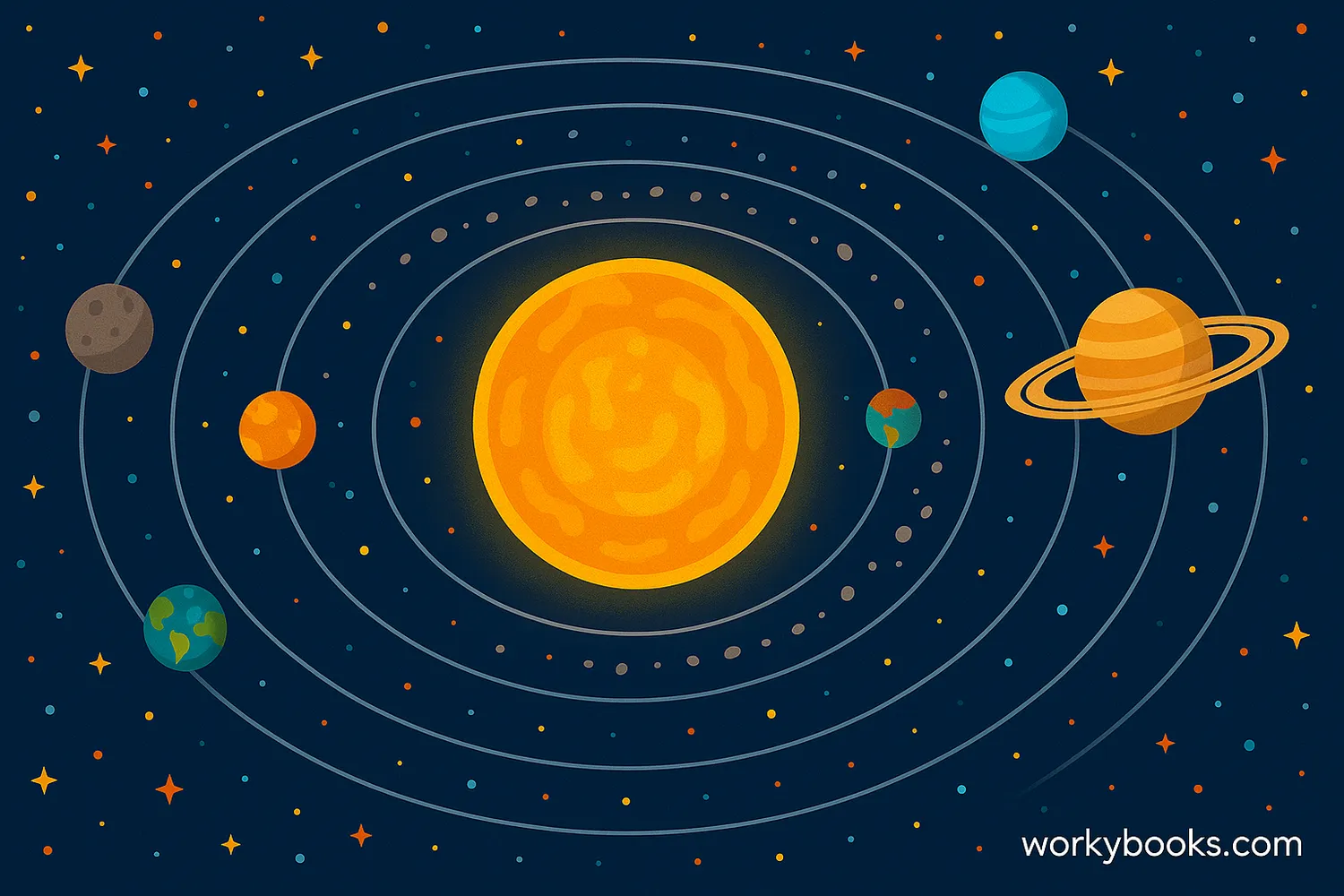
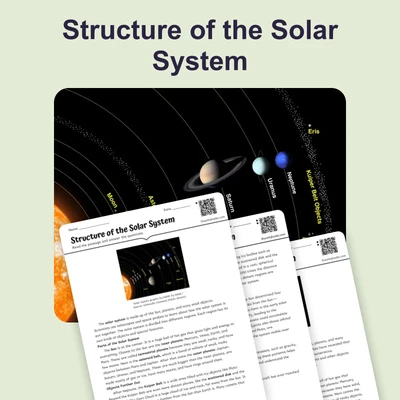
Our Solar System with the Sun at the center
The solar system is the collection of the Sun and all the objects that orbit around it, bound together by gravity. Scientists observe that planets move in regular paths around the Sun, which led to the discovery that the Sun contains over 99.8% of the system’s mass and acts as its center. Understanding the solar system is important because it helps us learn about the origins of Earth and the possible conditions for life elsewhere in the universe. This passage explores the structure, formation, and interactions of the solar system’s components.
Formation and Structure The solar system formed about 4.6 billion years ago from a nebula, which is a cloud of gas and dust in space. Due to gravity, this cloud collapsed, causing most of its material to gather at the center and form the Sun through a process called nuclear fusion. The remaining material spun around the Sun as a flat disk, gradually clumping together to create planets, moons, asteroids, and other bodies. The eight major planets are divided into two groups: the inner rocky planets (Mercury, Venus, Earth, and Mars) and the outer giants (Jupiter and Saturn as gas giants; Uranus and Neptune as ice giants). The asteroid belt lies between Mars and Jupiter, containing rocky debris. Beyond Neptune, the Kuiper Belt holds icy bodies and dwarf planets like Pluto and Eris. Farther out, the Oort Cloud is a spherical shell of icy objects that may be the source of long-period comets.
Systems and Interactions All bodies in the solar system interact through gravity and motion. The Sun’s gravity keeps planets in orbit, while planets’ gravity shapes the paths of their own moons and affects asteroids and comets. For example, Jupiter’s strong gravity influences the asteroid belt and helps shield inner planets from incoming comets. Moons orbit planets, and some, like Earth’s Moon, affect tides and even stabilize the planet’s axis. Scientists use telescopes, space probes, and mathematical models to study how these interactions occur and change over time. The scale of the solar system is enormous: Neptune is about 30 times farther from the Sun than Earth, and the Oort Cloud may extend up to 100,000 times farther than Earth’s distance from the Sun.
Real-World Implications and Connections Studying the solar system provides evidence for how planetary systems form around other stars, which is key to searching for life beyond Earth. Understanding impacts from asteroids and comets helps us protect our planet. Technology developed for exploring space has led to advances in materials, robotics, and communication on Earth. The solar system is also a laboratory for understanding physical laws, such as gravity and motion, that apply throughout the universe.
The solar system’s components work as a system, with each part influencing the others. This interconnectedness demonstrates core scientific principles and helps answer big questions about our place in the universe.
Interesting Fact: Jupiter is so massive that it could hold all the other planets combined and still have room left over!
What holds the solar system together?
GravityMagnetismElectricityAir pressure
Which object contains most of the mass in the solar system?
JupiterThe asteroid beltThe SunNeptune
What is the asteroid belt?
A region of icy bodies beyond NeptuneA ring of rocks between Mars and JupiterA layer of gas around the SunThe path comets follow
Which planets are called gas giants?
Earth and MarsJupiter and SaturnMercury and VenusUranus and Neptune
What does 'nuclear fusion' mean as used in the passage?
When atoms split to release energyWhen asteroids collideWhen atoms combine and release energyWhen planets form rings
What is a nebula in the context of solar system formation?
A rocky planetA type of moonA cloud of gas and dustA ring of comets
Why is Jupiter important for the solar system?
It is the hottest planetIts gravity helps protect inner planets from cometsIt orbits the Oort CloudIt absorbs sunlight
If Neptune is about 30 times farther from the Sun than Earth, what does this tell us about the solar system?
It is very smallIt is very crowdedIt is very largeIt is mostly filled with air
The Sun is at the center of the solar system. (True/False)
TrueFalse
The Kuiper Belt is located between Earth and Mars. (True/False)
TrueFalse
Perfect For:
👩🏫 Teachers
• Reading comprehension practice
• Auto-graded assessments
• Literacy skill development
👨👩👧👦 Parents
• Reading practice at home
• Comprehension improvement
• Educational reading time
🏠 Homeschoolers
• Reading curriculum support
• Independent reading practice
• Progress monitoring
Reading Features:
📖
Reading Passage
Engaging fiction or nonfiction text
❓
Comprehension Quiz
Auto-graded questions
📊
Instant Feedback
Immediate results and scoring
📄
Printable Version
Download for offline reading
🔊
Read Aloud
Voice-over with word highlighting
Reviews & Ratings
No reviews yet. Be the first to share your experience!
Related Content
Sunspots and Solar Flares
This quiz is designed to test your understanding of the fascinating phenomena of sunspots and solar flares, as described...
RI.4.1RI.4.4RI.5.1ESS1.A
The Hottest Planet in the Solar System
This NGSS-aligned middle school reading passage explains why Venus is the hottest planet in our solar system. Students l...
MS-ESS1-3
Comets
This middle school science passage explores the fascinating world of comets, commonly known as 'dirty snowballs.' Studen...
MS-ESS1-2
Mercury: Closest to the Sun
This comprehensive, standards-aligned passage explores Mercury—the smallest and closest planet to the Sun. Students in g...
MS-ESS1-2MS-ESS1-3
Venus: Earth's Twin?
This comprehensive science passage for grades 6-8 examines Venus—often called Earth's twin—by exploring its similarities...
MS-ESS1-2MS-ESS1-3
Earth: Our Home Planet
This comprehensive science passage for grades 6-8 explores Earth’s unique characteristics and the interconnected systems...
MS-ESS1-2
Mars: The Red Planet
This middle school science passage explores Mars, the Red Planet, providing students in grades 6-8 with a comprehensive ...
MS-ESS1-2MS-ESS1-3
What Is Gravity?
This comprehensive middle school science reading passage explores the concept of gravity, aligning with NGSS standards M...
MS-ESS1-2MS-PS2-4
Kepler's Laws of Planetary Motion
This comprehensive middle school science passage explores Kepler's Laws of Planetary Motion, meeting NGSS Standard MS-ES...
MS-ESS1-2
Tides and Tidal Forces
This middle school science passage explores the mechanisms of tides and tidal forces, aligning with NGSS standards MS-ES...
MS-ESS1-1MS-ESS1-2
Escape Velocity and Space Travel
This middle school science passage introduces students to the concept of escape velocity—the minimum speed required to b...
MS-ESS1-2MS-PS2-4
Weightlessness and Microgravity
This science reading passage for middle school students explores the phenomenon of weightlessness and microgravity. Alig...
MS-PS2-4MS-ESS1-2
Orbits and Orbital Motion
This middle school science passage, aligned with NGSS MS-ESS1-2 and MS-PS2-4, explores the science of orbits and orbital...
MS-ESS1-2MS-PS2-4
What Is the Solar System?
This passage provides a comprehensive overview of the solar system for grades 6-8, aligned with NGSS standards MS-ESS1-2...
MS-ESS1-2MS-ESS1-3
Structure of the Solar System
This comprehensive science reading passage introduces middle school students (grades 6-8) to the structure of the solar ...
MS-ESS1-2MS-ESS1-3
Moons of the Solar System
This comprehensive passage, designed for grades 6-8 and aligned to NGSS standard MS-ESS1-2, delves into the fascinating ...
MS-ESS1-2
Scale of the Solar System
This passage, aligned to NGSS standard MS-ESS1-3, helps middle school students grasp the immense scale of the solar syst...
MS-ESS1-3
Exploration of the Solar System
This comprehensive passage for grades 6-8 examines how humans explore the solar system, aligning with NGSS standards MS-...
MS-ESS1-3MS-ETS1-1
Optical Telescopes
This comprehensive passage explores the science of optical telescopes for middle school students, aligning with NGSS sta...
MS-ESS1-3MS-ETS1-1
Future of Alien Search
This informational passage for grades 6-8 explores how scientists are using cutting-edge missions and technology to sear...