This learning resource is available in interactive and printable formats. The interactive worksheet can be played online and assigned to students. The Printable PDF version can be downloaded and printed for completion by hand.
This comprehensive reading passage introduces middle school students to the science of astronomy, which is the study of objects and phenomena beyond Earth's atmosphere. Aligned with NGSS standards MS-ESS1-2 and MS-ESS1-3, this passage explores the mechanisms behind astronomical observations, the branches of astronomy (such as planetary science and cosmology), and their interactions. Students learn about the historical significance of astronomy, the questions it seeks to answer, and its technological and societal applications, such as GPS and weather satellites. The passage also highlights related fields and career paths, making it relevant for real-world connections. Glossary terms, a differentiated version for struggling readers, Spanish translations, and multiple activities (quiz, writing, graphic organizers) are included. Audio integration is available, supporting diverse learners and reinforcing key science practices.
CONTENT PREVIEW
Expand content preview
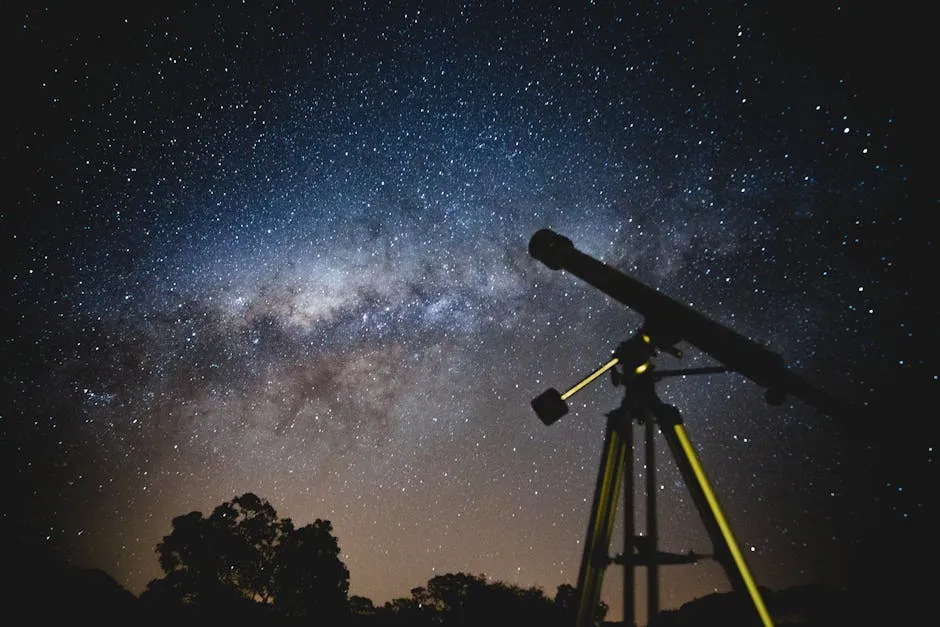
"Stunning starry sky with silhouette of telescope capturing the Milky Way in Brazil." by Lucas Pezeta / Pexels.
Astronomy is the scientific study of everything that exists beyond Earth's atmosphere. For thousands of years, humans have observed the night sky, tracking the movement of stars and planets to mark time, navigate, and seek understanding about the universe. Today, astronomy remains one of the oldest sciences, helping us answer big questions: What are stars made of? How did the universe begin? Are we alone in the cosmos?
Exploring the Universe: How Astronomy Works
Astronomers use a variety of tools and methods to study distant celestial objects. Telescopes, which gather and magnify light, allow us to observe planets, stars, and galaxies that are millions or even billions of kilometers away. By analyzing the light from these objects, scientists can determine their composition, temperature, distance, and motion. For example, by measuring how starlight is stretched or compressed (a phenomenon called the Doppler effect), astronomers can learn if an object is moving toward or away from Earth. Astronomy also involves collecting data from satellites and space probes to study planets and moons up close. This combination of observation, measurement, and technology reveals the physical laws that govern space.
Branches and Connections in Astronomy
Astronomy is divided into several branches. Planetary science investigates planets, moons, and other objects in our solar system. Stellar astronomy focuses on the life cycles of stars, from their formation to their explosive deaths as supernovas. Galactic astronomy studies groups of stars known as galaxies, while cosmology examines the universe as a whole, including its origin and future. Related fields, such as astrophysics, apply physical laws to explain how stars shine or why planets orbit. Astrobiology looks for signs of life elsewhere in the universe, and planetary geology studies the surfaces and structures of distant worlds. These branches often overlap, and discoveries in one area can lead to breakthroughs in another.
Impact, Applications, and Careers
Studying astronomy helps us understand our place in the universe and satisfies human curiosity about the unknown. It also leads to practical technologies: For instance, the development of weather satellites and GPS systems relies on knowledge gained from space exploration. Astronomy inspires new inventions, such as more powerful telescopes and computer programs for analyzing vast amounts of data. People who study astronomy can become astronomers, astrophysicists, aerospace engineers, or planetarium educators. Their work not only expands our knowledge but also supports advances in science and technology for society as a whole.
In summary, astronomy connects observation and technology to help us answer fundamental questions about space, time, and existence. By studying distant worlds and cosmic phenomena, we gain insights into the origins of matter, the forces that shape the universe, and the possibility of life beyond Earth.
Interesting Fact: The light from our nearest star, the Sun, takes about 8 minutes to reach Earth! That means when you look at the Sun (never directly), you are seeing it as it was 8 minutes ago.
What is the main focus of astronomy?
Studying objects and phenomena beyond Earth's atmosphereInvestigating the Earth's coreObserving animal behaviorExploring underwater ecosystems
Which tool is most commonly used by astronomers to observe distant objects in space?
MicroscopeTelescopeThermometerRadar
What does the branch of planetary science study?
The lives of starsPlanets, moons, and solar system objectsThe ocean floorHuman populations
According to the passage, what is the purpose of analyzing the light from celestial objects?
To determine their composition, distance, and motionTo create new starsTo increase Earth's gravityTo stop cosmic explosions
What does the term 'cosmology' refer to in the context of astronomy?
The study of Earth's weatherThe study of the origin and structure of the universeThe study of animal lifeThe study of plants
In the passage, what is an example of a practical application of astronomy?
Building roadsDeveloping GPS and weather satellitesGrowing cropsTeaching languages
Which related field focuses on the search for life elsewhere in the universe?
AstrobiologyGeologyStellar astronomyBotany
True or False: Astronomy only studies things within our solar system.
TrueFalse
True or False: The light from the Sun takes about 8 minutes to reach Earth.
TrueFalse
What is a main reason people study astronomy, according to the passage?
To learn about our place in the universe and inspire new technologyTo increase food productionTo study bacteriaTo build more highways
Perfect For:
👩🏫 Teachers
• Reading comprehension practice
• Auto-graded assessments
• Literacy skill development
👨👩👧👦 Parents
• Reading practice at home
• Comprehension improvement
• Educational reading time
🏠 Homeschoolers
• Reading curriculum support
• Independent reading practice
• Progress monitoring
Reading Features:
📖
Reading Passage
Engaging fiction or nonfiction text
❓
Comprehension Quiz
Auto-graded questions
📊
Instant Feedback
Immediate results and scoring
📄
Printable Version
Download for offline reading
🔊
Read Aloud
Voice-over with word highlighting
Reviews & Ratings
No reviews yet. Be the first to share your experience!
Related Content
Sunspots and Solar Flares
This quiz is designed to test your understanding of the fascinating phenomena of sunspots and solar flares, as described...
RI.4.1RI.4.4RI.5.1ESS1.A
The Hottest Planet in the Solar System
This NGSS-aligned middle school reading passage explains why Venus is the hottest planet in our solar system. Students l...
MS-ESS1-3
Scientific Investigations
This passage, aligned with NGSS standards for grades 6-8, introduces students to the process of scientific investigation...
MS-ETS1-1MS-ETS1-2MS-ETS1-3MS-ETS1-4
Comets
This middle school science passage explores the fascinating world of comets, commonly known as 'dirty snowballs.' Studen...
MS-ESS1-2
Tools and Technology in Earth Science
This middle school science reading passage explores the wide range of tools and technologies used in Earth science, from...
MS-ESS2-2MS-ESS3-2MS-ETS1-1MS-PS4-3
Types of Maps
This engaging science passage for grades 6-8 introduces students to the various types of maps and their uses, supporting...
MS-ESS2-2MS-ESS3-2MS-ETS1-1MS-ETS1-4
Remote Sensing
This middle school science passage introduces students to the concept of remote sensing—the collection of information ab...
MS-ESS3-3MS-PS4-2MS-ETS1-1MS-ETS1-3
Geographic Information Systems (GIS)
This engaging middle school science passage introduces students to Geographic Information Systems (GIS), aligning with N...
MS-ESS3-3MS-ETS1-1MS-ETS1-2MS-ETS1-3
The Electromagnetic Spectrum
This comprehensive science reading passage introduces middle school students (grades 6-8) to the electromagnetic spectru...
MS-PS4-1MS-PS4-2
Visible Light and Color
This comprehensive science passage for grades 6-8 explores visible light as the part of the electromagnetic spectrum tha...
MS-PS4-2
Light Waves
This middle school science passage introduces students in grades 6-8 to the concept of light as an electromagnetic wave,...
MS-PS4-2
Wave Absorption
This engaging science passage for grades 6-8 explores the mechanism of wave absorption, where waves transfer energy to m...
MS-PS4-2
Wave Behavior: Transmission
This informational science reading passage for grades 6-8 explores the concept of wave behavior, focusing on transmissio...
MS-PS4-2
Wave Refraction
This comprehensive science passage introduces middle school students to the concept of refraction, a key phenomenon in w...
MS-PS4-2
Wave Reflection
This middle school science passage explores the behavior of waves during reflection, focusing on how and why waves bounc...
MS-PS4-2
Types of Waves
This comprehensive passage for grades 6-8 explores the fundamental differences between mechanical and electromagnetic wa...
MS-PS4-1MS-PS4-2
What Is Light?
This comprehensive middle school science passage explains the nature of light, defined as visible electromagnetic radiat...
MS-PS4-2
Reflection and Mirrors
This engaging passage explores the science behind reflection and mirrors, designed for students in grades 6-8. Aligned w...
MS-PS4-2
Lasers
This passage explores the science of lasers for middle school students, aligning with NGSS standard MS-PS4-2. Students l...
MS-PS4-2
How We See
This informational science passage for grades 6-8 explores the mechanisms behind human vision, focusing on how light ent...