This learning resource is available in interactive and printable formats. The interactive worksheet can be played online and assigned to students. The Printable PDF version can be downloaded and printed for completion by hand.
This comprehensive science passage for grades 6-8 explores the inner (terrestrial) planets of our solar system—Mercury, Venus, Earth, and Mars—aligned to NGSS standards MS-ESS1-2 and MS-ESS1-3. Students will learn about the observable features and underlying mechanisms that make each planet unique, such as their rocky composition, atmospheric differences, and distance from the Sun. The passage explains how interactions between planetary atmospheres, magnetic fields, tectonics, and solar energy have led to dramatically different environments, from Mercury's barren surface to Venus's runaway greenhouse effect and Earth's life-supporting conditions in the Goldilocks zone. Real-world connections include planetary evolution, climate science, and the search for extraterrestrial life. Accompanying activities include a glossary, quiz, writing prompts, graphic organizers, and both English and Spanish versions (including audio integration). This resource builds science literacy and critical thinking skills while deepening understanding of planetary systems.
CONTENT PREVIEW
Expand content preview
The Inner Planets
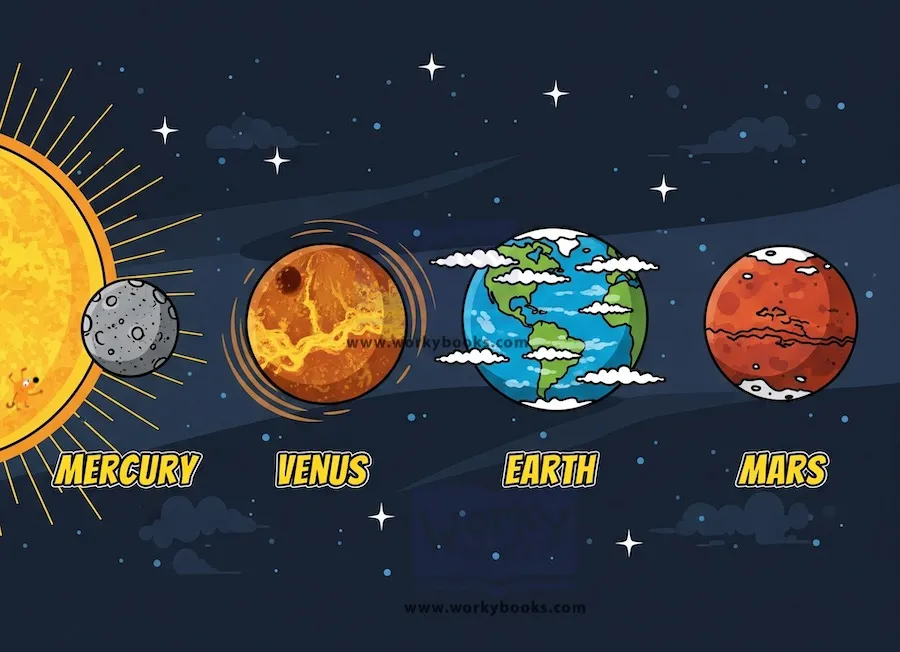
Terrestrial planets make up the inner part of our solar system. Mercury, Venus, Earth, and Mars are called terrestrial because they have solid, rocky surfaces. These planets are relatively small and orbit close to the Sun. Scientists study the differences and similarities among these planets to understand why only Earth supports life.
Rocky Worlds and Their Features
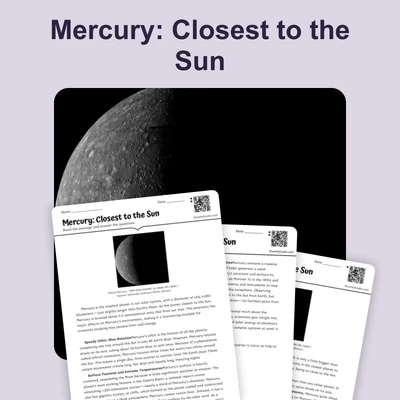
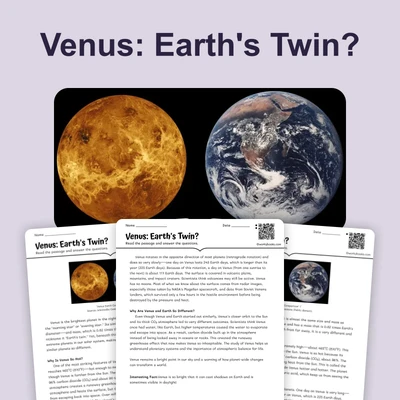
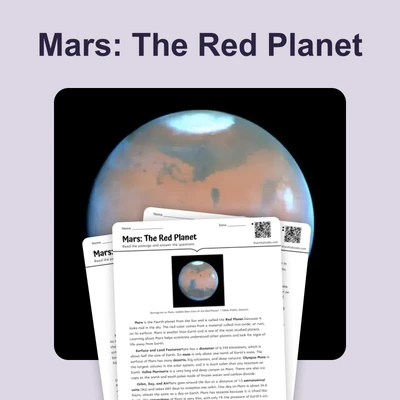
The four inner planets share a rocky composition but show unique characteristics. Mercury is the smallest planet and has almost no atmosphere. Its surface is covered in craters, and temperatures swing from 430°C (day) to -180°C (night) because there is no atmosphere to trap heat. Venus is similar in size to Earth but has a thick carbon dioxide atmosphere. This causes a runaway greenhouse effect, making Venus the hottest planet, with surface temperatures around 465°C. Earth is unique—it has liquid water, an oxygen-rich atmosphere, and supports a wide diversity of life. Mars has a thin atmosphere, mostly carbon dioxide, and evidence of past water in rivers and lakes. Mars has two small moons and surface temperatures that rarely rise above freezing.
Why Are the Inner Planets So Different?
Although the inner planets formed from similar materials, their environments evolved differently. Mercury’s small size and proximity to the Sun caused it to lose its atmosphere quickly. Venus, although farther from the Sun than Mercury, trapped heat due to its dense carbon dioxide atmosphere, leading to extremely high temperatures. Earth orbits in the Goldilocks zone, where conditions are just right for liquid water. Earth’s magnetic field protects its atmosphere from solar wind. Plate tectonics recycle materials and help regulate climate. Mars, being smaller and farther from the Sun, lost much of its atmosphere over time, but signs like dried riverbeds show it once had liquid water.
Earth’s Uniqueness and Broader Implications
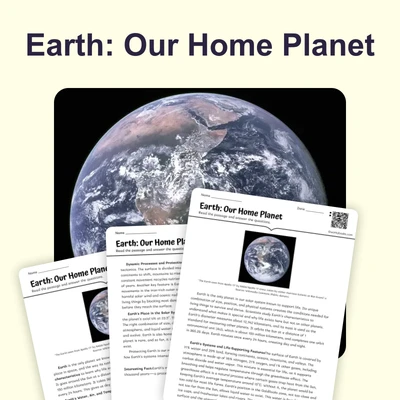
Earth stands out among the inner planets because of its ability to support life. The combination of its distance from the Sun, active plate tectonics, and protective magnetic field allow water to remain stable and temperatures to stay moderate. Scientists use what they learn about the inner planets to search for potentially habitable worlds elsewhere. Comparing their evolution helps us understand how planets change and what conditions are necessary for life.
In summary, the inner planets demonstrate how factors like atmosphere, size, distance from the Sun, and planetary processes interact to create very different worlds. These comparisons deepen our understanding of planetary systems and guide future exploration.
Interesting Fact: Venus rotates so slowly that a day on Venus (one full rotation) is longer than its year (one orbit around the Sun)!
Which planets are called terrestrial planets?
Mercury, Venus, Earth, and MarsJupiter, Saturn, Uranus, and NeptuneEarth, Mars, Jupiter, and SaturnVenus, Earth, Neptune, and Pluto
What is unique about Venus's atmosphere?
It is made mostly of nitrogenIt has a thick layer of carbon dioxide causing extreme heatIt has lots of oxygen and water vaporIt is very thin and almost gone
What causes Mercury to have such high and low temperatures?
It rotates very slowlyIt has a thick atmosphereIt has almost no atmosphere to trap heatIt is very far from the Sun
Which word in the passage means 'the region where conditions are just right for liquid water'?
Greenhouse effectTerrestrial zoneGoldilocks zoneSolar region
What is the role of Earth's magnetic field?
It creates earthquakesIt protects the atmosphere from solar windIt makes the planet rotate fasterIt heats the surface
Why is Earth able to support life while the other inner planets cannot?
Earth is the largest planetEarth has the most cratersEarth is in the Goldilocks zone with water, a magnetic field, and plate tectonicsEarth is farthest from the Sun
Why did Mars lose most of its atmosphere over time?
It is the hottest planetIt is too close to the SunIt is small and far from the Sun, so it couldn't keep a thick atmosphereIt has too many moons
Which of the following is true about the inner planets?
They all have thick atmospheresThey are all made of gasThey are close to the Sun and have rocky surfacesThey all have many large moons
Venus is the hottest planet in our solar system. (True/False)
TrueFalse
Earth is the only inner planet with evidence of past water. (True/False)
TrueFalse
Perfect For:
👩🏫 Teachers
• Reading comprehension practice
• Auto-graded assessments
• Literacy skill development
👨👩👧👦 Parents
• Reading practice at home
• Comprehension improvement
• Educational reading time
🏠 Homeschoolers
• Reading curriculum support
• Independent reading practice
• Progress monitoring
Reading Features:
📖
Reading Passage
Engaging fiction or nonfiction text
❓
Comprehension Quiz
Auto-graded questions
📊
Instant Feedback
Immediate results and scoring
📄
Printable Version
Download for offline reading
🔊
Read Aloud
Voice-over with word highlighting
Reviews & Ratings
No reviews yet. Be the first to share your experience!
Related Content
Sunspots and Solar Flares
This quiz is designed to test your understanding of the fascinating phenomena of sunspots and solar flares, as described...
RI.4.1RI.4.4RI.5.1ESS1.A
The Hottest Planet in the Solar System
This NGSS-aligned middle school reading passage explains why Venus is the hottest planet in our solar system. Students l...
MS-ESS1-3
Comets
This middle school science passage explores the fascinating world of comets, commonly known as 'dirty snowballs.' Studen...
MS-ESS1-2
Mercury: Closest to the Sun
This comprehensive, standards-aligned passage explores Mercury—the smallest and closest planet to the Sun. Students in g...
MS-ESS1-2MS-ESS1-3
Venus: Earth's Twin?
This comprehensive science passage for grades 6-8 examines Venus—often called Earth's twin—by exploring its similarities...
MS-ESS1-2MS-ESS1-3
Earth: Our Home Planet
This comprehensive science passage for grades 6-8 explores Earth’s unique characteristics and the interconnected systems...
MS-ESS1-2
Mars: The Red Planet
This middle school science passage explores Mars, the Red Planet, providing students in grades 6-8 with a comprehensive ...
MS-ESS1-2MS-ESS1-3
What Is Gravity?
This comprehensive middle school science reading passage explores the concept of gravity, aligning with NGSS standards M...
MS-ESS1-2MS-PS2-4
Kepler's Laws of Planetary Motion
This comprehensive middle school science passage explores Kepler's Laws of Planetary Motion, meeting NGSS Standard MS-ES...
MS-ESS1-2
Tides and Tidal Forces
This middle school science passage explores the mechanisms of tides and tidal forces, aligning with NGSS standards MS-ES...
MS-ESS1-1MS-ESS1-2
Escape Velocity and Space Travel
This middle school science passage introduces students to the concept of escape velocity—the minimum speed required to b...
MS-ESS1-2MS-PS2-4
Weightlessness and Microgravity
This science reading passage for middle school students explores the phenomenon of weightlessness and microgravity. Alig...
MS-PS2-4MS-ESS1-2
Orbits and Orbital Motion
This middle school science passage, aligned with NGSS MS-ESS1-2 and MS-PS2-4, explores the science of orbits and orbital...
MS-ESS1-2MS-PS2-4
What Is the Solar System?
This passage provides a comprehensive overview of the solar system for grades 6-8, aligned with NGSS standards MS-ESS1-2...
MS-ESS1-2MS-ESS1-3
Structure of the Solar System
This comprehensive science reading passage introduces middle school students (grades 6-8) to the structure of the solar ...
MS-ESS1-2MS-ESS1-3
Moons of the Solar System
This comprehensive passage, designed for grades 6-8 and aligned to NGSS standard MS-ESS1-2, delves into the fascinating ...
MS-ESS1-2
Scale of the Solar System
This passage, aligned to NGSS standard MS-ESS1-3, helps middle school students grasp the immense scale of the solar syst...
MS-ESS1-3
Exploration of the Solar System
This comprehensive passage for grades 6-8 examines how humans explore the solar system, aligning with NGSS standards MS-...
MS-ESS1-3MS-ETS1-1
Optical Telescopes
This comprehensive passage explores the science of optical telescopes for middle school students, aligning with NGSS sta...
MS-ESS1-3MS-ETS1-1
Future of Alien Search
This informational passage for grades 6-8 explores how scientists are using cutting-edge missions and technology to sear...