Comparing Iroquois and American Government — Reading Comprehension
Rate this
Premium Resource
Present
Present in classroom. No work saved
Assign
Classroom with student accounts, Track progress
Quick Play
No student accounts, assign with a link
Grades
6
7
8
PRINT+DIGITAL RESOURCE
This learning resource is available in interactive and printable formats. The interactive worksheet can be played online and assigned to students. The Printable PDF version can be downloaded and printed for completion by hand.
This engaging U.S. history reading passage explores the important similarities and differences between the government of the Iroquois Confederacy and the United States, aligned to HSS 8.2.1 and CCSS RI.6-8.1, RI.6-8.2. Students investigate how both systems balanced unity with local autonomy, focusing on representative assemblies and federal structures. The passage challenges students to analyze historical evidence, understand the role of government, and recognize the influence of the Iroquois on American political development. A full glossary, comprehension quiz, explanatory writing prompts, and graphic organizers support deep learning. It also features a read aloud audio option, a Spanish translation, and differentiated versions for various reading levels. This resource is ideal for developing historical thinking skills, expanding vocabulary, and connecting Native American and early U.S. history in the classroom.
CONTENT PREVIEW
Expand content preview
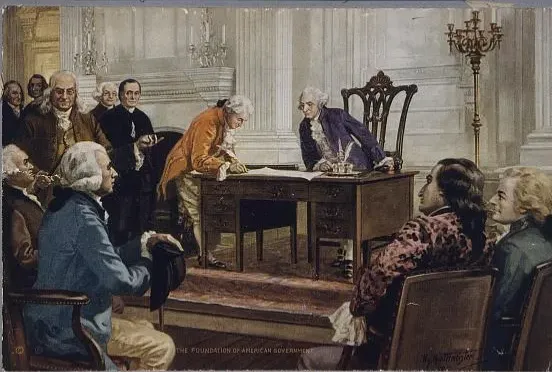
"The foundation of American government" by Hintermeister, Henry, 1897- / Library of Congress.
The Iroquois Confederacy and the United States are both known for their complex government systems that unite different groups under one structure. The Iroquois Confederacy, also called the Haudenosaunee, was formed by six Native American nations in northeastern North America. Each nation kept its own local leadership but participated in a larger council to make decisions for the whole group. In a similar way, the early United States was made up of thirteen colonies, each with its own government, but also part of a federal system led by a central government. This comparison helps us see how different societies have solved the problem of balancing unity and local independence.
Both the Iroquois and American governments used representative assemblies. In the Iroquois system, each nation chose leaders called sachems to represent them at the Grand Council. These sachems debated and made decisions on issues affecting all the nations. Similarly, the United States created Congress, where elected representatives from each state meet to make national laws. This structure allowed both systems to give a voice to member groups while keeping the whole confederacy or union strong.
Another important feature of both systems is their federal structure. In a federal system, power is shared between a central government and local governments. The Iroquois Grand Council could make decisions about war, peace, and treaties, but each nation kept control over its own daily affairs. In the United States, the federal government handles issues like defense and currency, but states manage education and local laws. This division of power protects the interests of smaller groups and prevents any one group from becoming too powerful.
Despite these similarities, there were also important differences. The Iroquois system placed great emphasis on reaching consensus. Leaders worked to agree on decisions that benefitted everyone, rather than simply voting and following the majority. In contrast, the U.S. government generally makes decisions based on majority rule. The Iroquois also included clan mothers, who played a key role in selecting and advising sachems, while the early American government limited official roles mostly to men.
The influence of the Iroquois Confederacy on American government is recognized by many historians. Some Founding Fathers, like Benjamin Franklin, admired the Iroquois way of uniting different nations while respecting their independence. Evidence shows that the Iroquois model helped inspire the U.S. Constitution’s ideas of federalism and representative assemblies. However, the two systems still reflected their own unique histories and cultures.
When comparing the Iroquois and American governments, it becomes clear that both faced the challenge of building unity among diverse peoples. By studying their structures, assemblies, and decision-making methods, historians better understand how different societies create effective governments. This analysis reveals the importance of both cooperation and the protection of local rights in building a strong nation.
Interesting Fact: The Iroquois Confederacy is one of the oldest participatory democracies in the world, existing centuries before the United States was founded.
What is the Iroquois Confederacy?
A union of six Native nationsA U.S. presidentA type of weaponA British colony
Who were sachems?
Iroquois leaders at the Grand CouncilAmerican judgesSpanish explorersBritish soldiers
What did Congress represent?
Elected U.S. representativesNative American clan mothersIroquois Grand CouncilFrench traders
Why did both governments use representatives?
To give groups a voiceTo collect taxesTo build roadsTo start wars
How were decisions made in the Iroquois system?
Through consensusBy one leaderBy random choiceBy clan mothers only
What is a federal system?
Power is sharedOnly central powerNo leadersOnly local rules
The Iroquois influenced the U.S. Constitution. True or false?
TrueFalse
What does consensus mean?
Agreement by allMajority voteMilitary ruleDictatorship
Perfect For:
👩🏫 Teachers
• Reading comprehension practice
• Auto-graded assessments
• Literacy skill development
👨👩👧👦 Parents
• Reading practice at home
• Comprehension improvement
• Educational reading time
🏠 Homeschoolers
• Reading curriculum support
• Independent reading practice
• Progress monitoring
Reading Features:
📖
Reading Passage
Engaging fiction or nonfiction text
❓
Comprehension Quiz
Auto-graded questions
📊
Instant Feedback
Immediate results and scoring
📄
Printable Version
Download for offline reading
🔊
Read Aloud
Voice-over with word highlighting
Reviews & Ratings
No reviews yet. Be the first to share your experience!
Related Content
New Nation America
This history reading passage, 'New Nation America,' covers how the United States struggled to become a united country af...
HSS 5.6.1RI.4.2
Native American Respect for Nature
This engaging history reading passage explores Native American respect for nature, emphasizing the close relationship be...
D2.HIS.2.3-5D2.HIS.3.3-5RI.4.3RI.4.4
Traditional Native American Clothing
This engaging history passage explores traditional Native American clothing and how it reflected the environment, values...
D2.HIS.2.3-5D2.HIS.3.3-5RI.4.3RI.4.4
The Cherokee Nation: History and Culture
This reading passage explores the rich history and culture of the Cherokee Nation, one of the largest Native American tr...
D2.HIS.2.3-5D2.HIS.14.3-5RI.4.3RI.4.4RI.4.10
Native Americans and Slavery in Early America
This comprehensive U.S. history reading passage explores the complex relationship between Native Americans and slavery d...
D2.HIS.2.3-5D2.HIS.3.3-5RI.4.3RI.4.4
Native American Tribes Across America
This engaging history reading passage introduces students to Native American tribes across America, focusing on their da...
D2.HIS.1.3-5D2.HIS.2.3-5RI.4.1RI.4.2
Native American Treaties
This passage examines early Native American treaties, agreements that were meant to establish peace and boundaries betwe...
D2.HIS.2.3-5D2.HIS.3.3-5RI.4.3RI.4.4
Disease and Native Americans
This engaging U.S. history reading passage explores the dramatic impact of European diseases on Native American populati...
D2.HIS.2.3-5D2.HIS.3.3-5RI.4.3RI.4.4
Native American Land Sales
This comprehensive history reading passage examines Native American land sales in U.S. history and asks students to cons...
D2.HIS.2.3-5D2.HIS.3.3-5RI.4.3RI.4.4
American Indians and U.S. Citizenship
This reading passage explores the complex history of American Indians and U.S. citizenship, focusing on the period after...
Native American Allies in Colonial Wars
This passage examines the complex role of Native American nations as allies and adversaries during the colonial wars of ...
D2.HIS.2.3-5D2.HIS.3.3-5RI.4.3RI.4.4
Columbian Exchange Impact on Native Americans
This passage examines the complex effects of the Columbian Exchange on Native Americans, analyzing the causes, consequen...
D2.HIS.2.3-5D2.HIS.3.3-5RI.4.3RI.4.4
Spanish Missions Impact on Native American
This reading passage explores the complex impact of Spanish missions on Native American culture in what is now the south...
D2.HIS.2.3-5D2.HIS.3.3-5RI.4.3RI.4.4
Native American Civilizations Before European Contact
This engaging U.S. History reading passage explores Native American civilizations before European contact, focusing on t...
D2.HIS.2.3-5D2.HIS.3.3-5RI.4.3RI.4.4
Native vs European Land Views
This passage examines the contrasting beliefs about land between Native American societies and European settlers, highli...
D2.HIS.2.3-5D2.HIS.3.3-5RI.4.3RI.4.4
Native Americans in Revolutionary War
This engaging U.S. history reading passage explores how Native American nations made difficult decisions during the Amer...
D2.HIS.2.3-5D2.HIS.3.3-5RI.4.3RI.4.4
Native Languages: Loss and Revival
This engaging U.S. history reading passage examines the history of Native American language loss and ongoing efforts tow...
D2.HIS.2.3-5D2.HIS.3.3-5RI.4.3RI.4.4
Native American Basket Weaving
This passage examines the historical importance of basket weaving among Indigenous Americans, highlighting how different...
The Full Moon in Native American Culture
W.4.5
The Race for Riches
This engaging U.S. history reading passage introduces students to the Age of Exploration and the intense race for riches...