Congressional Reconstruction
Interactive passage with audio narration, comprehension questions, and printable PDF.
By completing this purchase you agree to our Terms of Use and Privacy Policy. Your subscription renews automatically until you cancel. You can cancel anytime from your account settings. All sales are final and non-refundable. Digital content is available for download in your account immediately upon purchase.
What's included
Congressional Reconstruction preview and details
About this printable Congressional Reconstruction reading passage (Grades 6-8)
Sample passage and quiz from Congressional Reconstruction
Reading passage and comprehension quiz preview
Congressional Reconstruction
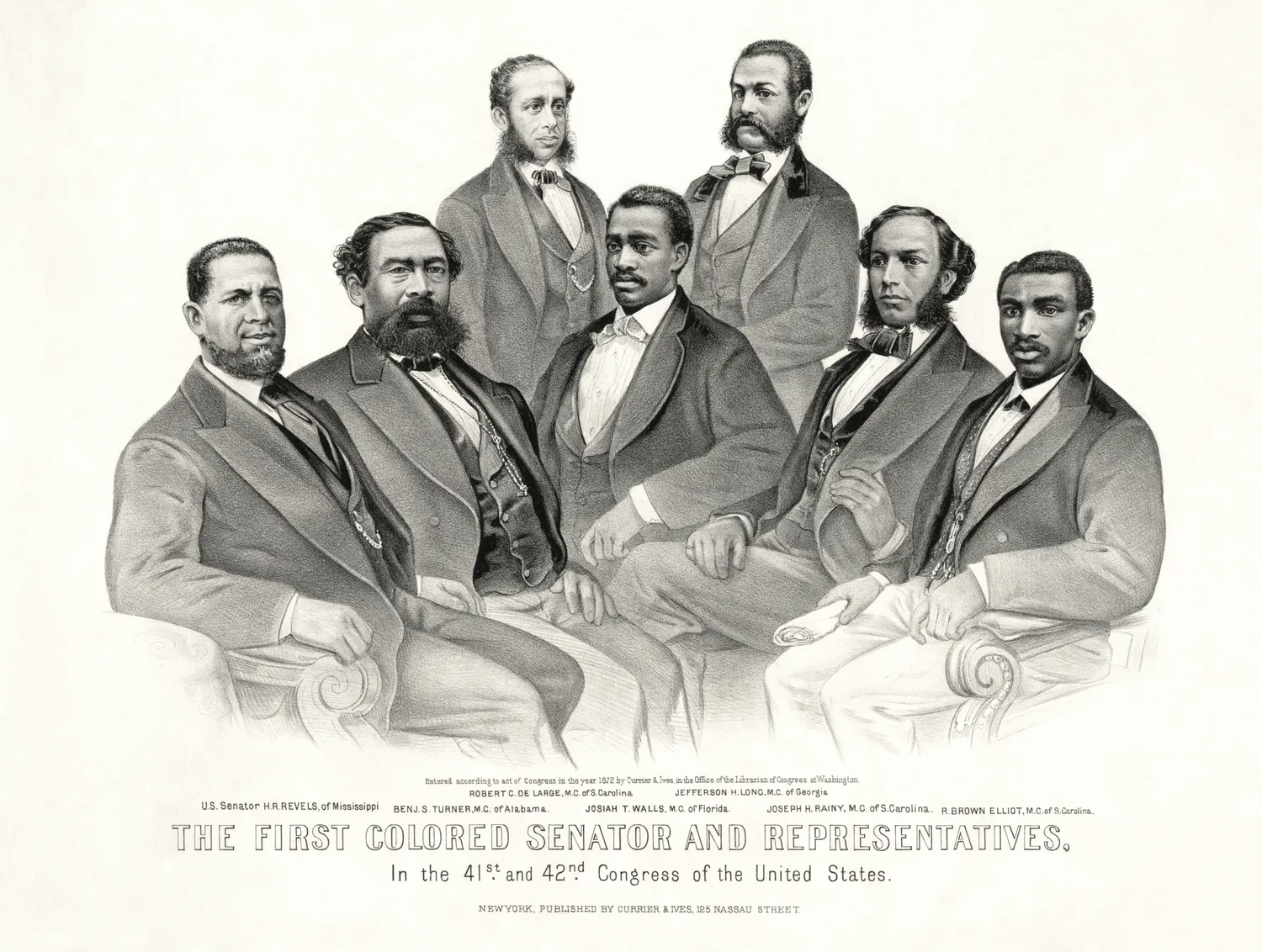
"First Colored Senator and Representatives" by Currier and Ives / Adam Cuerden /
Source: Wikimedia Commons (Public domain).
The period after the Civil War, known as Reconstruction, was a time of significant change in the United States. The central question was how to bring the Southern states back into the Union and how to ensure rights for formerly enslaved people. After President Abraham Lincoln's assassination, President Andrew Johnson took office. However, his approach to Reconstruction led to major disagreements with Congress. Johnson wanted to quickly restore the Southern states with minimal requirements. Many members of Congress, however, believed that stronger measures were necessary to protect the rights of newly freed African Americans and to reshape Southern society.
This disagreement created a serious problem. Johnson's policies allowed many former Confederate leaders to regain power and pass laws, called Black Codes, which limited the freedom of African Americans. Many in Congress felt these codes went against the goals of the war. In response, Congress decided to take control of Reconstruction themselves. They used their constitutional power to override Johnson's vetoes of important legislation, such as the Civil Rights Act of 1866. This act granted citizenship and equal protection to all people born in the United States, regardless of race.
Congressional Reconstruction introduced new solutions. One of the most important was the passage of the Reconstruction Acts in 1867. These laws divided the South into five military districts, each commanded by a Union general. The military districts were designed to maintain order and enforce federal laws, especially those related to civil rights. Southern states could not rejoin the Union until they created new state constitutions that protected voting rights for African American men and agreed to the ratification of the 14th Amendment, which guaranteed citizenship and equal protection under the law.
The process of ratification was a challenge. Many Southern leaders resisted these changes, but the presence of federal troops and the requirements set by Congress made it impossible to return to the old ways. Over time, most Southern states complied, though not without tension and conflict. The 14th Amendment became part of the Constitution in 1868, marking a turning point in American history. Later, the 15th Amendment expanded voting rights further by stating that the right to vote could not be denied based on race or color.
Congressional actions during Reconstruction had lasting consequences. On one hand, they expanded civil rights and changed the definition of citizenship in the United States. On the other, they led to resentment and hostility among some white Southerners, who opposed the presence of federal troops and the new laws. Despite these conflicts, Congressional Reconstruction established important legal and social foundations for future battles over equality.
Ultimately, the struggle between President Johnson and Congress shaped the direction of the country after the Civil War. The willingness of Congress to override vetoes, create military districts, and insist on ratification of constitutional amendments demonstrated the government’s ability to adapt to complex challenges and seek solutions to pressing social problems.
Interesting Fact: The only Southern state readmitted to the Union without being placed under military control was Tennessee, because it had already ratified the 14th Amendment.
Comprehension quiz (8 questions)
1. Who became president after Lincoln?
2. What were Black Codes?
3. Which amendment gave citizenship to all born in the U.S.?
4. Why did Congress create military districts?
5. How did Congress respond to Johnson’s vetoes?
6. What did the 15th Amendment do?
7. Johnson and Congress agreed on Reconstruction policies.
8. What is the meaning of 'override'?
Perfect for the way you teach
- Build comprehension skills
- Auto-graded quiz
- Differentiated reading
- Read together at home
- Improve fluency
- Quiet reading time
- Reading curriculum support
- Independent practice
- Track Lexile growth