Reading PassagePremium

Impeachment of Andrew Johnson

Interactive passage with audio narration, comprehension questions, and printable PDF.

No ratings yet
Grades 6–8ElaSocial-studiesHistoryEnglish · SpanishInteractive · Printable
Aligned toHSS 8.11.3RI.6-8.1RI.6-8.6
Just this resource
$1.50
One-time purchase
Best value
Unlock everything
$49.99$29.99/yr
40% off until Aug 1 — 10,000+ resources
Renews at $49.99/year.
Unlock above to use these actions

What's included

Reading passage
Audio narration
Comprehension quiz
Writing activity
Glossary & flashcards
Differentiated version
Spanish translation

Impeachment of Andrew Johnson preview and details

About this printable Impeachment of Andrew Johnson reading passage (Grades 6-8)

This history reading passage explores Andrew Johnson's impeachment trial, focusing on the events and constitutional debates that shaped the relationship between the presidency and Congress after the Civil War. Students will learn about the Tenure of Office Act, the reasons for Johnson's impeachment, and the dramatic Senate trial that ended in his acquittal by just one vote. The passage includes academic vocabulary, a glossary, and activities that support historical reasoning and Common Core ELA standards. Differentiated and Spanish versions are included to support diverse learners. The resource aligns with HSS 8.11.3 and CCSS.RI.6-8.1, RI.6-8.6, and provides read aloud audio and graphic organizers to deepen understanding of this pivotal moment in U.S. history.
Written by Workybooks TeamPublished by Workybooks
Preview

Sample passage and quiz from Impeachment of Andrew Johnson

Reading passage and comprehension quiz preview

Impeachment of Andrew Johnson
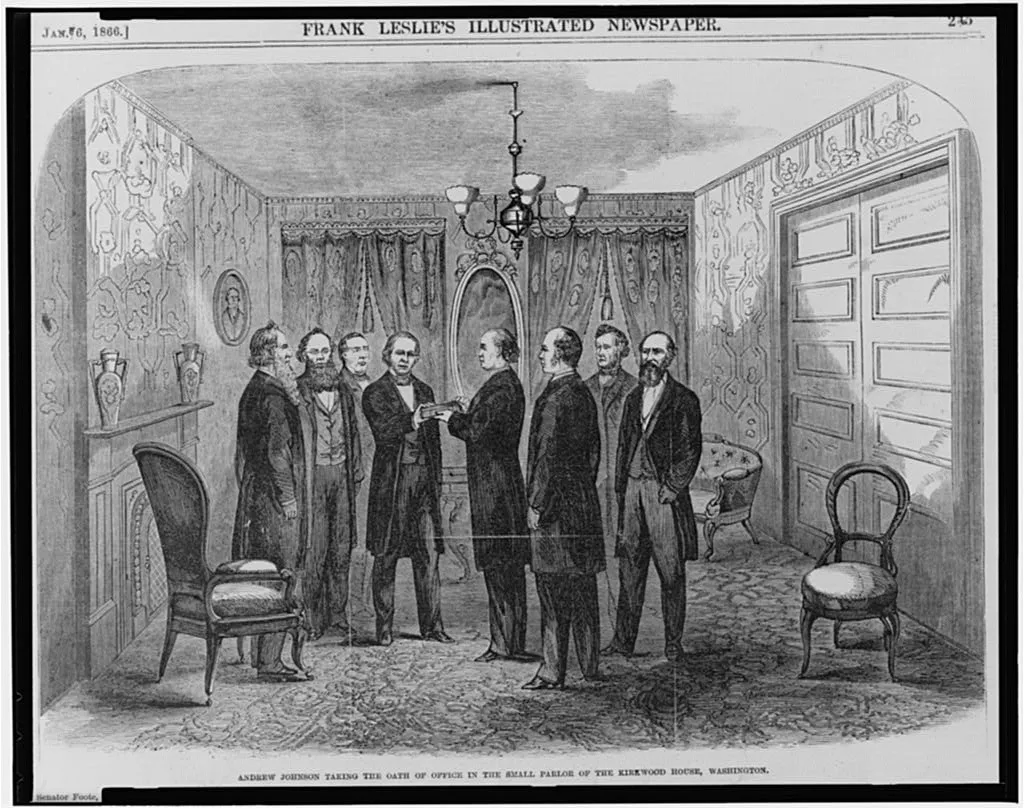
Johnson inauguration

"Johnson inauguration" by Frank Leslie's Illustrated Newspaper / 
Source: Wikimedia Commons (Public domain).

In 1868, President Andrew Johnson became the first U.S. president to face an impeachment trial. This historic event occurred during the challenging years following the Civil War, a time known as Reconstruction. The main conflict was between Johnson and the United States Congress over how to reunite the nation and protect the rights of newly freed African Americans. Johnson, who became president after Abraham Lincoln’s assassination, disagreed with Congress’s plans for Reconstruction. He often blocked their efforts, which created tension and distrust.

One of the most important disagreements was about the Tenure of Office Act. This law, passed by Congress in 1867, made it illegal for the president to remove certain government officials without the Senate’s approval. Congress wanted to limit Johnson’s power because they feared he would weaken progress on civil rights and Reconstruction. Johnson believed the law was unconstitutional—meaning it went against the rules of the U.S. Constitution—because it limited the president’s authority. Nevertheless, Johnson challenged the law by removing Secretary of War Edwin Stanton, who strongly supported Congress’s Reconstruction efforts.

In response, the House of Representatives voted to impeach Johnson. Impeachment is a formal accusation that a government official has committed serious wrongdoing. The House accused Johnson of violating the Tenure of Office Act and abusing his presidential powers. This began a dramatic trial in the Senate. Johnson’s lawyers argued that he had a right to test the law’s constitutionality and that his actions did not rise to the level of high crimes or misdemeanors, as required by the Constitution for removal from office.

The Senate trial became a national spectacle. The senators acted as both jury and judge, listening to witnesses and legal arguments. Many Americans followed the case closely, debating whether Johnson’s removal would protect democracy or threaten the balance of government power. In the end, the Senate fell one vote short of the two-thirds majority needed to convict Johnson. He was acquitted, meaning he was found not guilty and allowed to finish his term as president.

The outcome of Johnson’s impeachment had lasting consequences. It showed the importance of checks and balances in the U.S. government. The trial clarified that Congress could not remove a president just for political disagreements. It also highlighted ongoing conflicts between the executive and legislative branches during Reconstruction, especially about rights, power, and the meaning of the Constitution. Historians continue to study this event to understand how government power is controlled and shared in American democracy.

Interesting Fact: The single deciding vote to acquit Johnson was cast by Senator Edmund G. Ross, who later faced criticism and praise for his decision.

Comprehension quiz (8 questions)

1. Who was impeached in 1868?

Andrew Johnson
Abraham Lincoln
Edwin Stanton
Ulysses S. Grant

2. What law did Johnson violate?

Tenure of Office Act
Civil Rights Act
Emancipation Proclamation
Homestead Act

3. Who was the Secretary of War removed by Johnson?

Edwin Stanton
Edmund Ross
Andrew Johnson
Rutherford Hayes

4. Why did Congress pass the Tenure of Office Act?

Limit Johnson's power
Expand voting rights
Reduce Senate size
Support the President

5. What was the effect of Johnson's acquittal?

He stayed president
He resigned
He was jailed
He moved to Congress

6. What did the Senate need to convict Johnson?

Two-thirds majority
Simple majority
Unanimous vote
Half the votes

7. Johnson was found guilty by the Senate. True or false?

True
False

8. What does 'impeachment' mean?

Formal accusation of wrongdoing
Election of president
Passing a new law
Serving in Congress
Who it's for

Perfect for the way you teach

Teachers
  • Build comprehension skills
  • Auto-graded quiz
  • Differentiated reading
Parents
  • Read together at home
  • Improve fluency
  • Quiet reading time
Homeschoolers
  • Reading curriculum support
  • Independent practice
  • Track Lexile growth
Topics

Reviews & Ratings

No reviews yet. Be the first to share your experience!

More reading you might love

19 more
Passage
Congressional Reconstruction - reading educational content
Grades 6–8

Congressional Reconstruction

us history · HSS 8.11.3

$1.50
Passage
Pocahontas: Myth vs. Historical Reality - reading educational content
Grades 6–8

Pocahontas: Myth vs. Historical Reality

us history · HSS 5.3.1

$1.50
Passage
Roger Williams Religious Freedom - reading educational content
Grades 6–8

Roger Williams Religious Freedom

us history · HSS 5.4.3

$1.50
Passage
Benjamin Franklin in Colonial America - reading educational content
Grades 6–8

Benjamin Franklin in Colonial America

us history · HSS 5.5

$1.50
Passage
Colonial Apprenticeship System  - reading educational content
Grades 6–8

Colonial Apprenticeship System

us history · HSS 5.4.6

$1.50
Passage
Colonial Printing Press - reading educational content
Grades 6–8

Colonial Printing Press

us history · HSS 5.5

$1.50
Passage
Cities in Colonial America - reading educational content
Grades 6–8

Cities in Colonial America

us history · HSS 5.4.6

$1.50
Passage
Frontier Life in Colonial America - reading educational content
Grades 6–8

Frontier Life in Colonial America

us history · HSS 5.4.6

$1.50
Passage
Declaration of Independence - reading educational content
Grades 6–8

Declaration of Independence

us history · HSS 5.6.1

$1.50
Passage
Mercy Otis Warren: Political Writer - reading educational content
Grades 6–8

Mercy Otis Warren: Political Writer

us history · HSS 5.6.3

$1.50
Passage
Crispus Attucks - reading educational content
Grades 6–8

Crispus Attucks

us history · HSS 5.5.3

$1.50
Passage
French Alliance and American Revolution - reading educational content
Grades 6–8

French Alliance and American Revolution

us history · HSS 5.6.4

$1.50
Passage
Lewis and Clark Expedition - reading educational content
Grades 6–8

Lewis and Clark Expedition

us history · HSS 8.4.1

$1.50
Passage
Exodusters  - reading educational content
Grades 6–8

Exodusters

us history · HSS 8.12.1

$1.50
Passage
Uncle Tom's Cabin - reading educational content
Grades 6–8

Uncle Tom's Cabin

us history · HSS 8.9.4

$1.50
Passage
Dred Scott Decision - reading educational content
Grades 6–8

Dred Scott Decision

us history · HSS 8.9.4

$1.50
Passage
Election of 1860 - reading educational content
Grades 6–8

Election of 1860

us history · HSS 8.10.4

$1.50
Passage
Southern Secession - reading educational content
Grades 6–8

Southern Secession

us history · HSS 8.10.4

$1.50
Passage
Advantages and Disadvantages: North vs. South - reading educational content
Grades 6–8

Advantages and Disadvantages: North vs. South

us history · HSS 8.10.5

$1.50
Copyright © 2026 Workybooks. Made with ♥ in California.