This learning resource is available in interactive and printable formats. The interactive worksheet can be played online and assigned to students. The Printable PDF version can be downloaded and printed for completion by hand.
This comprehensive middle school science reading passage explores the phenomenon of ocean tides, aligned to NGSS standards MS-ESS1-1 and MS-ESS1-2. Students will learn how the gravitational pull of the Moon and Sun causes tides, why there are two high and two low tides daily, and how geography and celestial alignment affect tidal ranges. The text covers spring and neap tides, introduces tidal patterns, and explains the biological and technological importance of tides, including tidal energy. The resource includes a glossary, multiple-choice quiz, writing prompts, and graphic organizers to deepen understanding. Spanish translations and simplified versions support diverse learners. All content is audio integrated, making it accessible for auditory learners and supporting classroom inclusion. Key science vocabulary, cause-effect reasoning, and real-world connections help students build a strong foundation in Earth science.
CONTENT PREVIEW
Expand content preview
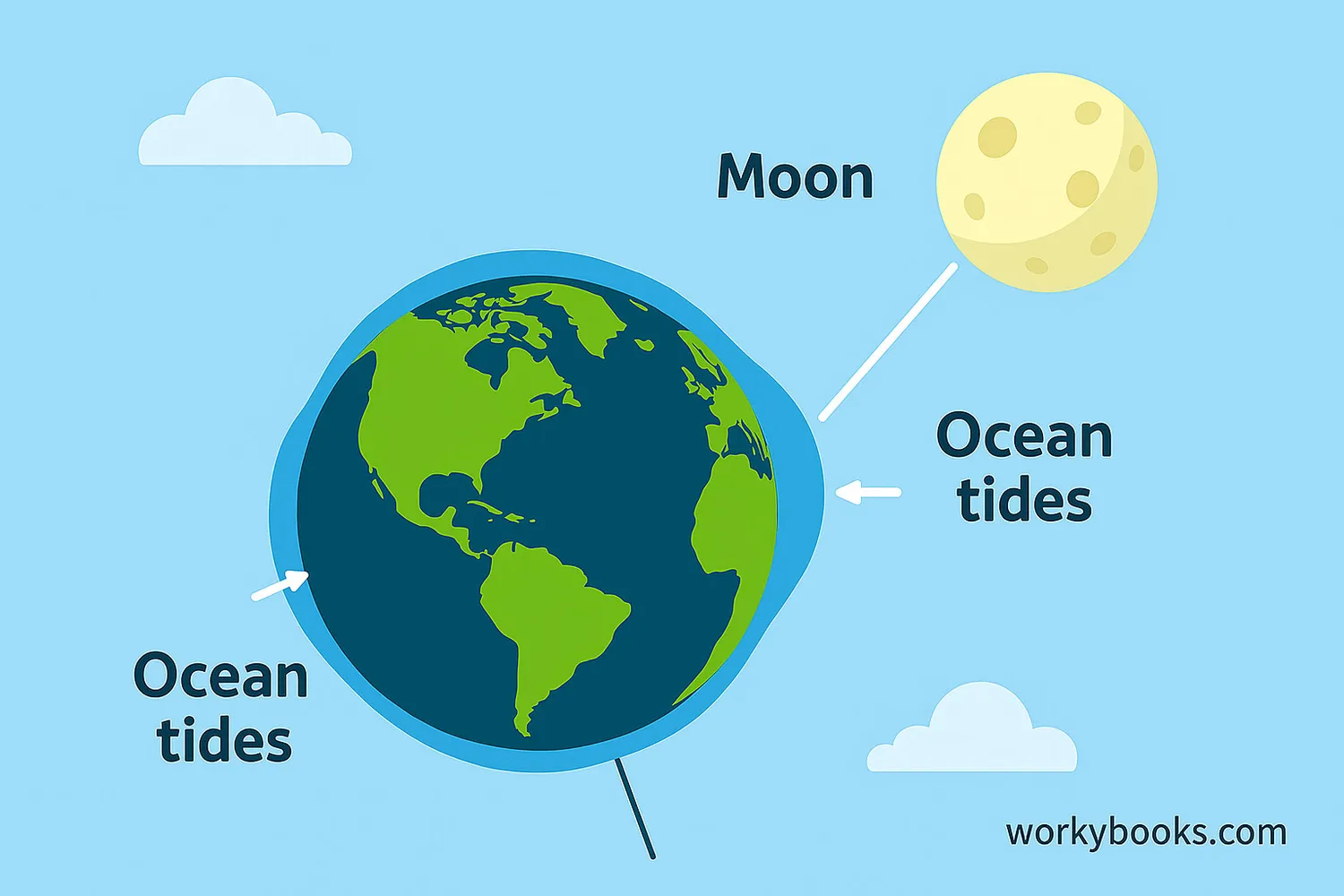
Diagram showing how Moon's gravity creates tides on Earth
Tides are the regular rise and fall of sea level that happen along coastlines all over the world. These changes in water level are not random; they follow a predictable pattern that has fascinated scientists for centuries. Understanding tides is important for navigation, coastal ecosystems, and even future energy solutions. The main cause of tides is the gravitational pull from the Moon and the Sun, which creates powerful forces on Earth's oceans.
The Mechanism Behind Tides
The Moon's gravitational pull is the primary force that creates tides. As the Moon's gravity pulls on Earth's oceans, it forms a bulge of water on the side of Earth facing the Moon. At the same time, a second bulge forms on the opposite side due to inertia. As the Earth rotates, different areas pass through these bulges, resulting in two high tides and two low tides most days. The cycle from one high tide to the next is approximately 12 hours and 25 minutes. While the Sun also exerts gravitational force, its effect on tides is about 46% as strong as the Moon’s.
Types and Patterns of Tides
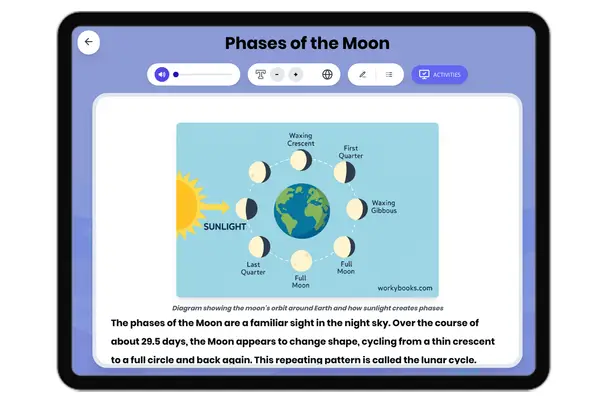
The alignment of the Sun, Moon, and Earth affects the strength of tides. During a spring tide—which happens at new and full moons—these bodies are aligned, and the tidal range is at its greatest. This means there are higher high tides and lower low tides. In contrast, during a neap tide—when the Sun and Moon are at right angles (quarter moons)—the tidal range is smallest. Tidal ranges also vary by location. For example, the Bay of Fundy in Canada experiences tidal ranges up to 16 meters, while other places have much smaller differences. There are different tidal patterns: diurnal tides (one high and one low tide per day), semidiurnal tides (two highs and two lows of similar height), and mixed tides (two highs and two lows of different heights).
Biological and Technological Importance
Tides play a vital role in coastal ecosystems. They move nutrients and support a wide variety of plants and animals. Many marine species, such as crabs and certain fish, time their life cycles with tidal rhythms. Tides also influence human activities—fishing, shipping, and recreation all depend on knowing when tides occur. Furthermore, scientists are exploring tidal energy as a renewable resource. By using the movement of water between high and low tides, we can generate electricity without producing greenhouse gases.
Tides reveal the interconnectedness of Earth’s systems, showing how the movements of the Moon and Sun affect our planet in measurable ways. By studying tides, scientists gain insights into gravity, planetary motion, and environmental change, making tides a key topic in Earth science.
Interesting Fact: The world’s highest tides occur at the Bay of Fundy in Canada, where the difference between high and low tide can reach up to 16 meters!
What is the main cause of tides on Earth?
The gravitational pull of the Moon and SunWind blowing across the oceanEarthquakes under the seaRainfall and evaporation
How many high tides usually occur in one day in most places?
OneTwoThreeFour
According to the passage, what is the effect of the Sun's gravity on tides compared to the Moon's?
It is about 46% as strong as the Moon's effectIt is twice as strong as the Moon's effectIt has no effect on tidesIt is exactly the same as the Moon's effect
What is a spring tide?
A tide with the greatest range between high and low tides, during new and full moonsA tide with the smallest range, during quarter moonsA tide that only happens in the spring seasonA tide caused by storms
What pattern of tides do most places experience?
Semidiurnal tides: two highs and two lows a dayDiurnal tides: one high and one low a dayMixed tides: no patternNo tides at all
What is the meaning of the word 'inertia' in the passage?
The tendency of an object to resist change in movementThe force of gravity from the SunThe spinning motion of the EarthThe pattern of two high tides a day
What does 'ecosystem' mean as used in the passage?
A community of living things and their environmentA pattern of ocean wavesA kind of tideA machine that makes energy
Why are tides important for some marine animals?
They time their life cycles with tidal rhythmsThey cause earthquakesThey make the water warmerThey help animals fly
True or False: Tidal energy creates electricity without producing greenhouse gases.
TrueFalse
True or False: The Bay of Fundy has some of the smallest tidal ranges in the world.
TrueFalse
Perfect For:
👩🏫 Teachers
• Reading comprehension practice
• Auto-graded assessments
• Literacy skill development
👨👩👧👦 Parents
• Reading practice at home
• Comprehension improvement
• Educational reading time
🏠 Homeschoolers
• Reading curriculum support
• Independent reading practice
• Progress monitoring
Reading Features:
📖
Reading Passage
Engaging fiction or nonfiction text
❓
Comprehension Quiz
Auto-graded questions
📊
Instant Feedback
Immediate results and scoring
📄
Printable Version
Download for offline reading
🔊
Read Aloud
Voice-over with word highlighting
Reviews & Ratings
No reviews yet. Be the first to share your experience!
Related Content
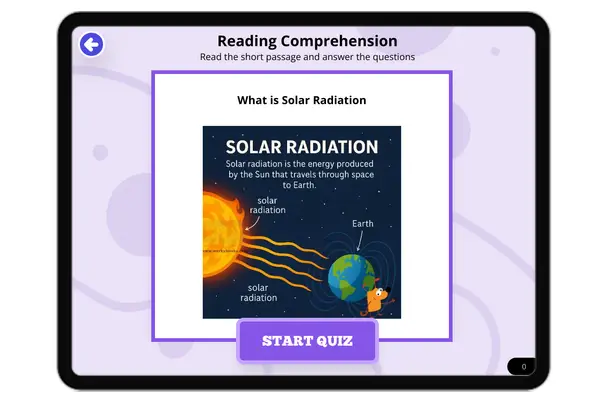
What is Solar Radiation
This NGSS-aligned science reading passage for middle school students explores the concept of solar radiation. Solar radi...
MS-ESS1-1
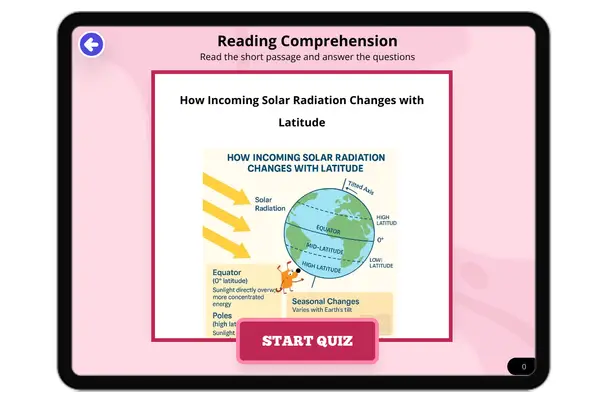
How Incoming Solar Radiation Changes with Latitude
This NGSS-aligned science reading passage helps middle school students understand how solar radiation, or insolation, ch...
MS-ESS1-1
Comets
This middle school science passage explores the fascinating world of comets, commonly known as 'dirty snowballs.' Studen...
MS-ESS1-2
Mercury: Closest to the Sun
This comprehensive, standards-aligned passage explores Mercury—the smallest and closest planet to the Sun. Students in g...
MS-ESS1-2MS-ESS1-3
Venus: Earth's Twin?
This comprehensive science passage for grades 6-8 examines Venus—often called Earth's twin—by exploring its similarities...
MS-ESS1-2MS-ESS1-3
Earth: Our Home Planet
This comprehensive science passage for grades 6-8 explores Earth’s unique characteristics and the interconnected systems...
MS-ESS1-2
Mars: The Red Planet
This middle school science passage explores Mars, the Red Planet, providing students in grades 6-8 with a comprehensive ...
MS-ESS1-2MS-ESS1-3
What Is Gravity?
This comprehensive middle school science reading passage explores the concept of gravity, aligning with NGSS standards M...
MS-ESS1-2MS-PS2-4
Kepler's Laws of Planetary Motion
This comprehensive middle school science passage explores Kepler's Laws of Planetary Motion, meeting NGSS Standard MS-ES...
MS-ESS1-2
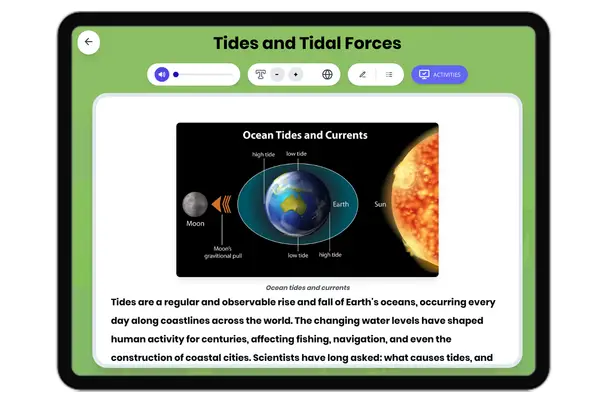
Tides and Tidal Forces
This middle school science passage explores the mechanisms of tides and tidal forces, aligning with NGSS standards MS-ES...
MS-ESS1-1MS-ESS1-2
Escape Velocity and Space Travel
This middle school science passage introduces students to the concept of escape velocity—the minimum speed required to b...
MS-ESS1-2MS-PS2-4
Weightlessness and Microgravity
This science reading passage for middle school students explores the phenomenon of weightlessness and microgravity. Alig...
MS-PS2-4MS-ESS1-2
Orbits and Orbital Motion
This middle school science passage, aligned with NGSS MS-ESS1-2 and MS-PS2-4, explores the science of orbits and orbital...
MS-ESS1-2MS-PS2-4
What Is the Solar System?
This passage provides a comprehensive overview of the solar system for grades 6-8, aligned with NGSS standards MS-ESS1-2...
MS-ESS1-2MS-ESS1-3
Structure of the Solar System
This comprehensive science reading passage introduces middle school students (grades 6-8) to the structure of the solar ...
MS-ESS1-2MS-ESS1-3
Moons of the Solar System
This comprehensive passage, designed for grades 6-8 and aligned to NGSS standard MS-ESS1-2, delves into the fascinating ...
MS-ESS1-2
Defining Life: What Are We Looking For?
This informational science passage for middle school students explores the question: What is life, and how do we define ...
MS-LS1-1MS-ESS1-2
The Night Sky
This comprehensive science reading passage for grades 6-8 aligns with NGSS standard MS-ESS1-1 and explores the systems a...
MS-ESS1-1
Ancient Astronomy
This engaging passage for grades 6-8 explores the history of astronomy through the lens of ancient observations. Student...
MS-ESS1-1
Tools of Modern Astronomy
This passage introduces middle school students to modern astronomy, aligning with NGSS standard MS-ESS1-1. It explains h...