This learning resource is available in interactive and printable formats. The interactive worksheet can be played online and assigned to students. The Printable PDF version can be downloaded and printed for completion by hand.
This comprehensive passage for grades 6-8 explores the science behind eclipses, including solar and lunar eclipses, their types, frequency, and underlying mechanisms. Students will learn why eclipses do not happen every month, the importance of the Moon’s 5-degree orbital tilt, and how the alignment of celestial bodies creates these phenomena. The passage also discusses safety precautions, why the Moon appears red during total lunar eclipses, and differences in duration between solar and lunar eclipses. Activities include reading comprehension, writing prompts, graphic organizers, and a glossary. This resource aligns with NGSS standard MS-ESS1-1 and is audio integrated for accessibility. Key concepts, vocabulary, and real-world applications are included to deepen understanding and scientific literacy.
CONTENT PREVIEW
Expand content preview
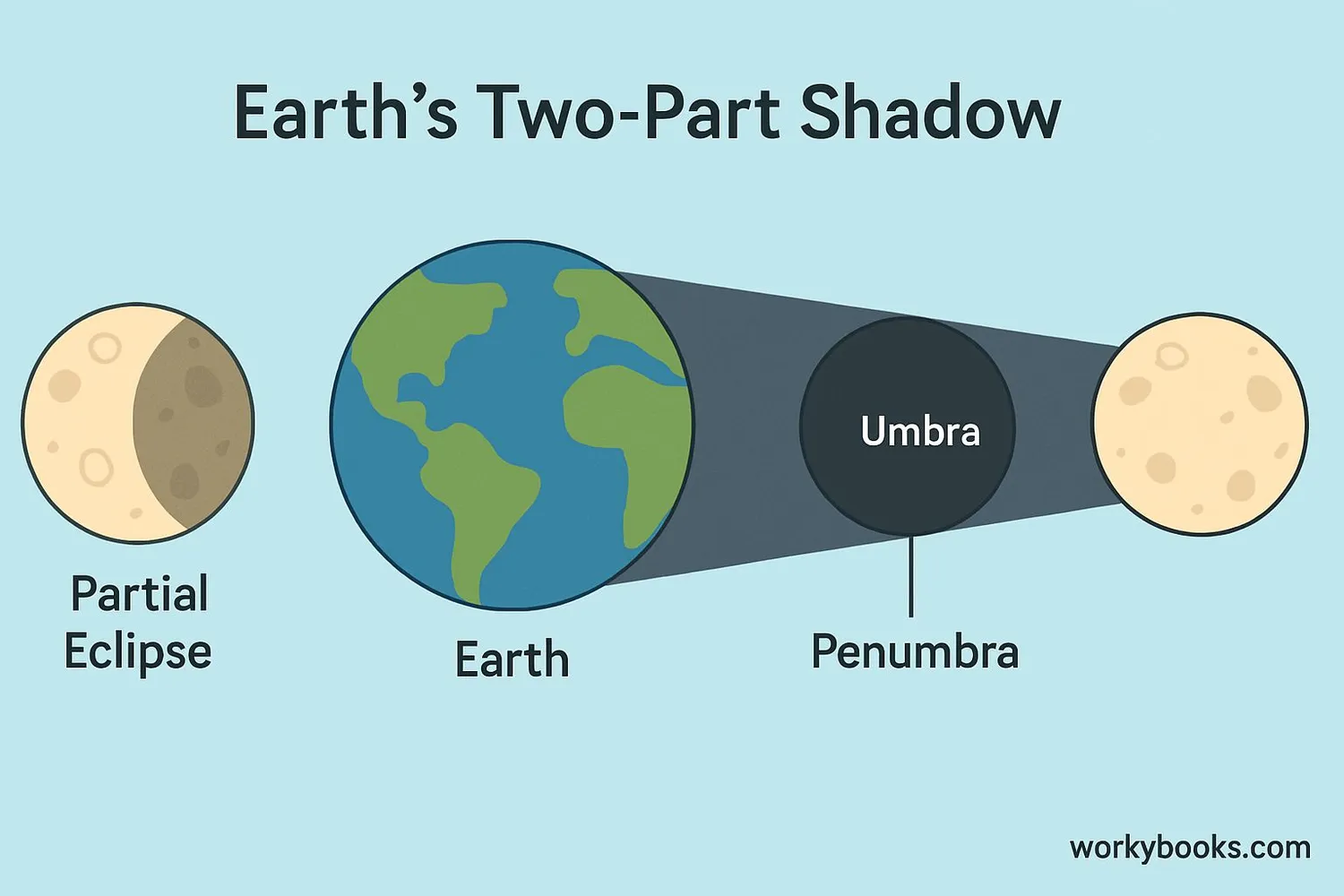
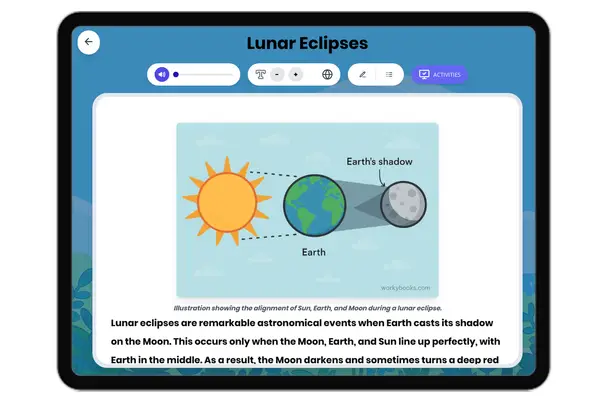
Diagram showing Earth's umbra and penumbra during a lunar eclipse
Eclipses occur when the Sun, Earth, and Moon line up in space, causing the light from one body to be blocked by another. These rare events have fascinated people for centuries and offer important clues about the movement of celestial bodies. There are two main types of eclipses: solar eclipses and lunar eclipses. Each type depends on the precise alignment of the Sun, Earth, and Moon, and reveals how these bodies interact within our solar system.
Why Eclipses Don’t Happen Every Month
Although the Moon orbits Earth about every 29.5 days, we do not see an eclipse every month. This is because the Moon's orbit is tilted about 5 degrees compared to Earth's orbit around the Sun. Most of the time, the Moon passes above or below the line connecting the Sun and Earth, so its shadow misses Earth or Earth's shadow misses the Moon. Eclipses only occur during special periods called eclipse seasons, which happen about twice a year when the orbital planes align. This careful timing explains why eclipses are rare and predictable.
Solar Eclipses: Types and Safety
A solar eclipse happens when the Moon passes between the Sun and Earth, blocking some or all sunlight. There are three main types: total, partial, and annular. A total solar eclipse occurs when the Moon completely covers the Sun, casting a dark shadow (the umbra) on a small area of Earth. Because the Moon is much smaller than Earth, the total shadow covers only a narrow path, sometimes as little as 100 kilometers wide. Outside this path, people see a partial eclipse, where only part of the Sun is blocked. In an annular eclipse, the Moon appears slightly smaller than the Sun, leaving a bright ring called the “ring of fire.” Viewing a solar eclipse requires special eclipse glasses to protect your eyes, except during the brief total phase when the Sun is completely covered.
Lunar Eclipses: Types and Colors
A lunar eclipse occurs when Earth passes between the Sun and the Moon, and Earth’s shadow falls on the Moon. There are three types: total, partial, and penumbral. In a total lunar eclipse, the Moon moves entirely into Earth's darkest shadow, the umbra, and often appears red. This red color happens because Earth's atmosphere bends and filters sunlight, allowing only red light to reach the Moon. Partial lunar eclipses occur when only part of the Moon enters the umbra. Penumbral eclipses are the faintest, with the Moon passing through the lighter part of Earth’s shadow. Unlike solar eclipses, lunar eclipses are safe to watch with the naked eye and can last much longer, sometimes up to several hours.
Understanding Eclipses: Patterns and Predictions
Scientists use careful observations and mathematical models to predict eclipses. They track the orbits and alignments of the Sun, Earth, and Moon, and use data from past eclipses to improve predictions. The next total solar eclipse in North America will occur in April 2024, and total lunar eclipses usually happen every couple of years. Studying eclipses helps scientists understand the dynamics of our solar system and the interactions between celestial bodies. The mechanisms behind eclipses show how predictable and interconnected natural systems can be.
Interesting Fact: During some total lunar eclipses, the Moon can appear copper-red or even blood-red, a phenomenon caused by Earth’s atmosphere filtering and scattering sunlight!
What is the main reason eclipses do not occur every month?
The Moon's orbit is tilted about 5° compared to Earth's orbit.The Sun is not always bright enough.The Earth's orbit changes every month.The Moon moves too slowly around Earth.
Which type of eclipse happens when the Moon passes between the Sun and Earth?
Solar eclipseLunar eclipsePenumbral eclipseAnnular eclipse
What is the path called where a total solar eclipse is visible?
UmbraPenumbraAnnularShadow
What safety measure is necessary for observing a solar eclipse (except during totality)?
Wear eclipse glassesUse a regular telescopeLook with the naked eyeCover your ears
What does the word 'mechanism' most closely mean in the passage?
Process or system by which something happensA type of shadowA special kind of eclipseA tool for observing stars
In the context of the passage, what is an 'eclipse season'?
The time when eclipses are possible due to orbital alignmentA season with less sunlightA time when the Moon is fullA type of lunar eclipse
Why does the Moon appear red during a total lunar eclipse?
Earth's atmosphere bends and filters sunlight, letting red light reach the MoonThe Sun is closer to the MoonThe Moon heats up and glows redThere is dust on the Moon
A partial solar eclipse covers the Sun completely. (True/False)
FalseTrue
Lunar eclipses are safe to observe without special glasses. (True/False)
TrueFalse
Which of these statements is correct about eclipse duration?
Lunar eclipses last much longer than solar eclipses.Solar eclipses last for several hours.Both types last the same amount of time.Solar eclipses last longer than lunar eclipses.
Perfect For:
👩🏫 Teachers
• Reading comprehension practice
• Auto-graded assessments
• Literacy skill development
👨👩👧👦 Parents
• Reading practice at home
• Comprehension improvement
• Educational reading time
🏠 Homeschoolers
• Reading curriculum support
• Independent reading practice
• Progress monitoring
Reading Features:
📖
Reading Passage
Engaging fiction or nonfiction text
❓
Comprehension Quiz
Auto-graded questions
📊
Instant Feedback
Immediate results and scoring
📄
Printable Version
Download for offline reading
🔊
Read Aloud
Voice-over with word highlighting
Reviews & Ratings
No reviews yet. Be the first to share your experience!
Related Content
What is Solar Radiation
This NGSS-aligned science reading passage for middle school students explores the concept of solar radiation. Solar radi...
MS-ESS1-1
How Incoming Solar Radiation Changes with Latitude
This NGSS-aligned science reading passage helps middle school students understand how solar radiation, or insolation, ch...
MS-ESS1-1
Tides and Tidal Forces
This middle school science passage explores the mechanisms of tides and tidal forces, aligning with NGSS standards MS-ES...
MS-ESS1-1MS-ESS1-2
The Night Sky
This comprehensive science reading passage for grades 6-8 aligns with NGSS standard MS-ESS1-1 and explores the systems a...
MS-ESS1-1
Ancient Astronomy
This engaging passage for grades 6-8 explores the history of astronomy through the lens of ancient observations. Student...
MS-ESS1-1
Tools of Modern Astronomy
This passage introduces middle school students to modern astronomy, aligning with NGSS standard MS-ESS1-1. It explains h...
MS-ESS1-1
How Astronomy Became a Science
This passage explores the transformative period known as the Scientific Revolution, with a special focus on the history ...
MS-ESS1-1
Earth's Rotation
This middle school science passage, aligned with NGSS standard MS-ESS1-1, focuses on Earth's rotation—how Earth spins on...
MS-ESS1-1
Earth's Revolution
This middle school science passage explores the science behind Earth's revolution around the Sun, closely aligned with N...
MS-ESS1-1
Why We Have Seasons
This comprehensive middle school science reading passage explains the mechanisms behind Earth's seasons, directly addres...
MS-ESS1-1
Earth's Seasons
This comprehensive reading passage for grades 6-8 explains why Earth has seasons, revealing the scientific mechanisms be...
MS-ESS1-1
Phases of the Moon
This comprehensive middle school science passage explains the phases of the Moon, focusing on the mechanisms behind the ...
MS-ESS1-1
Tides
This comprehensive middle school science reading passage explores the phenomenon of ocean tides, aligned to NGSS standar...
MS-ESS1-1MS-ESS1-2
The Moon's Characteristics
This comprehensive science reading passage for grades 6-8 examines the Moon's physical characteristics, including its si...
MS-ESS1-1MS-ESS1-2
Lunar Eclipses
This passage introduces middle school students to the phenomenon of lunar eclipses, connecting observable events to the ...
MS-ESS1-1
The Sun's Characteristics
This engaging science passage introduces middle school students to the Sun’s key characteristics, such as its classifica...
MS-ESS1-1MS-ESS1-2
What Is a Galaxy?
This comprehensive middle school science passage answers the question: What is a galaxy? Aligned to NGSS standard MS-ESS...
MS-ESS1-1
The Milky Way: Our Home Galaxy
This comprehensive science passage introduces middle school students to the Milky Way, the barred spiral galaxy that is ...
MS-ESS1-1
Types of Galaxies
This comprehensive middle school science passage introduces students to the classification and characteristics of galaxi...