This learning resource is available in interactive and printable formats. The interactive worksheet can be played online and assigned to students. The Printable PDF version can be downloaded and printed for completion by hand.
This passage introduces middle school students to the phenomenon of lunar eclipses, connecting observable events to the underlying scientific mechanisms. Students will learn how lunar eclipses occur only when the Earth passes precisely between the Sun and the Moon during a full moon phase, and why these events are relatively rare due to the Moon's tilted orbit. The text explains the difference between total, partial, and penumbral lunar eclipses, highlighting scientific vocabulary such as umbra, penumbra, and alignment. Real-world applications include the safe observation of eclipses and how ancient peoples used them for prediction. The passage aligns with NGSS MS-ESS1-1, focusing on modeling the Earth-Sun-Moon system. Audio integration supports various learning styles, making it accessible to all students. Teachers can use this resource to build foundational astronomy knowledge while encouraging scientific reasoning, cause-and-effect analysis, and connections to broader principles of planetary systems.
CONTENT PREVIEW
Expand content preview
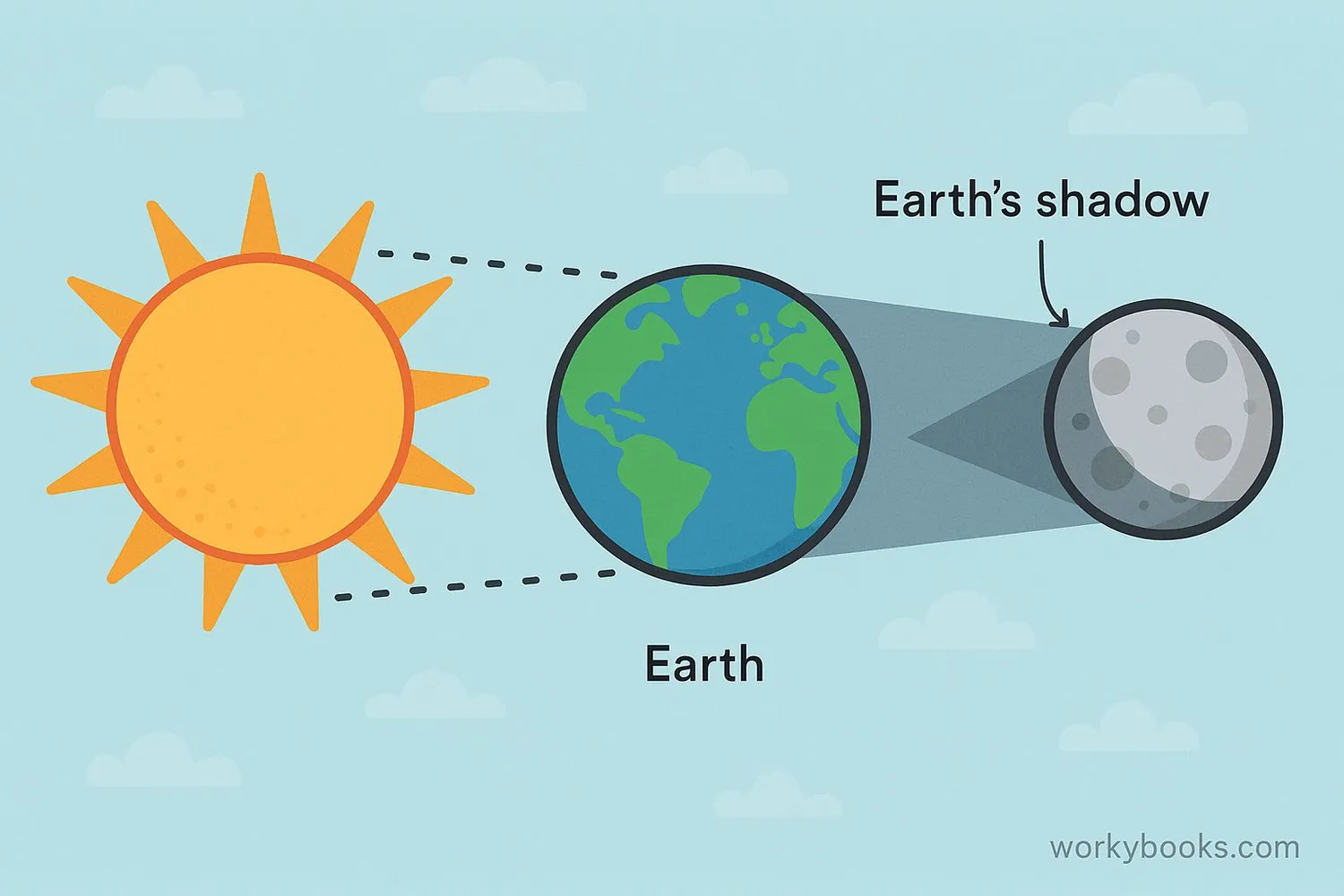
Illustration showing the alignment of Sun, Earth, and Moon during a lunar eclipse.
Lunar eclipses are remarkable astronomical events when Earth casts its shadow on the Moon. This occurs only when the Moon, Earth, and Sun line up perfectly, with Earth in the middle. As a result, the Moon darkens and sometimes turns a deep red color. Lunar eclipses have fascinated people for centuries, inspiring myths and scientific discoveries. Understanding the cause of these events reveals important information about the motions and relationships of objects in our solar system.
The Mechanics of a Lunar Eclipse For a lunar eclipse to occur, the Moon must be in its full moon phase. During this phase, the Sun fully illuminates the Moon as seen from Earth. A lunar eclipse happens when Earth passes directly between the Sun and the Moon, blocking sunlight and casting a shadow on the Moon. However, lunar eclipses do not happen every full moon. This is because the Moon's orbit is tilted about 5 degrees compared to Earth's orbit around the Sun. Most of the time, the Moon passes slightly above or below Earth's shadow. Only during certain periods, called eclipse seasons, does the alignment become precise enough for an eclipse. These seasons happen about twice a year.
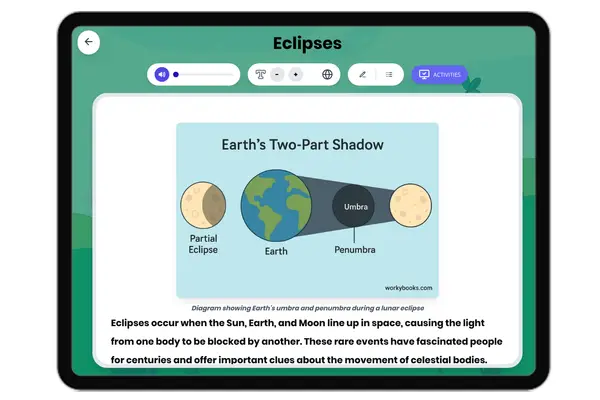
Types of Lunar Eclipses and Their Effects There are three main types of lunar eclipses. In a total lunar eclipse, the entire Moon passes through Earth's umbra, the darkest part of its shadow. The Moon appears red, sometimes called a "blood moon," because Earth's atmosphere bends and scatters sunlight. Red wavelengths bend around Earth and reach the Moon, while blue light is scattered away. A total lunar eclipse can last up to 107 minutes. In a partial lunar eclipse, only part of the Moon enters the umbra, so only a portion is darkened. In a penumbral eclipse, the Moon moves through Earth's penumbra, the lighter outer shadow, causing just a subtle dimming that is often hard to notice.
Observing Lunar Eclipses: Frequency, Visibility, and History Lunar eclipses occur about two to three times per year, depending on the alignment of the Earth, Sun, and Moon. Unlike solar eclipses, lunar eclipses are safe to watch with the naked eye and can be seen from anywhere on the night side of Earth—about half the planet. Ancient cultures sometimes feared lunar eclipses, not knowing their cause, but over time, scientists learned to predict them using careful observations and calculations. Today, lunar eclipses are studied to learn about Earth's atmosphere, as the red color provides clues about the air's composition and dust levels. These events help us understand larger patterns in the solar system and reinforce the importance of observation and prediction in science.
Interesting Fact: During a total lunar eclipse, the Moon can appear more than 10,000 times dimmer than when it is fully lit by the Sun.
What is a lunar eclipse?
When Earth's shadow falls on the MoonWhen the Moon blocks the Sun's light to EarthWhen the Sun moves between Earth and the MoonWhen the Moon is closest to Earth
Why don’t lunar eclipses happen every full moon?
Because the Moon's orbit is tilted compared to Earth'sBecause the Sun is not always bright enoughBecause Earth’s orbit changes every yearBecause the Moon is too far away
Which of the following best describes the umbra?
The darkest part of Earth’s shadowThe lightest part of the MoonThe outer edge of the SunA phase of the Moon
What causes the Moon to appear red during a total lunar eclipse?
Earth’s atmosphere bends and scatters sunlightThe Moon’s surface is covered in red dustThe Sun shines directly on the MoonEarth’s shadow is blue in color
How often do lunar eclipses occur each year?
About two to three timesOnce every decadeEvery full moonOnly during summer
What does the word 'alignment' mean in the passage?
When objects are arranged in a straight lineWhen the Moon is fullWhen the Sun is brightestWhen Earth rotates
Which statement is true based on the passage?
Lunar eclipses are safe to watch with the naked eyeLunar eclipses only happen during the dayYou need special glasses to watch a lunar eclipseLunar eclipses can only be seen from one country
If a scientist wants to study Earth's atmosphere, why might a lunar eclipse be useful?
The red color of the Moon shows information about air and dustIt helps scientists see the Sun more clearlyIt makes the Moon disappearIt blocks out all sunlight on Earth
Lunar eclipses inspired myths and scientific discoveries. (True/False)
TrueFalse
The penumbra is the darkest part of Earth’s shadow. (True/False)
TrueFalse
Perfect For:
👩🏫 Teachers
• Reading comprehension practice
• Auto-graded assessments
• Literacy skill development
👨👩👧👦 Parents
• Reading practice at home
• Comprehension improvement
• Educational reading time
🏠 Homeschoolers
• Reading curriculum support
• Independent reading practice
• Progress monitoring
Reading Features:
📖
Reading Passage
Engaging fiction or nonfiction text
❓
Comprehension Quiz
Auto-graded questions
📊
Instant Feedback
Immediate results and scoring
📄
Printable Version
Download for offline reading
🔊
Read Aloud
Voice-over with word highlighting
Reviews & Ratings
No reviews yet. Be the first to share your experience!
Related Content
What is Solar Radiation
This NGSS-aligned science reading passage for middle school students explores the concept of solar radiation. Solar radi...
MS-ESS1-1
How Incoming Solar Radiation Changes with Latitude
This NGSS-aligned science reading passage helps middle school students understand how solar radiation, or insolation, ch...
MS-ESS1-1
Tides and Tidal Forces
This middle school science passage explores the mechanisms of tides and tidal forces, aligning with NGSS standards MS-ES...
MS-ESS1-1MS-ESS1-2
The Night Sky
This comprehensive science reading passage for grades 6-8 aligns with NGSS standard MS-ESS1-1 and explores the systems a...
MS-ESS1-1
Ancient Astronomy
This engaging passage for grades 6-8 explores the history of astronomy through the lens of ancient observations. Student...
MS-ESS1-1
Tools of Modern Astronomy
This passage introduces middle school students to modern astronomy, aligning with NGSS standard MS-ESS1-1. It explains h...
MS-ESS1-1
How Astronomy Became a Science
This passage explores the transformative period known as the Scientific Revolution, with a special focus on the history ...
MS-ESS1-1
Earth's Rotation
This middle school science passage, aligned with NGSS standard MS-ESS1-1, focuses on Earth's rotation—how Earth spins on...
MS-ESS1-1
Earth's Revolution
This middle school science passage explores the science behind Earth's revolution around the Sun, closely aligned with N...
MS-ESS1-1
Why We Have Seasons
This comprehensive middle school science reading passage explains the mechanisms behind Earth's seasons, directly addres...
MS-ESS1-1
Earth's Seasons
This comprehensive reading passage for grades 6-8 explains why Earth has seasons, revealing the scientific mechanisms be...
MS-ESS1-1
Phases of the Moon
This comprehensive middle school science passage explains the phases of the Moon, focusing on the mechanisms behind the ...
MS-ESS1-1
Tides
This comprehensive middle school science reading passage explores the phenomenon of ocean tides, aligned to NGSS standar...
MS-ESS1-1MS-ESS1-2
Eclipses
This comprehensive passage for grades 6-8 explores the science behind eclipses, including solar and lunar eclipses, thei...
MS-ESS1-1
The Moon's Characteristics
This comprehensive science reading passage for grades 6-8 examines the Moon's physical characteristics, including its si...
MS-ESS1-1MS-ESS1-2
The Sun's Characteristics
This engaging science passage introduces middle school students to the Sun’s key characteristics, such as its classifica...
MS-ESS1-1MS-ESS1-2
What Is a Galaxy?
This comprehensive middle school science passage answers the question: What is a galaxy? Aligned to NGSS standard MS-ESS...
MS-ESS1-1
The Milky Way: Our Home Galaxy
This comprehensive science passage introduces middle school students to the Milky Way, the barred spiral galaxy that is ...
MS-ESS1-1
Types of Galaxies
This comprehensive middle school science passage introduces students to the classification and characteristics of galaxi...