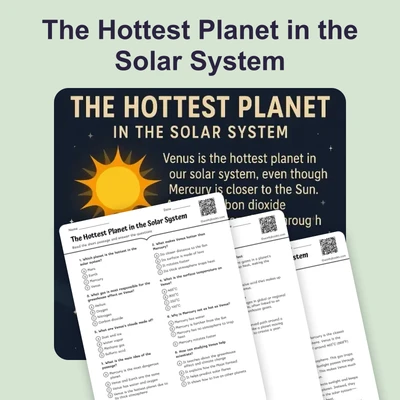
This learning resource is available in interactive and printable formats. The interactive worksheet can be played online and assigned to students. The Printable PDF version can be downloaded and printed for completion by hand.
Explore Venus, often called Earth's hot twin, in this engaging science passage written for students in grades 4-5. Aligned with NGSS standards, the passage introduces key scientific concepts such as atmosphere, greenhouse effect, volcanoes, and planetary orbits. Students will learn how Venus compares to Earth, why it is so hot, and how its thick clouds trap heat. The passage features a glossary of important terms, comprehension questions, a writing activity, and a full Spanish translation. Real-world examples and a fun fact make the content relatable and memorable for young learners. All content is audio integrated, making it accessible for different learning needs. This resource supports science literacy, vocabulary building, and critical thinking while connecting space science to everyday life.
CONTENT PREVIEW
Expand content preview
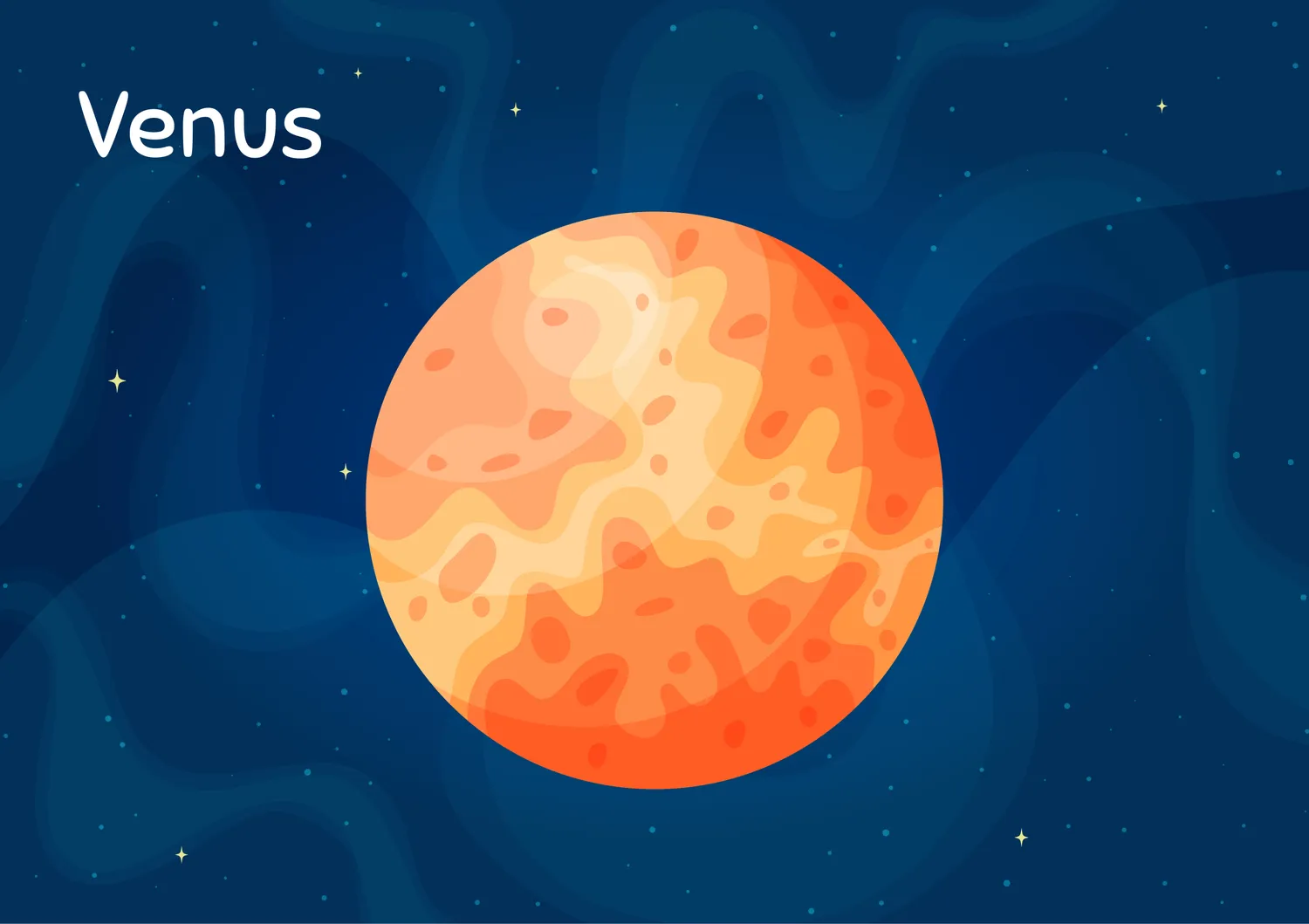
Venus is the second planet from the Sun in our solar system. It is sometimes called Earth's "hot twin" because it is almost the same size as Earth and has a similar rocky surface. But Venus is very different from our planet in many important ways.
One of the biggest differences is Venus's atmosphere. The atmosphere on Venus is very thick and is made mostly of a gas called carbon dioxide. This thick layer of gas traps heat from the Sun, causing a powerful greenhouse effect. Because of this, Venus is the hottest planet in the solar system, even hotter than Mercury, which is closer to the Sun. Temperatures on Venus can reach over 460°C (860°F)—hot enough to melt lead!
The thick atmosphere also gives Venus its bright, yellow-white clouds. These clouds are made of tiny drops of sulfuric acid, which would be very dangerous for humans. The clouds reflect sunlight, making Venus the brightest planet we can see from Earth.
Venus has mountains, valleys, and many volcanoes. Scientists believe that Venus may have more volcanoes than any other planet in the solar system. Most of these volcanoes are not active today, but in the past, they may have changed the surface of Venus by releasing hot lava and gases.
Unlike Earth, Venus does not have any moons or water on its surface. The high temperatures and thick clouds make it impossible for liquid water to exist there.
Even though Venus is not a place where humans can live, studying Venus helps scientists learn more about how planets work and how atmospheres can change over time.
Interesting Fact: A day on Venus is longer than its year! It takes about 243 Earth days to spin once, but only 225 Earth days to go around the Sun.
What is Venus mainly made of?
Rock and gasIce and waterMetal and sandWood and air
What gas is most common in Venus's air?
OxygenCarbon dioxideNitrogenHelium
What covers Venus and makes it bright?
Dust stormsIce sheetsThick cloudsTall trees
Why is Venus hotter than Mercury?
Closer to SunMore volcanoesGreenhouse effectHas more moons
What would happen if Venus had water?
It would freezeIt would boil awayIt would turn blueIt would become clouds
Why can't people live on Venus?
No air and too coldToo hot and dangerous cloudsToo many animalsNo sunlight
Venus is the hottest planet. True or false?
TrueFalse
What is a volcano?
A mountain that eruptsA river of iceA large valleyA type of cloud
Perfect For:
👩🏫 Teachers
• Reading comprehension practice
• Auto-graded assessments
• Literacy skill development
👨👩👧👦 Parents
• Reading practice at home
• Comprehension improvement
• Educational reading time
🏠 Homeschoolers
• Reading curriculum support
• Independent reading practice
• Progress monitoring
Reading Features:
📖
Reading Passage
Engaging fiction or nonfiction text
❓
Comprehension Quiz
Auto-graded questions
📊
Instant Feedback
Immediate results and scoring
📄
Printable Version
Download for offline reading
🔊
Read Aloud
Voice-over with word highlighting
Reviews & Ratings
No reviews yet. Be the first to share your experience!
Related Content
Earth: Our Home in Space
This engaging Grade 4-5 science passage, aligned to NGSS, introduces students to Earth's special place in the solar syst...
Tools and Technology in Earth Science
This middle school science reading passage explores the wide range of tools and technologies used in Earth science, from...
MS-ESS2-2MS-ESS3-2MS-ETS1-1MS-PS4-3
Earth's Place in the Universe
This reading passage explains Earth's place in the universe, supporting NGSS 1-ESS1-1. It describes how Earth is one of ...
1-ESS1-1
Scientific Inquiry in Earth Science
This passage explores scientific inquiry in Earth science for grades 6-8, aligned with NGSS standards MS-ESS1-4, MS-ESS2...
MS-ESS1-4MS-ESS2-1MS-ESS3-5SEP
What Is Space Weather and How Does It Affect the Earth?
This NGSS-aligned science passage for middle school explains what space weather is and how it affects Earth. Students le...
MS-ESS2-2
Escape Velocity and Space Travel
This middle school science passage introduces students to the concept of escape velocity—the minimum speed required to b...
MS-ESS1-2MS-PS2-4
Space Stations
This informational science reading passage for grades 6-8 explores the complex systems and technology behind space stati...
MS-ESS1-3MS-ETS1-1
What Is Earth Science?
This engaging middle school science passage introduces students to the field of Earth science, aligning with NGSS standa...
MS-ESS1MS-ESS2MS-ESS3SEP
The Space Garden
This innovative passage combines plant science with space exploration, aligning with NGSS standards for life sciences an...
RL.3.1RL.2.1RL.4.9
Measuring Distances in Space
This middle school science passage explores how astronomers measure the vast distances in space, aligning with NGSS stan...
MS-ESS1-3
Earth: Our Home Planet
This comprehensive science passage for grades 6-8 explores Earth’s unique characteristics and the interconnected systems...
MS-ESS1-2
Meteorite Impacts on Earth
This engaging science reading passage for Grades 4-5 explores meteorite impacts on Earth, aligning with NGSS standards. ...
Exploring Space: Rockets and Spacecraft
Space exploration has been one of humanity's greatest achievements, made possible by rockets and spacecraft. Rockets act...
RI.4.4RI.4.2
Earth's Rotation
This middle school science passage, aligned with NGSS standard MS-ESS1-1, focuses on Earth's rotation—how Earth spins on...
MS-ESS1-1
Facts About Earth
This engaging science reading passage introduces Grade 4 and 5 students to Earth, our home planet. Aligned with NGSS sta...
International Space Station
Discover the wonders of the International Space Station with this informative coloring page showcasing the orbiting outpost where astronauts live and work in space. As children color the complex modul...
Earth's Moon Facts
This engaging science passage, 'The Moon: Earth's Companion,' is designed for Grade 4-5 students and aligns with NGSS ge...
The Space Needle
Students read a passage about the history and features of Seattle's Space Needle, then answer comprehension questions to...
RI.4.2
Earth's Seasons
This comprehensive reading passage for grades 6-8 explains why Earth has seasons, revealing the scientific mechanisms be...
MS-ESS1-1
Venus: Earth's Twin?
This comprehensive science passage for grades 6-8 examines Venus—often called Earth's twin—by exploring its similarities...