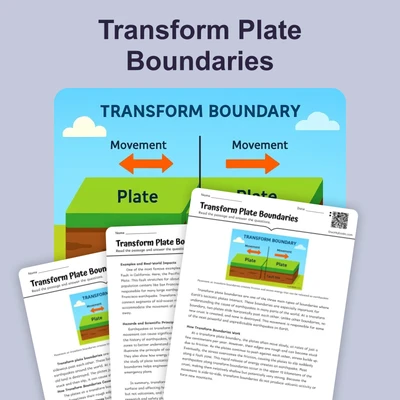
Faults
Interactive passage with audio narration, comprehension questions, and printable PDF.
By completing this purchase you agree to our Terms of Use and Privacy Policy. Your subscription renews automatically until you cancel. You can cancel anytime from your account settings. All sales are final and non-refundable. Digital content is available for download in your account immediately upon purchase.
What's included
Faults preview and details
About this printable Faults science reading passage, NGSS-aligned (Grades 5-8)
Sample passage and quiz from Faults
Reading passage and comprehension quiz preview
Faults
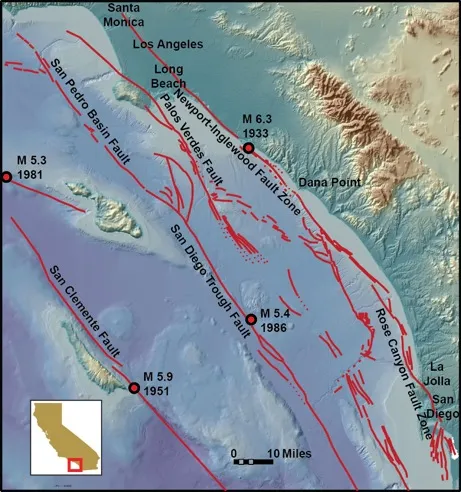
"Borderlands active faults page" by Pacific Coastal and Marine Science Center, United States Geological Survey / Wikimedia Commons (Public domain).
Faults are some of the most important features found in Earth's crust. These are cracks, or fractures, where blocks of rock have moved past each other. Faults help explain why earthquakes occur and how large sections of land, like mountains and valleys, form over time. Scientists study faults to better understand Earth's constantly changing surface and to predict natural hazards that can affect people and the environment.
How Faults Form and Move
Most faults form because of the movement of Earth's tectonic plates. When stress builds up in the crust, rocks break and slip along a fault. There are three main types of faults, each defined by how the rocks move. A normal fault happens when the hanging wall moves down compared to the footwall. This is caused by tensional forces that pull Earth's crust apart, usually at divergent boundaries. In a reverse fault, the hanging wall moves up, which occurs when the crust is squeezed together, often at convergent boundaries. A special type of reverse fault with a very gentle angle is called a thrust fault. The third type, the strike-slip fault, involves rocks sliding past each other horizontally. These are usually found at transform boundaries where plates grind alongside each other.
Identifying Faults and Their Effects
Scientists identify faults by looking for evidence such as offset layers of rock, sudden changes in landscape, or fault scarps—steep cliffs formed by fault movement. For example, the San Andreas Fault in California is a classic strike-slip fault responsible for many earthquakes. The Sierra Nevada front in the western United States is an example of a normal fault, where the land drops down to form a steep mountain front. In contrast, the Rocky Mountains contain reverse faults created by powerful compressive forces. Many faults are part of fault zones, which are broad regions containing numerous related faults. Faults can be classified as active (moving now), potentially active (could move), or inactive (unlikely to move again). Understanding these classifications helps communities prepare for future earthquakes.
Faults, Earthquakes, and Earth's Systems
Movement along faults releases energy in the form of earthquakes. The rate and size of these movements can vary greatly—from slow creep to sudden, violent shifts. For example, some faults may only move a few millimeters per year, while others can slip by several meters during a single earthquake. Faults not only shape the physical landscape but also influence water flow, soil formation, and even where people build cities. By studying faults, scientists gather data to create earthquake hazard maps and design safer buildings. These studies connect to broader scientific ideas about Earth's dynamic systems, showing how energy and matter are constantly cycled through the planet's crust.
Faults are more than just cracks in the ground—they are evidence of powerful forces shaping our world. By analyzing faults, scientists can uncover Earth's past and predict how it may change in the future.
Interesting Fact: The San Andreas Fault moves about 2 inches (5 centimeters) per year, which is about as fast as your fingernails grow!
Comprehension quiz (10 questions)
1. What is a fault?
2. Which type of fault is found at divergent boundaries?
3. What causes a reverse fault to form?
4. What is a fault scarp?
5. According to the passage, which fault is a classic example of a strike-slip fault?
6. What does the term 'fault zone' mean as used in the passage?
7. How do scientists use information about faults to help communities?
8. Which of the following is TRUE based on the passage?
9. Faults can be classified as active, potentially active, or inactive.
10. Some faults move only a few millimeters per year.
Perfect for the way you teach
- Build comprehension skills
- Auto-graded quiz
- Differentiated reading
- Read together at home
- Improve fluency
- Quiet reading time
- Reading curriculum support
- Independent practice
- Track Lexile growth