Forests Under Climate Stress
Interactive passage with audio narration, comprehension questions, and printable PDF.
What's included
Forests Under Climate Stress preview and details
About this printable Forests Under Climate Stress science reading passage, NGSS-aligned (Grades 5-8)
Sample passage and quiz from Forests Under Climate Stress
Reading passage and comprehension quiz preview
Forests Under Climate Stress
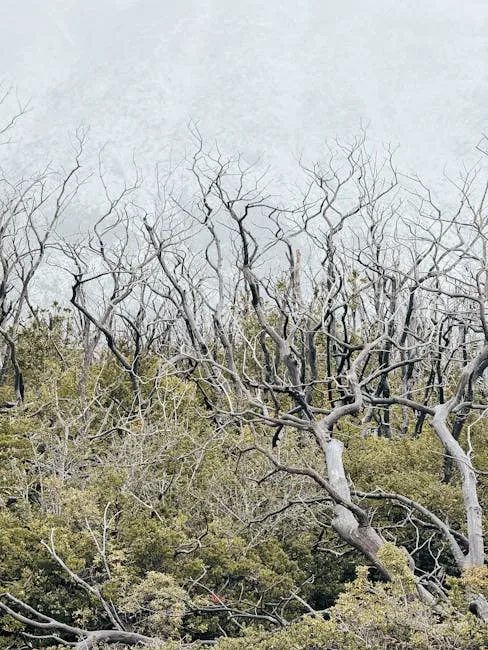
"A stark contrast of withered trees and green foliage in a Chilean forest landscape." by Marina Zvada / Pexels.
Forests around the world face mounting pressure from climate change. Rising temperatures and changing rainfall patterns create conditions that weaken trees and alter entire forest ecosystems. This stress comes not from direct human cutting but from the warming climate itself. Evidence shows that heat and drought make trees vulnerable to threats they once could resist.
When temperatures rise and rainfall decreases, trees experience drought stress. Water moves through trees from roots to leaves, carrying nutrients and keeping cells healthy. During drought, trees cannot get enough water to maintain these processes. Scientists observe that drought-weakened trees produce less sap to defend against attacks. This makes them easy targets for insect pests like bark beetles. These small insects bore into tree bark and lay eggs. Cold winters once killed most bark beetles each year, keeping their populations low. However, warmer winters now allow more beetles to survive and multiply. Beetle outbreaks can kill vast stretches of forest in just a few years.
Climate change also brings longer, hotter fire seasons. Dry conditions turn forests into fuel for wildfires. Heat waves dry out dead wood and living plants, making them burn more easily. Fires that once occurred every few decades may now happen every few years. These changes matter because forests provide critical ecosystem services. They store huge amounts of carbon in their wood and soil. When trees die from beetles or burn in fires, they release this stored carbon back into the atmosphere. A stressed forest can shift from a carbon sink to a carbon source, making climate change worse.
The Amazon rainforest shows how serious this problem can become. Scientists worry this massive forest could reach a tipping point. If enough trees die from heat, drought, and fire, the rainforest might transform into grassland. Such a change would release enormous amounts of carbon and destroy habitat for countless species. The Amazon stores about 150 billion tons of carbon. Losing this forest would affect Earth's entire climate system and eliminate homes for millions of plant and animal species.
Interesting Fact: A single bark beetle outbreak in western North America killed trees across an area larger than the state of Washington, releasing carbon equal to five years of vehicle emissions from the entire region.
Comprehension quiz (10 questions)
1. What is the main source of stress on forests discussed in this passage?
2. How do warmer winters affect bark beetle populations?
3. What does the term 'drought stress' mean in the context of trees?
4. According to the passage, what happens when drought-weakened trees produce less sap?
5. Why does a stressed forest releasing carbon make climate change worse?
6. What could happen to the Amazon rainforest if it reaches a tipping point?
7. How do longer, hotter fire seasons affect forests?
8. Approximately how much carbon does the Amazon rainforest store?
9. Cold winters once helped control bark beetle populations by killing most beetles each year.
10. A forest can only be a carbon sink and can never become a carbon source.
Perfect for the way you teach
- Build comprehension skills
- Auto-graded quiz
- Differentiated reading
- Read together at home
- Improve fluency
- Quiet reading time
- Reading curriculum support
- Independent practice
- Track Lexile growth