Geography of Early Rome
Interactive passage with audio narration, comprehension questions, and printable PDF.
By completing this purchase you agree to our Terms of Use and Privacy Policy. Your subscription renews automatically until you cancel. You can cancel anytime from your account settings. All sales are final and non-refundable. Digital content is available for download in your account immediately upon purchase.
What's included
Geography of Early Rome preview and details
About this printable Geography of Early Rome reading passage (Grades 5-8)
Sample passage and quiz from Geography of Early Rome
Reading passage and comprehension quiz preview
Geography of Early Rome
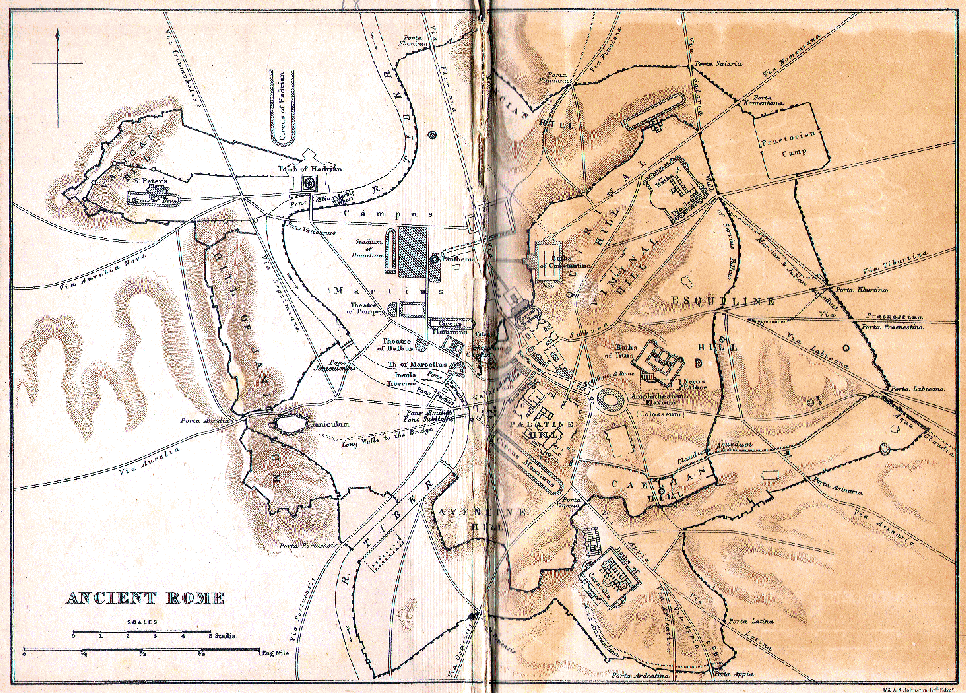
SKETCH-MAP OF ANCIENT ROME. by James Bikie
Source: Wikimedia Commons (Public domain).
The city of Rome began on the Italian Peninsula, where geography shaped its destiny as one of history’s most influential civilizations. Located in central Italy, Rome’s founders settled near the Tiber River, surrounded by seven hills. This natural setting provided fertile land, fresh water, and protection from invasion, making the area ideal for early settlement.
The origins of Rome are rooted in both legend and evidence. According to Roman tradition, twin brothers Romulus and Remus, raised by a she-wolf, founded the city in 753 BCE. Archaeologists have found traces of small villages on the Palatine Hill dating back to at least the 8th century BCE, supporting a timeline close to the legendary founding. The area’s hills made it easy to defend, while the Tiber River allowed for trade and transportation. Nearby, the Etruscans in the north and Greeks in the south influenced early Roman culture, sharing art, technology, and religious practices.
Rome’s location also influenced its growth into a powerful city-state. The fertile plains along the Tiber supported agriculture, which helped the population grow. The river itself connected Rome to the Mediterranean Sea, giving Romans access to trade routes and new ideas. Over time, Rome expanded its territory, first controlling nearby villages and then uniting the regions of Latium. By the 6th century BCE, Rome was ruled by kings, but archaeological evidence shows a forum where citizens gathered for markets, meetings, and political debates. This early public space set the stage for the later Republic, where citizens elected leaders and shared power.
Daily life in early Rome reflected a clear social hierarchy. At the top were the wealthy landowners, known as patricians, while most Romans were commoners, or plebeians. Archaeological discoveries, like family homes and pottery, show differences in wealth and status. As Rome grew, conflicts between social classes led to important changes, including new laws and rights for plebeians. These early struggles shaped Rome’s political structure for centuries.
Rome’s rise was not guaranteed. Geography, cultural exchange, and social change all contributed to its success. From a cluster of villages on seven hills, Rome became the center of a vast empire. Studying its early foundations helps us understand how geography and human decisions shape civilizations across time.
Interesting Fact: Archaeologists have found ancient walls and huts on the Palatine Hill, providing real evidence for the legendary founding of Rome.
Comprehension quiz (8 questions)
1. Where was Rome founded?
2. Who were Romulus and Remus?
3. What river flows near Rome?
4. How did geography help Rome grow?
5. Why was the forum important?
6. What effect did social conflict have?
7. Rome was influenced by the Etruscans. True or false?
8. What does 'Republic' mean?
Perfect for the way you teach
- Build comprehension skills
- Auto-graded quiz
- Differentiated reading
- Read together at home
- Improve fluency
- Quiet reading time
- Reading curriculum support
- Independent practice
- Track Lexile growth