George Washington Constitutional Convention — Reading Comprehension
Rate this
Premium Resource
Present
Present in classroom. No work saved
Assign
Classroom with student accounts, Track progress
Quick Play
No student accounts, assign with a link
Grades
6
7
8
PRINT+DIGITAL RESOURCE
This learning resource is available in interactive and printable formats. The interactive worksheet can be played online and assigned to students. The Printable PDF version can be downloaded and printed for completion by hand.
This passage explores George Washington's pivotal role at the Constitutional Convention of 1787, focusing on his influence, leadership, and the complexities of forming a new government for the United States. The reading highlights multiple perspectives, including the motivations and concerns of delegates from different states, and analyzes the challenges faced in creating a unified Constitution. Students will examine historical evidence, such as quotes from Washington and other Founding Fathers, and learn key academic vocabulary. The content is aligned with HSS 8.2 and RI.6.3 standards, making it ideal for classroom instruction. The resource includes a Spanish translation, differentiated version for accessible reading, and a variety of activities such as a multiple-choice quiz, writing prompts, graphic organizers, and a timeline. Read aloud audio is also available, making this a comprehensive resource for understanding the formation of the U.S. government and the significance of George Washington's leadership at the Convention.
CONTENT PREVIEW
Expand content preview
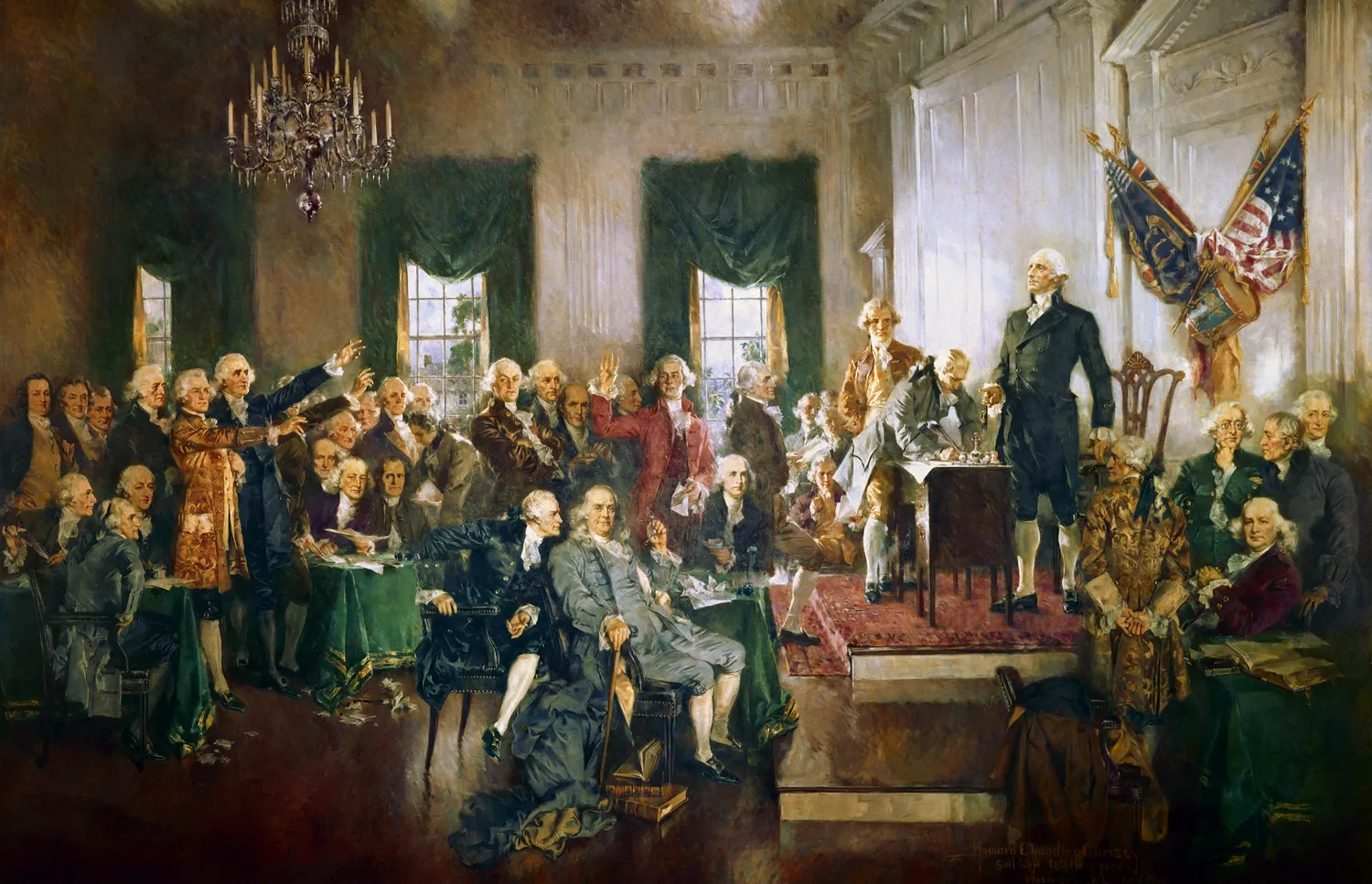
"Scene at the Signing of the Constitution of the United States" by Howard Chandler Christy / Source: Wikimedia Commons (Public domain).
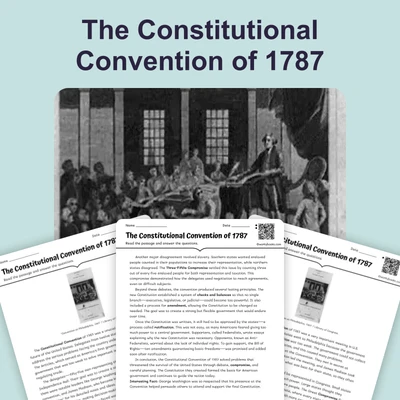
The Constitutional Convention of 1787 was a turning point for the United States. After years of struggle under the Articles of Confederation, the nation faced serious problems, such as a weak central government and disputes between the states. The need for a stronger framework of government became urgent. To address these challenges, delegates from twelve states met in Philadelphia, and George Washington was unanimously chosen to preside over the convention.
Washington’s role as the presiding officer was both symbolic and practical. His reputation as a respected leader and former commander of the Continental Army gave the convention immediate credibility. Many Americans trusted Washington’s judgment, and his presence reassured delegates that the process would be fair and orderly. This was important because the delegates needed public support for any new plan they developed.
However, the convention was not free from conflict. Delegates debated fiercely over key issues, such as the balance of power between large and small states and how representatives would be chosen. Washington rarely spoke during these debates, choosing instead to guide the proceedings calmly and enforce the rules. By doing so, he helped maintain order and encouraged compromise, which was essential for progress.
One major problem was how to create a government strong enough to govern effectively but not so powerful that it threatened individual freedoms. Washington’s steady leadership allowed delegates like James Madison and Benjamin Franklin to propose solutions, including a system of checks and balances. This system would prevent any one branch of government from becoming too powerful. The final document, the United States Constitution, became a compromise that combined different ideas and solved many of the nation’s problems.
Washington’s support for the new Constitution was crucial in the ratification process. Many Americans were suspicious of the new plan, fearing it gave too much power to the federal government. Washington’s endorsement convinced many people that the Constitution was trustworthy. States held conventions to debate and vote on ratification, and Washington’s reputation influenced several undecided states to approve the Constitution.
After the Constitution was ratified, Washington was elected as the first President of the United States. His actions as president set important precedents for future leaders, such as serving only two terms and respecting the limits of presidential power. Thus, his leadership at the Constitutional Convention had a lasting impact on the development of American democracy.
Interesting Fact: During the hot Philadelphia summer of 1787, windows were kept closed for secrecy, making the debates extremely uncomfortable for the delegates, including George Washington.
Who presided over the Constitutional Convention?
George WashingtonJames MadisonThomas JeffersonJohn Adams
Where did the Constitutional Convention take place?
BostonPhiladelphiaNew YorkRichmond
What document did the convention create?
Bill of RightsDeclaration of IndependenceU.S. ConstitutionFederalist Papers
Why was Washington’s presence important?
He wrote the ConstitutionHe kept order and gave credibilityHe was from a big stateHe argued for small states
How did Washington influence ratification?
By writing essaysBy leading debatesBy supporting the ConstitutionBy voting in every state
What was a key problem at the convention?
Choosing the new capitalBalancing state and federal powerEnding the warWriting the Declaration
The Articles of Confederation gave strong central power.
TrueFalse
What does 'credibility' mean in the passage?
Having trust and respectBeing a good speakerWorking quietlyMaking laws
Perfect For:
👩🏫 Teachers
• Reading comprehension practice
• Auto-graded assessments
• Literacy skill development
👨👩👧👦 Parents
• Reading practice at home
• Comprehension improvement
• Educational reading time
🏠 Homeschoolers
• Reading curriculum support
• Independent reading practice
• Progress monitoring
Reading Features:
📖
Reading Passage
Engaging fiction or nonfiction text
❓
Comprehension Quiz
Auto-graded questions
📊
Instant Feedback
Immediate results and scoring
📄
Printable Version
Download for offline reading
🔊
Read Aloud
Voice-over with word highlighting
Reviews & Ratings
No reviews yet. Be the first to share your experience!
Related Content
Presidential Precedents George Washington
This comprehensive history reading passage examines George Washington’s presidency and how his leadership set key nation...
New Nation America
This history reading passage, 'New Nation America,' covers how the United States struggled to become a united country af...
HSS 5.6.1RI.4.2
George Washington First President
This passage explores how George Washington became the first President of the United States in 1789 and the crucial prec...
The Cherokee Nation: History and Culture
This reading passage explores the rich history and culture of the Cherokee Nation, one of the largest Native American tr...
D2.HIS.2.3-5D2.HIS.14.3-5RI.4.3RI.4.4RI.4.10
American Indians and U.S. Citizenship
This reading passage explores the complex history of American Indians and U.S. citizenship, focusing on the period after...
John Adams: Second President
This engaging U.S. history reading passage introduces students to John Adams, the second President of the United States....
D2.HIS.2.3-5D2.HIS.14.3-5RI.4.3RI.4.4
James Madison Early Life
This passage explores the formative years of James Madison—his upbringing in Virginia, his education, and his early expe...
George Washington: Our First President
This engaging U.S. history reading passage introduces students to George Washington, America’s first president, through ...
D2.HIS.2.3-5D2.HIS.3.3-5RI.4.3RI.4.4
George Washington Early Life
This reading passage explores George Washington’s remarkable journey from Virginia plantation farmer to the first presid...
New Orleans: An Important Port
This engaging U.S. history reading passage explores the crucial role of New Orleans and the Louisiana Purchase in shapin...
D2.HIS.3.3-5D2.HIS.14.3-5RI.4.3RI.4.4
John Adams Presidency
This passage explores the complex presidency of John Adams, the second president of the United States, focusing on the p...
D2.HIS.2.3-5D2.HIS.3.3-5RI.4.3RI.4.4
George Washington Whiskey Rebellion
This engaging U.S. History reading passage examines George Washington and the Whiskey Rebellion, a crucial moment that t...
Modern American Presidents
This engaging reading passage introduces students to Modern American Presidents, focusing on the leadership, challenges,...
D2.HIS.1-4.3-5RI.4.3RI.4.4
Hamilton vs Jefferson
This engaging U.S. history reading passage explores the contrasting visions of Alexander Hamilton and Thomas Jefferson, ...
Leaders Call for a New Constitution
This reading passage explores the pivotal moment in U.S. history when American leaders recognized the weaknesses of the ...
Madison War of 1812
This engaging reading passage explores President James Madison’s 1812 war message to Congress, which played a pivotal ro...
James Madison: Father of the Constitution
This passage provides a detailed exploration of James Madison’s pivotal role in creating the U.S. Constitution, earning ...
Battle of New Orleans 1815
This passage explores the pivotal Battle of New Orleans in 1815, focusing on Andrew Jackson’s leadership and the complex...
D2.HIS.2.3-5D2.HIS.3.3-5RI.4.3RI.4.4
Madison First Congress
This passage explores the critical period of the First Congress in 1789, focusing on James Madison's leadership and the ...
James Monroe and the Monroe Doctrine
This engaging U.S. history reading passage introduces students to President James Monroe and the Monroe Doctrine, a key ...