Giant and Supergiant Stars
Interactive passage with audio narration, comprehension questions, and printable PDF.
By completing this purchase you agree to our Terms of Use and Privacy Policy. Your subscription renews automatically until you cancel. You can cancel anytime from your account settings. All sales are final and non-refundable. Digital content is available for download in your account immediately upon purchase.
What's included
Giant and Supergiant Stars preview and details
About this printable Giant and Supergiant Stars science reading passage, NGSS-aligned (Grades 5-8)
Sample passage and quiz from Giant and Supergiant Stars
Reading passage and comprehension quiz preview
Giant and Supergiant Stars
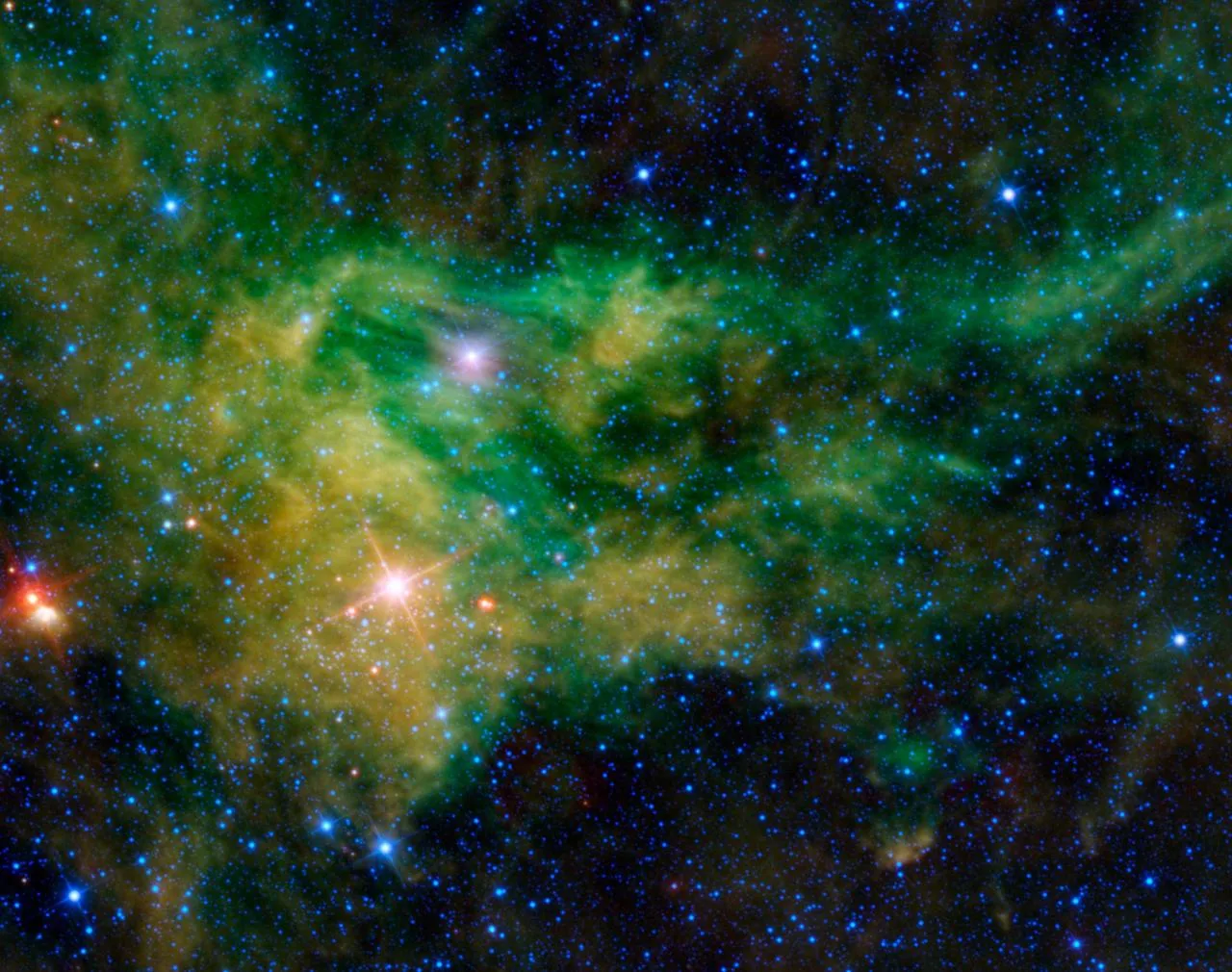
NASA Wide-field Infrared Survey Explorer captured this colorful image of the nebula BFS 29 surrounding the star CE-Camelopardalis, found hovering in the band of the night sky comprising the Milky Way. Supergiant Star Near Giraffe Hind Foot" / NASA
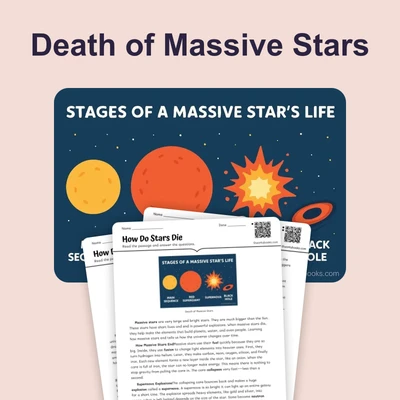
Giant and supergiant stars are massive stars in the late stages of their lives. These enormous stars form when a star exhausts its hydrogen fuel supply. After billions of years of burning hydrogen in its core, a star begins to change dramatically.
When hydrogen runs out, the star's core contracts under gravity. This contraction releases energy that heats the outer layers. The outer layers expand outward, causing the star to grow much larger. Scientists observe that the star's surface cools as it expands. This cooling gives the star a reddish color. Evidence shows that these changes occur in all stars with enough mass.
Red giants are stars that have expanded to dozens of times their original size. Our Sun can eventually become a red giant in about five billion years. When this happens, it may expand beyond Earth's current orbit. Aldebaran, a red giant in the constellation Taurus, is approximately 44 times larger than the Sun. Astronomers can measure its size using special instruments.
Red supergiants are even more massive and larger than red giants. These stars represent the most extreme examples of stellar evolution. Betelgeuse, a red supergiant in the constellation Orion, is over 700 times larger than the Sun. If Betelgeuse replaced our Sun, it would extend past the orbit of Mars. Scientists explain that supergiants burn through their fuel much faster than smaller stars.
Giant and supergiant stars glow brilliantly despite their cooler surfaces. They produce enormous amounts of light because of their huge size. These stars can be seen from great distances across space. However, this bright phase does not last long in cosmic terms. Red supergiants may shine for only a few million years before dying. They end their lives in spectacular supernova explosions that scatter elements throughout space.
Understanding giant and supergiant stars matters because they help scientists learn about stellar life cycles. These stars also create and distribute heavy elements necessary for planets and life. Observations of these massive stars provide evidence about how the universe evolves over time.
Interesting Fact: Betelgeuse is so large that if it were hollow, it could hold more than 300 million Suns inside it. Astronomers predict it may explode as a supernova sometime in the next 100,000 years.
Comprehension quiz (10 questions)
1. What happens to a star when it runs out of hydrogen fuel?
2. How much larger is Betelgeuse compared to the Sun?
3. What does the term 'stellar evolution' mean in the passage?
4. Why do giant and supergiant stars appear red?
5. Based on the passage, what can scientists infer about supergiant stars compared to smaller stars?
6. If Betelgeuse replaced our Sun, where would it extend to in our solar system?
7. What would happen if a student wanted to apply the concept of stellar evolution to predict the Sun's future?
8. Why is understanding giant and supergiant stars important for learning about the universe?
9. True or False: All stars with enough mass will eventually become red giants or supergiants.
10. True or False: Red supergiant stars shine for billions of years before dying.
Perfect for the way you teach
- Build comprehension skills
- Auto-graded quiz
- Differentiated reading
- Read together at home
- Improve fluency
- Quiet reading time
- Reading curriculum support
- Independent practice
- Track Lexile growth