Reading PassagePremium

Homer and the Iliad

Interactive passage with audio narration, comprehension questions, and printable PDF.

No ratings yet
Grades 6–8ReadingElaSocial-studiesHistoryEnglish · SpanishInteractive · Printable
Aligned to6.4.2RH.6-8.2RH.6-8.4
Just this resource
$1.50
One-time purchase
Best value
Unlock everything
$49.99$24.99/yr
50% off until Sept 15 — 10,000+ resources
Renews at $49.99/year.

By completing this purchase you agree to our Terms of Use and Privacy Policy. Your subscription renews automatically until you cancel. You can cancel anytime from your account settings. All sales are final and non-refundable. Digital content is available for download in your account immediately upon purchase.

Unlock above to use these actions

What's included

Reading passage
Audio narration
Comprehension quiz
Writing activity
Glossary & flashcards
Differentiated version
Spanish translation

Part of this bundle

Homer and the Iliad preview and details

About this printable Homer and the Iliad reading passage (Grades 6-8)

This history reading passage explores the life and historical significance of Homer, the legendary epic poet of Ancient Greece, known for composing the Iliad and the Odyssey. Students will learn about the origins of these epic poems, Homer’s role in Greek society, the oral tradition, and how his works influenced both ancient and modern cultures. The passage includes primary source references, cause-and-effect analysis, and vocabulary essential for understanding the context of ancient Greek literature. It is aligned with the California HSS Framework 6.4.2 and Common Core RH.6-8.2, RH.6-8.4 standards. Additional resources include a Spanish translation, differentiated reading level, multiple-choice quiz, writing assessment, and graphic organizers. Read aloud audio and activities support diverse learners and help them connect Homer's contributions to broader themes in world history and literature.
Written by Workybooks TeamPublished by Workybooks
Preview

Sample passage and quiz from Homer and the Iliad

Reading passage and comprehension quiz preview

Homer and the Iliad
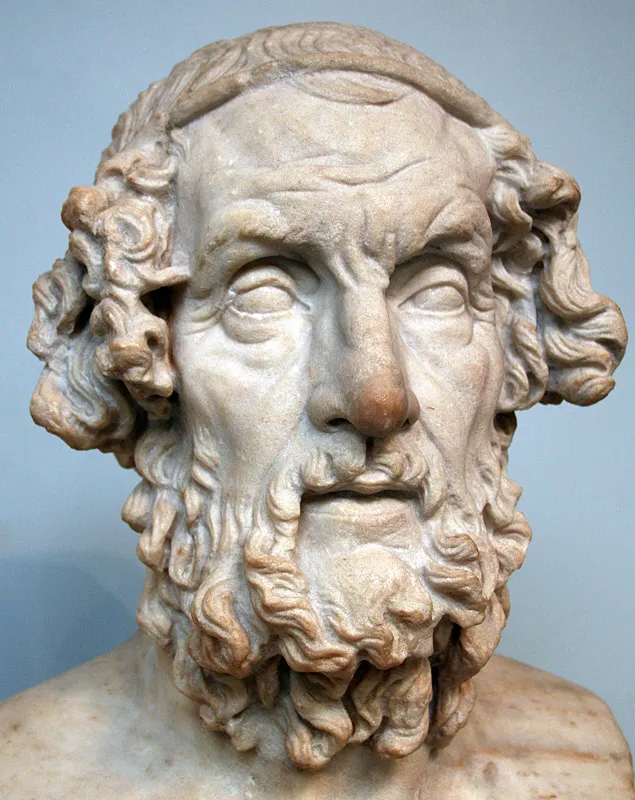
Homer British Museum

"Homer British Museum" / Wikimedia Commons (Public domain). 

Homer is recognized as one of the most important poets of ancient Greece. He is traditionally credited as the author of two monumental works, the Iliad and the Odyssey. These epic poems, believed to have been composed during the eighth century BCE, are considered the foundation of Greek literature and have shaped the way later societies understand heroism, fate, and the gods.

The Iliad tells the story of the final weeks of the Trojan War. It features legendary figures such as Achilles, Hector, and King Priam. While the events described are based on oral traditions and myths, archaeological sites, like the ruins of Troy discovered in modern-day Turkey, provide some evidence that conflicts occurred in the region. The Odyssey follows Odysseus, a Greek hero, as he faces challenges and adventures on his journey home from the war. Both poems reveal the values of Greek society, such as bravery, loyalty, and cleverness.

Homer likely lived in Ionia, a region on the western coast of Asia Minor (now Turkey). However, very little is known for certain about his life. Some ancient sources describe him as blind, while others question whether a single person named Homer actually existed. Historians debate whether the epics were created by one poet or developed over generations by many storytellers. Despite this, Homer’s name became associated with the poems due to his reputation as a master bard, or professional storyteller.

Homer’s works were originally passed down through oral tradition. This means the stories were memorized and performed aloud rather than written down. Skilled bards used repetitive phrases and poetic devices to help remember the long stories. Writing systems, like the Greek alphabet, were just beginning to be used during Homer’s time. Eventually, the epics were written down, preserving them for future generations. The poems not only entertained ancient audiences but also taught lessons about life, leadership, and respect for the gods.

The impact of Homer’s epics extended across the Greek world. The poems helped unite the various city-states of Greece by providing a shared set of stories and values. Greek children and adults learned about their history and identity through these tales. Over time, the Iliad and the Odyssey influenced art, drama, and philosophy. Today, Homer’s legacy continues, as his works remain central to the study of literature and history around the world.

The story of Homer links to broader themes of world history by showing how literature preserves cultural identity and influences generations. His works highlight the power of storytelling to unite people and shape civilizations.

Interesting Fact: In ancient Greece, winning a poetry contest was almost as prestigious as winning an athletic competition at the Olympic Games!

Comprehension quiz (8 questions)

1. Who is credited with writing the Iliad?

Homer
Socrates
Alexander
Odysseus

2. Where did Homer likely live?

Ionia
Athens
Sparta
Rome

3. What is the Odyssey about?

Odysseus's journey home
Building the Parthenon
Achilles in battle
Greek alphabet

4. How did Homer's poems first spread?

Oral tradition
Written books
Stone carvings
Paintings

5. Why are the Iliad and Odyssey important?

They shaped Greek identity
They describe farming
They are about Egypt
They are short stories

6. What effect did Homer’s poems have on city-states?

United them with shared values
Started wars
Made new alphabets
Built temples

7. Homer was a bard. True or false?

True
False

8. What does city-state mean?

Independent city with its own government
A kind of poem
A Greek hero
A war between cities
Who it's for

Perfect for the way you teach

Teachers
  • Build comprehension skills
  • Auto-graded quiz
  • Differentiated reading
Parents
  • Read together at home
  • Improve fluency
  • Quiet reading time
Homeschoolers
  • Reading curriculum support
  • Independent practice
  • Track Lexile growth
Topics

Reviews & Ratings

No reviews yet. Be the first to share your experience!

More reading you might love

19 more
Passage
Juan Bautista de Anza's Expedition - reading educational content
Grades 3–5

Juan Bautista de Anza's Expedition

us history · HSS 4.2.3+1

$1.50
Passage
How Explorers Changed California - reading educational content
Grades 3–5

How Explorers Changed California

us history · HSS 4.2.2+1

$1.50
Passage
California Gold Discovery - reading educational content
Grades 3–5

California Gold Discovery

us history · HSS 4.4.1+1

$1.50
Passage
California Mining Camps - reading educational content
Grades 3–5

California Mining Camps

us history · HSS 4.4.2+1

$1.50
Passage
San Francisco Growth - reading educational content
Grades 3–5

San Francisco Growth

us history · HSS 4.4.3+1

$1.50
Passage
Transcontinental Railroad - reading educational content
Grades 3–5

Transcontinental Railroad

us history · HSS 4.4.1+1

$1.50
Passage
California Agriculture Growth - reading educational content
Grades 3–5

California Agriculture Growth

us history · HSS 4.4.6+1

$1.50
Passage
The 1879 California Constitution - reading educational content
Grades 3–5

The 1879 California Constitution

us history · HSS 4.5.1+1

$1.50
Passage
California Progressive Era - reading educational content
Grades 3–5

California Progressive Era

us history · HSS 4.5.2+1

$1.50
Passage
How a California Bill Becomes Law - reading educational content
Grades 3–5

How a California Bill Becomes Law

us history · HSS 4.5.3+1

$1.50
Passage
Civic Participation in California - reading educational content
Grades 3–5

Civic Participation in California

us history · HSS 4.5.5+1

$1.50
Passage
Meroë Capital of Ancient Kush - reading educational content
Grades 5–8

Meroë Capital of Ancient Kush

ancient history · CA HSS 6.2.6+3

$1.50
Passage
Lost City of Pompeii - reading educational content
Grades 5–8

Lost City of Pompeii

ancient history · CA HSS 6.1+3

$1.50
Passage
King Tut's Tomb Discovered - reading educational content
Grades 5–8

King Tut's Tomb Discovered

ancient history · CA HSS 6.2.9+2

$1.50
Passage
Farming in Ancient Mesopotamia - reading educational content
Grades 5–8

Farming in Ancient Mesopotamia

ancient history · CA HSS 6.2+4

$1.50
Passage
Mesopotamian Irrigation Systems - reading educational content
Grades 5–8

Mesopotamian Irrigation Systems

ancient history · CA HSS 6.2+4

$1.50
Passage
Sumerian City-States - reading educational content
Grades 5–8

Sumerian City-States

ancient history · CA HSS 6.2.1+3

$1.50
Passage
Greek Art and Architecture - reading educational content
Grades 5–8

Greek Art and Architecture

ancient history · CA HSS 6.4+3

$1.50
Passage
Hellenistic Age - reading educational content
Grades 5–8

Hellenistic Age

ancient history · CA HSS 6.4+2

$1.50
Copyright © 2026 Workybooks. Made with ♥ in California.