How Accurate Are Climate Predictions
Interactive passage with audio narration, comprehension questions, and printable PDF.
By completing this purchase you agree to our Terms of Use and Privacy Policy. Your subscription renews automatically until you cancel. You can cancel anytime from your account settings. All sales are final and non-refundable. Digital content is available for download in your account immediately upon purchase.
What's included
How Accurate Are Climate Predictions preview and details
About this printable How Accurate Are Climate Predictions science reading passage, NGSS-aligned (Grades 5-8)
Sample passage and quiz from How Accurate Are Climate Predictions
Reading passage and comprehension quiz preview
How Accurate Are Climate Predictions
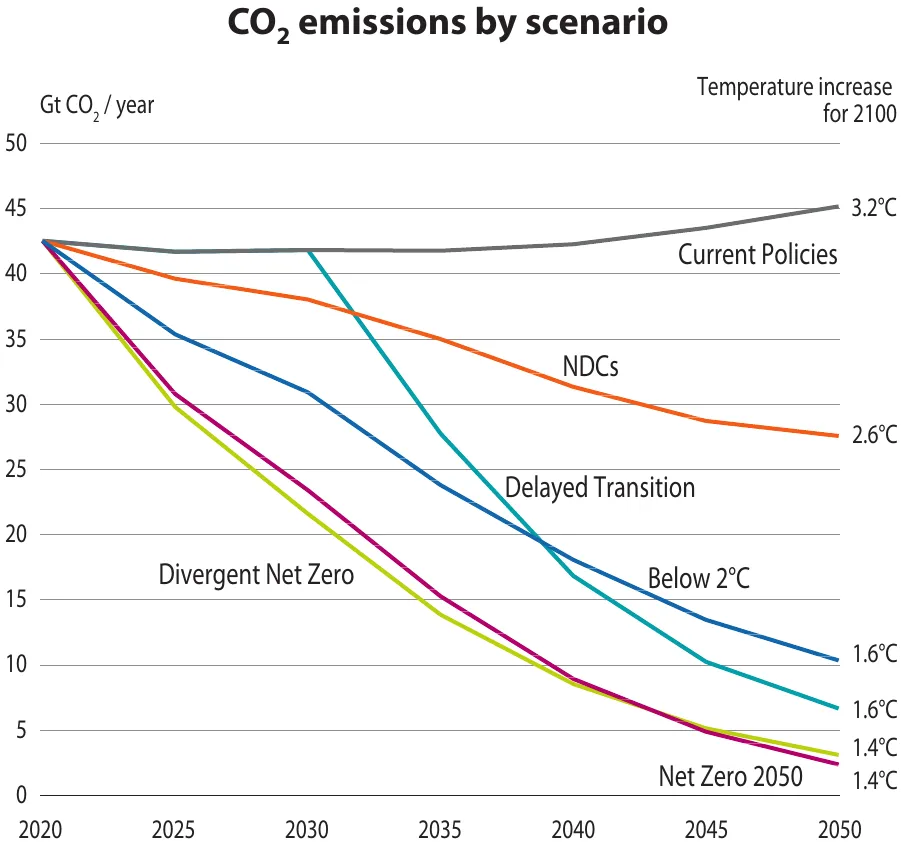
NGFS Climate Scenarios 2022, CO2 emissions by scenario, based on the REMIND model by IIASA NGFS Climate Scenarios Database, REMIND model. / Wikimedia Commons
Climate scientists use computer programs called climate models to predict future warming. But how do we know these predictions can be trusted? Scientists test their models by running them backward through time. They input conditions from decades ago and let the model run forward. When the simulation matches the warming we actually observed, it provides strong evidence the model captures how climate works.
Climate predictions for the future come as ranges, not single numbers. This might seem like a weakness, but it's actually scientific honesty. The uncertainty exists for two main reasons. First, scientists cannot predict exactly how natural processes like volcanic eruptions will unfold. Second, and more importantly, the outcome depends on choices humans haven't made yet. How much greenhouse gas will we continue to emit? Different emission scenarios produce different warming levels. A projection shows what could happen under specific conditions, not what will definitely occur.
Evidence shows that older predictions have held up remarkably well. In 1988, scientist James Hansen presented climate projections to Congress. His models predicted warming of about 0.6 degrees Celsius by 2020 under a moderate emissions scenario. The actual warming measured through 2020 was approximately 0.6 degrees Celsius. This close match between forecast and reality demonstrates that scientists understand the basic physics driving climate change. Multiple models from different research teams around the world produce similar results, which strengthens confidence in the predictions.
Scientists also test their models against paleoclimate data from ice cores and tree rings. When models successfully reproduce past climate shifts, like ice ages, it shows they can handle major changes. The models aren't perfect, and scientists work constantly to improve them. However, the overall direction is clear and consistent. Evidence indicates Earth will continue warming if greenhouse gas levels keep rising.
Understanding prediction accuracy matters because it helps society make informed decisions. Climate models don't just predict temperature. They also project changes in rainfall patterns, sea level rise, and extreme weather frequency. These predictions guide planning for infrastructure, agriculture, and disaster preparedness. The fact that models have successfully predicted the warming trend gives scientists confidence about future projections, even though exact details remain uncertain.
Interesting Fact: The first computer climate model was created in 1967 by Syukuro Manabe and Richard Wetherald. Their simple model correctly predicted that doubling carbon dioxide would warm Earth by about 2 degrees Celsius, which matches modern, far more complex models.
Comprehension quiz (10 questions)
1. How do scientists test whether climate models work correctly?
2. Why do climate predictions come as ranges instead of exact numbers?
3. What does the term 'projection' mean in climate science?
4. According to the passage, James Hansen's 1988 climate prediction was:
5. What is paleoclimate data used for?
6. What does 'uncertainty' mean in the context of climate predictions?
7. According to the passage, what strengthens confidence in climate predictions?
8. Besides temperature, what else do climate models predict?
9. True or False: Climate models are perfect and never need improvement.
10. True or False: The first computer climate model from 1967 predicted warming amounts similar to modern complex models.
Perfect for the way you teach
- Build comprehension skills
- Auto-graded quiz
- Differentiated reading
- Read together at home
- Improve fluency
- Quiet reading time
- Reading curriculum support
- Independent practice
- Track Lexile growth