How Deforestation Contributes to Climate Change — Reading Comprehension
Rate this
Premium Resource
Present
Present in classroom. No work saved
Assign
Classroom with student accounts, Track progress
Quick Play
No student accounts, assign with a link
Grades
6
7
8
PRINT+DIGITAL RESOURCE
This learning resource is available in interactive and printable formats. The interactive worksheet can be played online and assigned to students. The Printable PDF version can be downloaded and printed for completion by hand.
This engaging science passage, aligned with NGSS standards, explains how deforestation contributes to climate change for middle school students. Students will learn about key scientific concepts such as the carbon cycle, greenhouse gases, and photosynthesis. The passage defines important vocabulary terms, uses real-world examples, and concludes with an interesting science fact. Also included are a glossary, a Spanish translation of the passage, a multiple-choice comprehension quiz, and writing prompts that promote scientific thinking. The content is written at a Grade 6-8 reading level and is audio integrated for accessibility. This resource helps students understand environmental issues and encourages them to connect science concepts to their everyday lives. Keywords include deforestation, climate change, carbon dioxide, greenhouse gases, and global warming.
CONTENT PREVIEW
Expand content preview
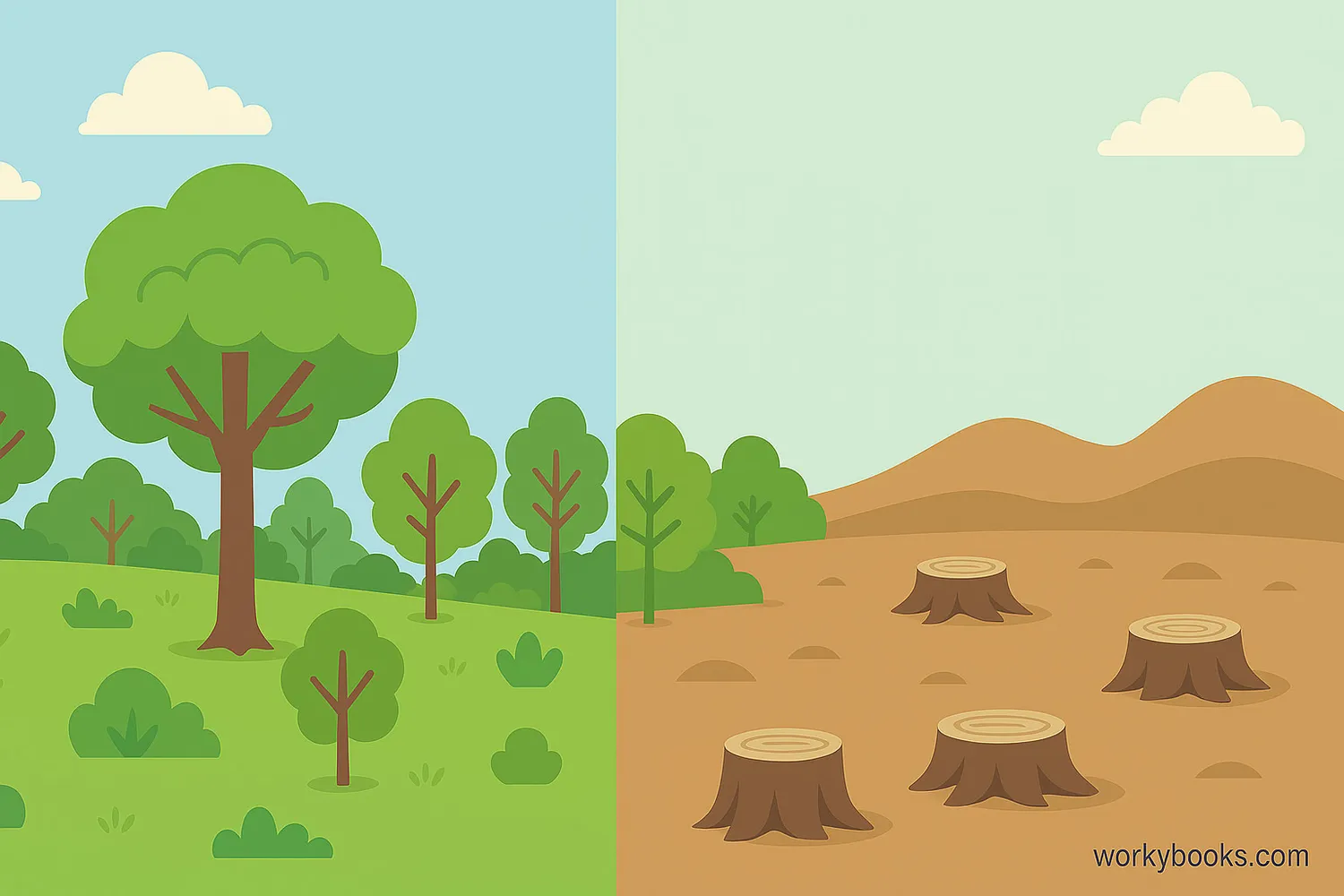
When forests are cut down, there are fewer trees left to absorb carbon dioxide.
Deforestation is when large areas of forests are cut down or removed, often to make space for farming, roads, or buildings. Forests cover about 31% of the Earth’s land. They play a very important role in keeping the planet healthy.
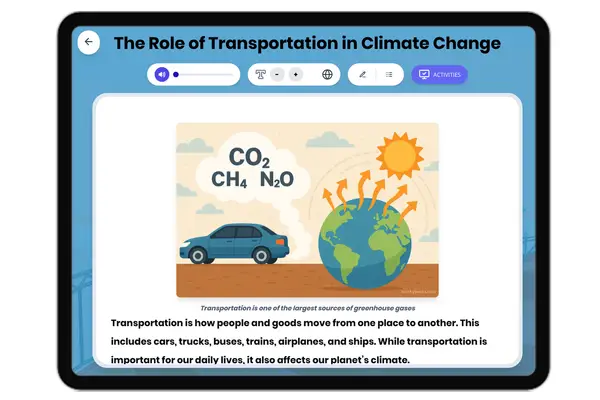
Trees and other plants use a process called photosynthesis to take in carbon dioxide (CO2) from the air. During photosynthesis, trees absorb carbon dioxide and release oxygen. This helps reduce the amount of carbon dioxide, which is a main greenhouse gas that traps heat in the atmosphere.
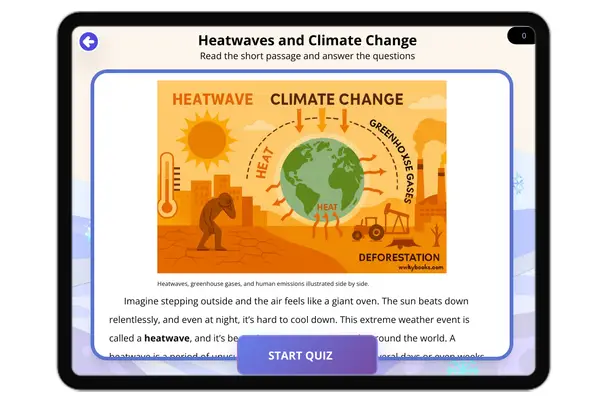
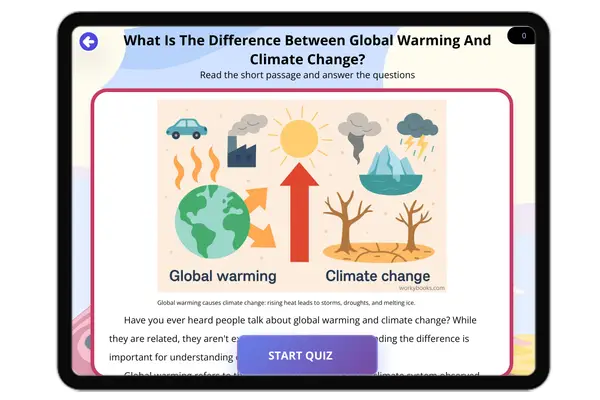
When forests are cut down, there are fewer trees left to absorb carbon dioxide. This means more carbon dioxide stays in the atmosphere, which can cause the Earth’s temperature to rise. This process is called global warming, and it is a big part of climate change. Climate change can lead to problems like stronger storms, rising sea levels, and droughts.
Deforestation doesn’t just stop trees from absorbing carbon dioxide. When trees are burned or left to rot, the carbon stored in their wood is released back into the air as carbon dioxide. This adds even more greenhouse gases to the atmosphere.
One real-world example is the Amazon Rainforest in South America. It is sometimes called the “lungs of the Earth” because it holds so many trees. When large parts of the Amazon are cleared for cattle ranching or farming, huge amounts of carbon dioxide are released, making climate change worse around the world.
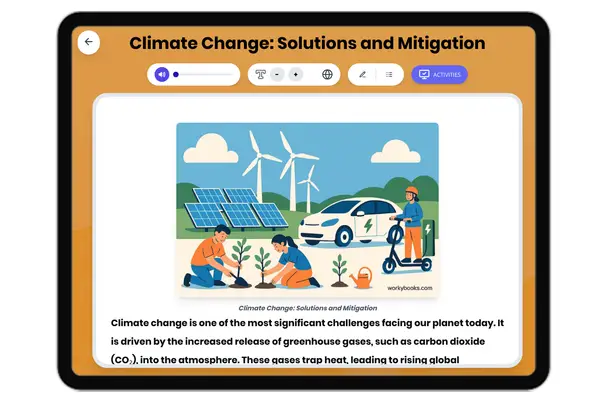
People can help fight climate change by protecting forests, planting new trees, and using land more carefully. Scientists, governments, and everyday people all have a role in stopping deforestation and reducing greenhouse gases.
Interesting Fact: The world loses about 10 million hectares of forests every year, which is about the size of 27 soccer fields every minute!
What is deforestation?
Cutting down large areas of forestsPlanting many new treesAdding water to plantsProtecting wildlife in forests
Which gas do trees remove from air?
Carbon dioxideOxygenNitrogenHydrogen
What is a greenhouse gas?
Gas that traps heatGas that cools EarthGas found only in oceansGas used for cooking
Why does deforestation cause more CO2 in air?
Fewer trees absorb CO2More oxygen is madeRainfall increasesEarth cools down
How can people help stop climate change?
Protect forestsCut down more treesBurn more woodUse more land for roads
What happens if trees are burned?
Carbon is releasedMore CO2 is absorbedOxygen turns to waterSoil becomes richer
Deforestation helps lower greenhouse gases. True or false?