How Digestion and Blood Work Together — Reading Comprehension
Rate this
Premium Resource
Present
Present in classroom. No work saved
Assign
Classroom with student accounts, Track progress
Quick Play
No student accounts, assign with a link
Grades
3
4
5
Standards
NGSS 4-LS1-1
PRINT+DIGITAL RESOURCE
This learning resource is available in interactive and printable formats. The interactive worksheet can be played online and assigned to students. The Printable PDF version can be downloaded and printed for completion by hand.
This 250-word reading passage introduces fourth-grade students to the relationship between the digestive system and circulatory system, aligned with NGSS standard 4-LS1-1. Students discover how nutrients from food pass from the digestive system into the blood, and how the heart pumps nutrient-rich blood to every cell in the body. The passage uses simple, age-appropriate language to explain this key example of body systems working together. Audio-integrated features support diverse learners by providing text-to-speech functionality. The passage includes bolded vocabulary terms with immediate definitions, real-world examples, and an engaging fact about the digestive process. Supplementary activities include comprehension questions testing recall and application, writing prompts requiring explanation and connection-making, and graphic organizers that help students visualize the sequence of nutrient delivery and the structure-function relationships of body systems. A simplified differentiated version ensures accessibility for students reading below grade level. Spanish translations of both passages support English language learners. This comprehensive resource builds foundational understanding of how body systems interact, preparing students for hands-on investigations and deeper exploration of human body functions.
CONTENT PREVIEW
Expand content preview
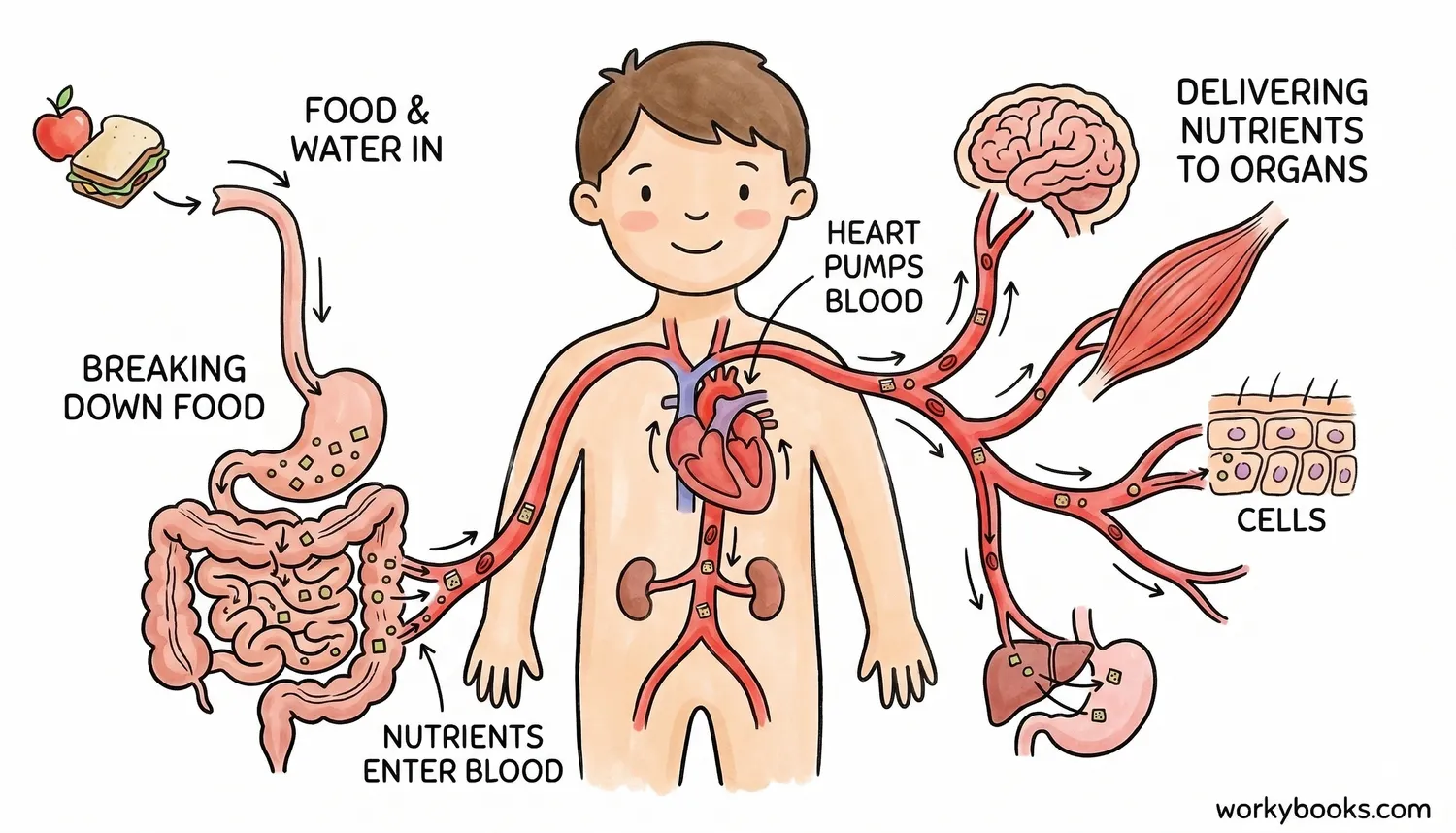
Digestive and circulatory systems working together to deliver energy to cells.
Your body has many different systems that work together to keep you alive and healthy. Two important systems are the digestive system (the parts of your body that break down food) and the circulatory system (the heart and blood vessels that move blood around your body). These two systems depend on each other to deliver the energy and materials your body needs.
When you eat food, your digestive system goes to work. Your stomach and intestines break down the food into tiny pieces called nutrients (substances from food that your body needs to grow and stay healthy). But these nutrients cannot help your body while they are still in your stomach or intestines. They need to travel to every part of your body—your brain, muscles, skin, and all your other organs.
This is where blood comes in. After nutrients are broken down in your digestive system, they pass through the walls of your intestines and enter your blood. Think of blood like a delivery truck that carries important packages to different addresses. Once the nutrients are in your blood, your heart pumps that nutrient-rich blood through blood vessels to every cell in your body. Without blood, the nutrients from your lunch would have nowhere to go. Without digestion, your blood would have nothing to deliver. These two systems must work together for your body to get the energy it needs.
Interesting Fact: Your small intestine is about 20 feet long, and it has tiny finger-like bumps called villi that help nutrients pass into your blood faster!
What does the digestive system do?
Pumps blood through the bodyBreaks down food into nutrientsCarries oxygen to cellsMakes the heart beat
What are nutrients?
Tiny pieces of undigested foodRed blood cells in bloodSubstances from food the body needsParts of the stomach
Where do nutrients go after digestion?
They stay in the stomachThey pass into the bloodThey go to the lungsThey leave the body
Why does blood need the digestive system?
To make the heart pumpTo create new blood cellsTo get nutrients to carryTo move through vessels
What happens after nutrients enter blood?
They are broken down againHeart pumps them to cellsThey return to the stomachThey become waste
Blood is compared to what?
A factory that makes thingsA filter that cleans waterA delivery truck carrying packagesA storage container
Body systems can work independently without help.
TrueFalse
What is the circulatory system?
Stomach and intestinesBrain and nervesHeart and blood vesselsLungs and airways
Perfect For:
👩🏫 Teachers
• Reading comprehension practice
• Auto-graded assessments
• Literacy skill development
👨👩👧👦 Parents
• Reading practice at home
• Comprehension improvement
• Educational reading time
🏠 Homeschoolers
• Reading curriculum support
• Independent reading practice
• Progress monitoring
Reading Features:
📖
Reading Passage
Engaging fiction or nonfiction text
❓
Comprehension Quiz
Auto-graded questions
📊
Instant Feedback
Immediate results and scoring
📄
Printable Version
Download for offline reading
🔊
Read Aloud
Voice-over with word highlighting
Reviews & Ratings
No reviews yet. Be the first to share your experience!
Related Content
How Animals See Differently
This engaging 250-word reading passage introduces fourth-grade students to the fascinating world of animal vision and ey...
NGSS 4-LS1-1LS1.D
Animal Internal Structure
This engaging science passage for Grade 4-5 students explores animal internal structure and how organs work together to ...
NGSS 4-LS1-1
What Are Bones Made Of
This engaging 250-word reading passage introduces Grade 4 students to the structure and function of bones, aligned with ...
NGSS 4-LS1-1LS1.A
How Bones Protect Organs
This engaging 250-word reading passage helps Grade 4 students understand how bones protect organs, aligned with NGSS sta...
NGSS 4-LS1-1LS1.A
How Joints Connect Bones
This 250-word reading passage teaches fourth-grade students about joints and their role in the human skeletal system. Al...
NGSS 4-LS1-1LS1.A
How Muscles Move Bones
This comprehensive 250-word reading passage introduces fourth-grade students to the fundamental concept of how muscles a...
NGSS 4-LS1-1
Two Types of Muscles
This 250-word reading passage introduces fourth-grade students to the two main types of muscles in the human body: volun...
NGSS 4-LS1-1
What Are Muscles
This engaging 250-word reading passage introduces fourth-grade students to the essential concept of muscles and how they...
NGSS 4-LS1-1
How Skin Protects Body
This audio-integrated reading passage introduces fourth-grade students to the protective functions of skin, aligned with...
NGSS 4-LS1-1
Layers of the Skin
This engaging 250-word reading passage introduces fourth-grade students to the three layers of skin and their functions....
NGSS 4-LS1-1LS1.A
What Are Plant Structures
This engaging 250-word reading passage introduces fourth-grade students to the fundamental concept of plant structures a...
NGSS 4-LS1-1
Parts of Plant Stems
This engaging 250-word reading passage introduces fourth-grade students to the internal structure and function of plant ...
NGSS 4-LS1-1LS1.A
How Water Moves Inside Plants
This 250-word reading passage introduces fourth-grade students to the concept of water transport in plants, aligned with...
NGSS 4-LS1-1
Parts of a Flower
This comprehensive 250-word reading passage introduces fourth-grade students to the essential parts of a flower and thei...
NGSS 4-LS1-1LS1.A
How Fish Gills Work
This engaging 250-word reading passage introduces fourth-grade students to the concept of fish gills and how they functi...
NGSS 4-LS1-1
How Leaves Make Food
This engaging Grade 4 science reading passage explains how leaves make food through photosynthesis. Students discover th...
NGSS 4-LS1-1LS1.A
How Animal Hearts Work
This 250-word audio-integrated reading passage introduces fourth-grade students to the essential function of the heart a...
NGSS 4-LS1-1LS1.A
Animal Skeleton Structure
This 250-word reading passage introduces fourth grade students to animal skeleton structure, aligned with NGSS 4-LS1-1 a...
NGSS 4-LS1-1LS1.A
How Animal Lungs Work
This 250-word reading passage introduces fourth-grade students to how animal lungs work, aligned with NGSS standard 4-LS...
NGSS 4-LS1-1LS1.A
What Is Inside a Seed
This engaging 250-word reading passage helps Grade 4 students understand the internal structure of seeds, aligned with N...