How Do You Become an Astronomer
Interactive passage with audio narration, comprehension questions, and printable PDF.
By completing this purchase you agree to our Terms of Use and Privacy Policy. Your subscription renews automatically until you cancel. You can cancel anytime from your account settings. All sales are final and non-refundable. Digital content is available for download in your account immediately upon purchase.
What's included
How Do You Become an Astronomer preview and details
About this printable How Do You Become an Astronomer science reading passage, NGSS-aligned (Grades 5-8)
Sample passage and quiz from How Do You Become an Astronomer
Reading passage and comprehension quiz preview
How Do You Become an Astronomer
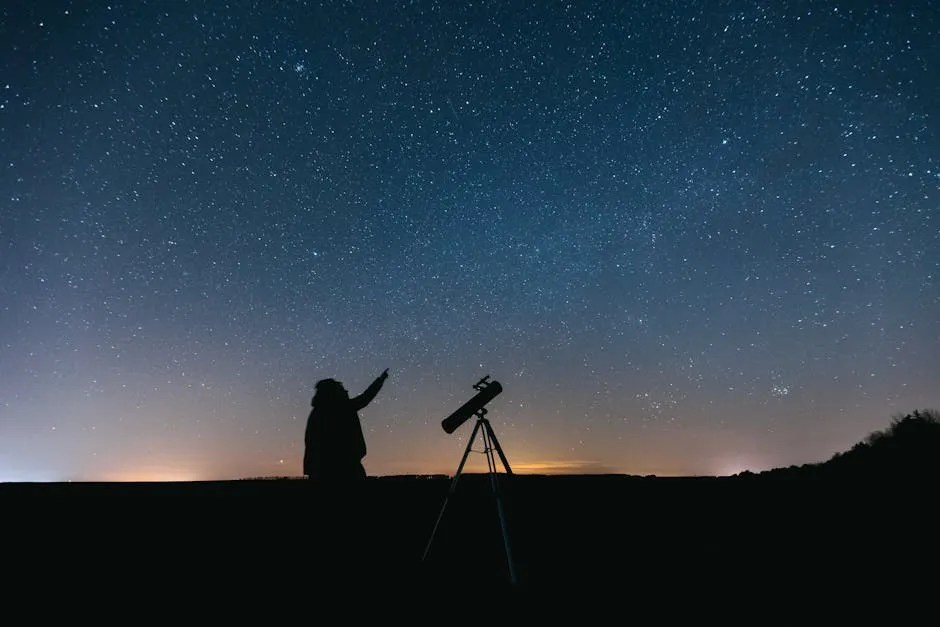
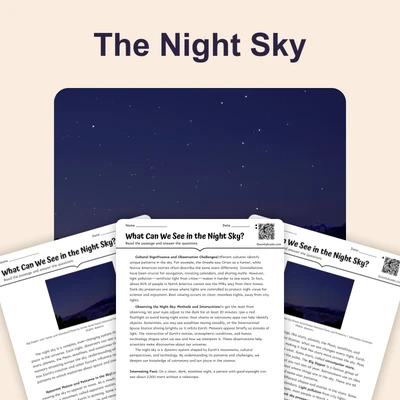
"Silhouette of person with telescope gazing at a starry night sky, showcasing celestial beauty." by Thirdman / Pexels.
Becoming an astronomer starts with curiosity about the night sky and leads to years of advanced science education. Most professional astronomers earn a PhD, which is the highest university degree. This journey typically takes about ten years after high school. Students who want to become astronomers should focus on math and science classes during middle school and high school.
The path begins with a four-year college degree called a bachelor's degree. Students major in astronomy, physics, or a related science field. They study topics like planetary motion, star formation, and how light travels through space. After college, future astronomers attend graduate school for five to seven more years. Graduate students take advanced courses and conduct original research. They often use powerful telescopes to collect data about distant objects in space. Many graduate students also teach undergraduate classes to gain teaching experience.
Professional astronomers work in several different careers. Some conduct research at universities or government laboratories like NASA. These scientists study questions about planets, stars, galaxies, and the universe itself. Other astronomers teach at colleges and universities, sharing their knowledge with students. Some operate large telescopes at observatories around the world. A few astronomers help plan space missions by analyzing data from spacecraft and satellites. Scientists use evidence from telescopes and space probes to understand how celestial objects form and change over time.
Students do not need to wait until they earn a PhD to explore astronomy. Amateur astronomers make real contributions to science. They discover comets, track asteroid movements, and observe variable stars. Many schools have astronomy clubs where students can use telescopes and learn from experienced observers. Online programs allow students to analyze real space data collected by professional telescopes. Evidence shows that amateur astronomers have discovered hundreds of celestial objects that professional scientists then study in detail.
The career of astronomy matters because it helps us understand our place in the universe. Astronomers study Earth's position in the solar system and how our planet relates to other worlds. Their research can reveal information about climate patterns, asteroid impacts, and the conditions needed for life. By studying space, scientists gain knowledge that may help protect Earth and expand human exploration beyond our planet.
Interesting Fact: Vera Rubin, a famous astronomer, discovered evidence for dark matter by observing how galaxies rotate. Her work changed our understanding of what makes up most of the universe.
Comprehension quiz (10 questions)
1. What is the highest degree that most professional astronomers earn?
2. How long does it typically take to become an astronomer after high school?
3. What does the term 'research' mean in the context of this passage?
4. Which word best describes a building equipped with telescopes for observing space?
5. Based on the passage, what can we infer about amateur astronomers?
6. Why is studying astronomy important for understanding Earth?
7. If a student wanted to prepare for a career in astronomy, which subjects should they focus on in middle school?
8. How might the work of astronomers help protect Earth in the future?
9. True or False: Students must wait until they earn a PhD before they can explore astronomy.
10. True or False: Graduate students in astronomy often teach undergraduate classes while completing their degrees.
Perfect for the way you teach
- Build comprehension skills
- Auto-graded quiz
- Differentiated reading
- Read together at home
- Improve fluency
- Quiet reading time
- Reading curriculum support
- Independent practice
- Track Lexile growth