How Glaciers Shape the Land — Reading Comprehension
Rate this
Premium Resource
Present
Present in classroom. No work saved
Assign
Classroom with student accounts, Track progress
Quick Play
No student accounts, assign with a link
Grades
3
4
5
6
PRINT+DIGITAL RESOURCE
This learning resource is available in interactive and printable formats. The interactive worksheet can be played online and assigned to students. The Printable PDF version can be downloaded and printed for completion by hand.
This engaging science passage for Grades 4-5 introduces students to the fascinating way glaciers carve and shape the land. Aligned with NGSS standards, the passage explains key scientific concepts such as glacier movement, erosion, valleys, and moraines, using clear definitions and real-world examples. Students will learn important vocabulary, test their understanding with a multiple-choice quiz, and practice writing skills with thoughtful activities. The resource also includes a full Spanish translation and is audio integrated, making it accessible for diverse learners. Teachers and students will find this passage especially useful for exploring how slow changes in nature can create dramatic landforms over time. Key topics include glacier erosion, U-shaped valleys, and the lasting impact of glaciers on Earth's surface.
CONTENT PREVIEW
Expand content preview
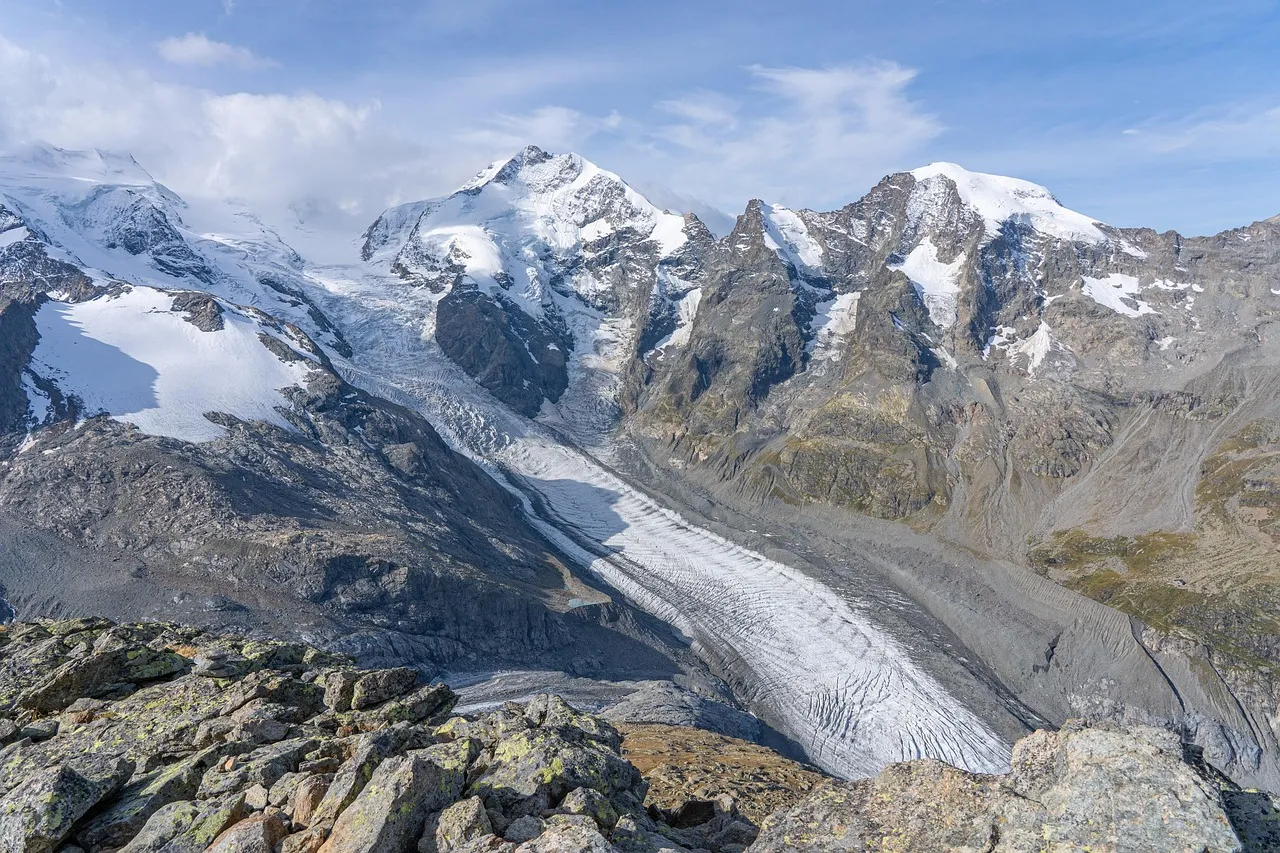
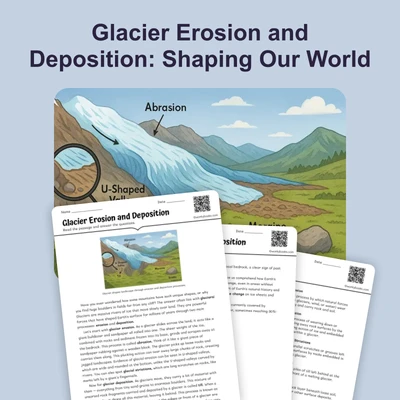
Glaciers are huge, slow-moving rivers of ice.shaping land. Image by ChiemSeherin / Source: Pixabay.
A glacier is a massive, slow-moving river of ice. Glaciers form when snow piles up year after year in cold places and gets packed down into thick ice. These giant ice rivers can be as large as entire cities and move very slowly across the land. Understanding glaciers helps us explain how many of Earth's landforms were created.
As a glacier moves, it acts like a giant piece of sandpaper scraping across the ground. The ice and rocks frozen in the bottom of the glacier erode, or wear away, the land beneath it. Erode means to slowly break down and remove rock and soil. The glacier grinds rock into powder and picks up huge boulders, soil, and everything else in its path. This powerful scraping carved many of the valleys, lakes, and landforms we see today. A valley is a low area of land between hills or mountains, and a lake is a large body of water surrounded by land.
The Great Lakes, located between the United States and Canada, were carved by glaciers thousands of years ago. When a glacier melts, it drops all the material it was carrying. This process is called deposition. Deposition means dropping off or leaving behind sediment and rocks. The melting glacier leaves behind hills made of rock and sediment, which is a mixture of sand, soil, and small pieces of rock.
Interesting Fact: Yosemite Valley in California was carved by glaciers, and some of the rocks the glaciers scraped are as smooth as glass!
What is a glacier?
A fast-moving stream of waterA slow-moving river of iceA type of mountainA frozen lake
How do glaciers form?
From rain that freezes quicklyFrom frozen ocean waterFrom snow packed down over yearsFrom melting ice caps
What landforms did glaciers create?
Deserts and canyonsValleys and lakesVolcanoes and islandsRivers and beaches
Why do glaciers erode land?
Ice melts and creates holesWind blows ice across groundIce and rocks scrape groundWater flows under the ice
What happens when glaciers melt?
They pick up more rocksThey move faster across landThey create new ice riversThey drop carried material
How does glacier erosion help scientists?
It shows how ice formsIt explains how landforms were createdIt predicts future weather patternsIt measures mountain heights
Glaciers can be as large as cities.
TrueFalse
What does deposition mean?
Ice melting into waterLeaving behind sediment and rocksSnow turning into iceRocks grinding into powder
Perfect For:
👩🏫 Teachers
• Reading comprehension practice
• Auto-graded assessments
• Literacy skill development
👨👩👧👦 Parents
• Reading practice at home
• Comprehension improvement
• Educational reading time
🏠 Homeschoolers
• Reading curriculum support
• Independent reading practice
• Progress monitoring
Reading Features:
📖
Reading Passage
Engaging fiction or nonfiction text
❓
Comprehension Quiz
Auto-graded questions
📊
Instant Feedback
Immediate results and scoring
📄
Printable Version
Download for offline reading
🔊
Read Aloud
Voice-over with word highlighting
Reviews & Ratings
No reviews yet. Be the first to share your experience!
Related Content
Tools and Technology in Earth Science
This middle school science reading passage explores the wide range of tools and technologies used in Earth science, from...
MS-ESS2-2MS-ESS3-2MS-ETS1-1MS-PS4-3
Scientific Inquiry in Earth Science
This passage explores scientific inquiry in Earth science for grades 6-8, aligned with NGSS standards MS-ESS1-4, MS-ESS2...
MS-ESS1-4MS-ESS2-1MS-ESS3-5SEP
What Is Earth Science?
This engaging middle school science passage introduces students to the field of Earth science, aligning with NGSS standa...
MS-ESS1MS-ESS2MS-ESS3SEP
Earth: Our Home in Space
This engaging Grade 4-5 science passage, aligned to NGSS, introduces students to Earth's special place in the solar syst...
Earth's Spheres
This middle school science passage introduces students to Earth's four major spheres: the geosphere, hydrosphere, atmosp...
MS-ESS2-4MS-ESS2-6
What Is Space Weather and How Does It Affect the Earth?
This NGSS-aligned science passage for middle school explains what space weather is and how it affects Earth. Students le...
MS-ESS2-2
Earth's Energy Balance
This engaging, NGSS-aligned science passage for grades 6–8 explores Earth's energy balance, a key process that keeps our...
MS-ESS2-6
Earth's Rotation
This middle school science passage, aligned with NGSS standard MS-ESS1-1, focuses on Earth's rotation—how Earth spins on...
MS-ESS1-1
Earth's Land and Water
This 250-word reading passage introduces fourth-grade students to the fundamental concept of how land and water are dist...
NGSS 4-ESS2-2ESS2.B
Earth's Interior
This comprehensive passage for grades 6-8 explores Earth's layered interior, including the crust, mantle, outer core, an...
MS-ESS2-1MS-ESS2-2
Facts About Earth
This engaging science reading passage introduces Grade 4 and 5 students to Earth, our home planet. Aligned with NGSS sta...
Meteorite Impacts on Earth
This engaging science reading passage for Grades 4-5 explores meteorite impacts on Earth, aligning with NGSS standards. ...
Venus: Earth's Twin?
This comprehensive science passage for grades 6-8 examines Venus—often called Earth's twin—by exploring its similarities...
MS-ESS1-2MS-ESS1-3
Earth Changes Over Millions of Years
This engaging, audio-integrated science passage for Grade 4-5 students explores how Earth has changed over millions of y...
Volcano Patterns on Earth
This Grade 4 science reading passage introduces students to volcano patterns on Earth, aligned with NGSS standard 4-ESS2...
NGSS 4-ESS2-2
Earth's Moon Facts
This engaging science passage, 'The Moon: Earth's Companion,' is designed for Grade 4-5 students and aligns with NGSS ge...
Earth's Quick and Slow Changes
In 'Earth's Quick and Slow Changes,' students categorize 12 Earth events by their speed of occurrence, enhancing underst...
Earth: Our Home Planet
This comprehensive science passage for grades 6-8 explores Earth’s unique characteristics and the interconnected systems...
MS-ESS1-2
Earth's Revolution
This middle school science passage explores the science behind Earth's revolution around the Sun, closely aligned with N...
MS-ESS1-1
Earthquake Patterns on Earth
This engaging 250-word reading passage introduces fourth-grade students to earthquake patterns on Earth, aligned with NG...