How Planetary Defense Works
Interactive passage with audio narration, comprehension questions, and printable PDF.
By completing this purchase you agree to our Terms of Use and Privacy Policy. Your subscription renews automatically until you cancel. You can cancel anytime from your account settings. All sales are final and non-refundable. Digital content is available for download in your account immediately upon purchase.
What's included
How Planetary Defense Works preview and details
About this printable How Planetary Defense Works science reading passage, NGSS-aligned (Grades 5-8)
Sample passage and quiz from How Planetary Defense Works
Reading passage and comprehension quiz preview
How Planetary Defense Works
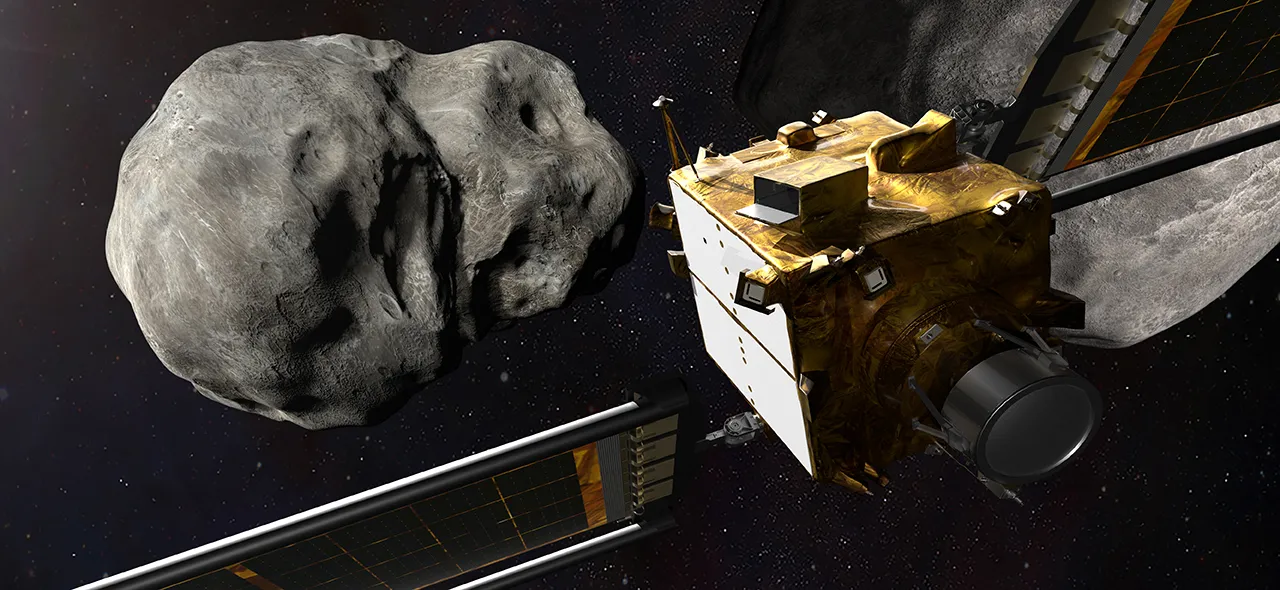
"Artist's illustration of NASA's Double Asteroid Redirection Test Mission" by National Aeronautics and Space Administration / Wikimedia Commons
Asteroids and comets do hit Earth. Scientists explain that a massive asteroid impact caused the extinction of the dinosaurs about 66 million years ago. Evidence shows that space rocks continue to enter our atmosphere regularly. Most burn up before reaching the ground, but larger objects can cause serious damage. This real risk is why scientists developed planetary defense systems to protect our planet.
Scientists use powerful telescopes to monitor near-Earth objects, or NEOs. These space rocks include asteroids and comets that orbit close to our planet. Telescopes scan the sky every night to detect and track these objects. When scientists discover a new NEO, they record its position and speed. They use this data to calculate the object's orbit, which is the path it follows around the Sun.
After tracking an object for several weeks or months, scientists can predict where it will travel in the future. They calculate collision probability, which measures the chance that an object might hit Earth. Most NEOs have a collision probability of nearly zero. However, scientists continue monitoring them because orbits can change slightly over time. Gravity from planets and the Sun can pull objects into different paths.
When scientists identify a potentially dangerous asteroid, they develop plans to change its course. One method is called kinetic impact. This technique involves crashing a spacecraft into an asteroid at high speed. The impact transfers energy to the asteroid and pushes it slightly off course. Even a small change in speed can make the asteroid miss Earth by a safe distance.
NASA tested this method in September 2022 with the DART mission. Scientists sent a spacecraft to crash into Dimorphos, a small asteroid orbiting a larger asteroid called Didymos. The mission succeeded in changing Dimorphos's orbit by about 33 minutes. This deflection proved that humans can alter an asteroid's path. The test showed that planetary defense technology works when we have enough warning time.
Planetary defense matters because it protects life on Earth. Scientists estimate that an asteroid larger than one kilometer across could cause global damage. Early detection gives us time to plan and launch a deflection mission. International space agencies now work together to track NEOs and share data. This cooperation helps ensure that we can respond quickly if a dangerous object heads toward Earth.
Interesting Fact: Scientists track more than 30,000 near-Earth objects, and they discover about 3,000 new ones each year. Most are small and pose no threat to our planet.
Comprehension quiz (10 questions)
1. What caused the extinction of the dinosaurs about 66 million years ago?
2. What do scientists use to monitor near-Earth objects?
3. What does 'collision probability' mean in the context of planetary defense?
4. What is the term for the curved path an object follows around the Sun?
5. Based on the passage, why do scientists continue monitoring NEOs even when collision probability is nearly zero?
6. How does the kinetic impact method work to deflect an asteroid?
7. What can you infer about the importance of early detection of dangerous asteroids?
8. If scientists discovered an asteroid heading toward Earth in 50 years, which planetary defense method would likely be most useful based on the passage?
9. True or False: The DART mission in 2022 successfully changed the orbit of the asteroid Dimorphos.
10. True or False: Most near-Earth objects are large enough to cause global damage if they hit Earth.
Perfect for the way you teach
- Build comprehension skills
- Auto-graded quiz
- Differentiated reading
- Read together at home
- Improve fluency
- Quiet reading time
- Reading curriculum support
- Independent practice
- Track Lexile growth