How the Constitution Divides Power
Interactive passage with audio narration, comprehension questions, and printable PDF.
By completing this purchase you agree to our Terms of Use and Privacy Policy. Your subscription renews automatically until you cancel. You can cancel anytime from your account settings. All sales are final and non-refundable. Digital content is available for download in your account immediately upon purchase.
What's included
How the Constitution Divides Power preview and details
About this printable How the Constitution Divides Power reading passage (Grades 6-8)
Sample passage and quiz from How the Constitution Divides Power
Reading passage and comprehension quiz preview
How the Constitution Divides Power
The United States Constitution divides power to prevent any one person or group from becoming too powerful. This system was developed because the Founders remembered how British rulers had abused their authority. They wanted to create a government that protected individual rights and balanced the interests of different groups.
One major way the Constitution accomplishes this is through federalism. Federalism means that power is shared between the national government and state governments. Some powers, called enumerated powers, are specifically given to the federal government. For example, only the national government can print money or make treaties with other countries. Other powers are reserved for the states, such as running public schools and conducting elections.
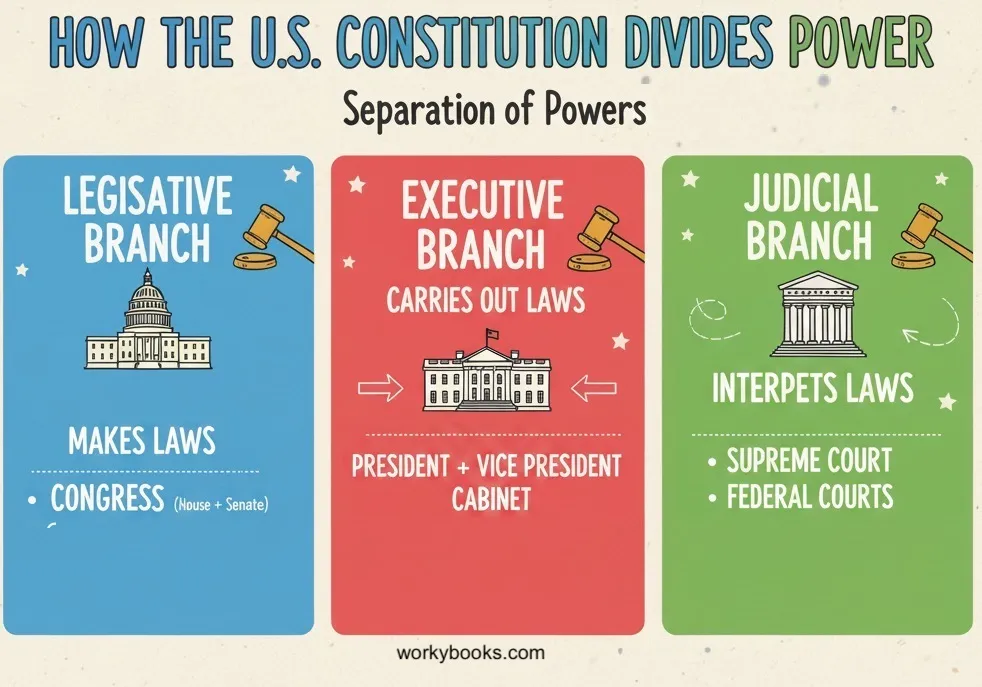
Another method the Constitution uses is the separation of powers. At the federal level, government authority is divided among three branches: legislative, executive, and judicial. The legislative branch, or Congress, makes the laws. The executive branch, led by the President, carries out the laws. The judicial branch, which includes the Supreme Court, interprets the laws and decides if they follow the Constitution.
This structure creates a system of checks and balances. Each branch has certain powers that allow it to limit the actions of the others. For instance, the President can veto a law passed by Congress, but Congress can override that veto with enough votes. The Supreme Court can declare laws unconstitutional, preventing the other branches from breaking constitutional rules.
Despite its strengths, this system has also led to conflicts. Sometimes, the national government and states disagree about who should control certain issues, like education or voting rights. Over time, the Supreme Court has helped settle many of these disputes, using the Constitution as a guide. The balance between state and federal power has changed as the country has grown and faced new challenges.
By dividing power both among different levels of government and among the branches, the Constitution seeks to protect freedom and prevent tyranny. The Founders believed that spreading out authority would make it harder for anyone to abuse power. This idea remains a central feature of American government today.
Interesting Fact: When the Constitution was first written, it did not include the Bill of Rights. These first ten amendments, which protect individual freedoms, were added shortly after to address concerns about government power.
Comprehension quiz (8 questions)
1. What is federalism?
2. Which branch makes laws?
3. When was the Bill of Rights added?
4. Why did the founders use separation of powers?
5. What can the Supreme Court do?
6. What is an enumerated power?
7. Separation of powers means one branch controls all.
8. What does tyranny mean?
Perfect for the way you teach
- Build comprehension skills
- Auto-graded quiz
- Differentiated reading
- Read together at home
- Improve fluency
- Quiet reading time
- Reading curriculum support
- Independent practice
- Track Lexile growth