How Do You Stargaze From Home
Interactive passage with audio narration, comprehension questions, and printable PDF.
By completing this purchase you agree to our Terms of Use and Privacy Policy. Your subscription renews automatically until you cancel. You can cancel anytime from your account settings. All sales are final and non-refundable. Digital content is available for download in your account immediately upon purchase.
What's included
How Do You Stargaze From Home preview and details
About this printable How Do You Stargaze From Home science reading passage, NGSS-aligned (Grades 5-8)
Sample passage and quiz from How Do You Stargaze From Home
Reading passage and comprehension quiz preview
How Do You Stargaze From Home
You can explore astronomy from your own backyard with simple tools and curiosity. Stargazing does not require expensive equipment or special training. Constellations, planets, and meteor showers become visible when you know where and when to look. The night sky offers countless opportunities for discovery right above your home.
Star charts and mobile apps help identify celestial objects in the night sky. Paper star charts show patterns of stars for different seasons and times. Astronomy apps use your phone's location to display real-time sky maps. These tools help you find familiar constellations like Orion or Ursa Major. Apps can also track planets as they move across the sky throughout the year.
Binoculars reveal details that eyes alone cannot see in the night sky. A basic pair of binoculars can show Jupiter's four largest moons orbiting the planet. They also reveal craters and mountains on Earth's moon during different lunar phases. Binoculars work better than small telescopes for viewing large star clusters. They cost less and are easier to use for beginning stargazers.
Meteor showers happen on predictable dates when Earth passes through comet debris. The Perseid meteor shower peaks every August around the 12th each year. The Geminid shower appears reliably in mid-December with dozens of meteors per hour. Scientists track these events because Earth follows the same orbit annually. You can plan viewing sessions weeks in advance using astronomy calendars.
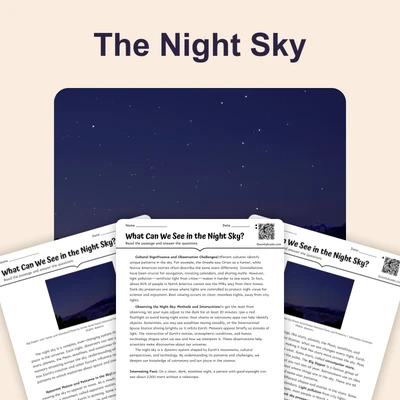
Light pollution from cities makes stargazing more difficult in urban areas. Streetlights and building lights wash out faint stars and galaxies. Dark-sky parks are protected areas with minimal artificial light at night. These parks offer the best conditions for observing the Milky Way and distant celestial objects. Even from home, turning off outdoor lights improves your view significantly.
The same sky that guided ancient sailors still rewards curious students today. Ancient navigators used star patterns to cross oceans without modern technology. Evidence shows that Polynesian sailors navigated thousands of miles using only stars. Today's stargazers connect with this long human tradition of sky observation. Understanding celestial patterns helps us appreciate Earth's place in the solar system.
Interesting Fact: The International Dark-Sky Association has certified over 130 dark-sky parks worldwide where the Milky Way appears so bright that it can cast shadows on the ground.
Comprehension quiz (10 questions)
1. What tools help identify celestial objects in the night sky?
2. What can binoculars reveal about Jupiter?
3. What does the term 'light pollution' mean in the passage?
4. Based on the passage, what does 'celestial objects' refer to?
5. Why do meteor showers happen on predictable dates each year?
6. What evidence shows ancient navigators used stars for travel?
7. If you wanted to view a meteor shower in August, which shower should you watch for?
8. How could you improve stargazing conditions from your home?
9. True or False: Expensive equipment is required to begin stargazing from home.
10. True or False: Dark-sky parks have minimal artificial light at night.
Perfect for the way you teach
- Build comprehension skills
- Auto-graded quiz
- Differentiated reading
- Read together at home
- Improve fluency
- Quiet reading time
- Reading curriculum support
- Independent practice
- Track Lexile growth